| Ultimi arrivi - Mars Reconnaissance Orbiter (MRO) |

ESP_014103_2485-ESP_014393_2485.jpgLook who's there: the Phoenix Lander! (Natural Colors; credits: Lunexit)60 visiteThe High Resolution Imaging Science Experiment (HiRISE) camera on NASA's Mars Reconnaissance Orbiter captured Winter images of NASA's Phoenix Mars Lander surrounded by dry-ice frost on Mars.
As the Sun began to reappear on the horizon following the deepest, darkest days of North Polar Winter on Mars, the HiRISE camera imaged the Phoenix Landing Site on July 30, 2009, (left image) and in Aug. 22, 2009 (right).
The Sun was only 1° above the Local Horizon when the July image was taken at approximately 14:00 M.L.T. .-
In the August image the Sun was 6° above the L.H. when the image was taken, at about 13:44 M.L.T. .
By matching up the images with the known location of the Lander, the HiRISE team identified the hardware, disguised by frost, despite the fact that the views were hindered by poor lighting and atmospheric haze, which often obscures the Martian Surface at this location and season.
Carbon Dioxide frost completely blankets the Surface in both images. The amount of brightness doesn't necessarily indicate the amount of frost seen in the image because of the way the images are processed to produce optical contrast. Each of these images is stretched differently for optimal contrast, so "bright" and "dark" can't be compared directly between images without doing complex calibrations. In fact, if you stretched all of them exactly the same, the darker areas in the frost covered images are still brighter than typical soil, like that surrounding the Lander in the frost-free image.
Other factors affect the relative brightness, such as the size of individual grains of CO2 ice, the amount of dust mixed in with the ice, the amount of sunlight hitting the Surface, and different lighting angles and slopes. The winds are also changing direction and strength, moving loose frost and dust around over time.
Studying these changes will help scientists understand the nature of the seasonal frost and Winter Weather Patterns in this area of Mars.
The amount of CO2 frost is increasing as late Winter transitions to early Spring, so the layer of frost is getting thicker in each image, slowly encasing the Lander. The maximum thickness was expected to be on the order of tens of centimeters, which would have reached its peak in September 2009. The thickness has not been confirmed yet because the MRO Spacecraft suspended taking images when it entered safe mode on August 26.
Oct. 26, 2009, marked the first day of Spring in the Northern Hemisphere of Mars.
The Planetary Society has put together an animation comparing the hardware at different times. (see ---> http://www.planetary.org/blog/article/00002182/).
The Phoenix Mars Lander ceased communications last November (2008), after successfully completing its mission and returning unprecedented science data to Earth. Launched Aug. 4, 2007, Phoenix safely touched down on Mars on May 25, 2008, at a site farther North than where any previous Spacecraft had landed. During the first quarter of 2010, teams at JPL will listen to see if Phoenix is still able to communicate with Earth. Springtime thaw images may also be available.
These views are a portion of a HiRISE image which is available in full-frame at http://hirise.lpl.arizona.edu/ESP_014393_2485.
MareKromiumNov 07, 2009
|
|
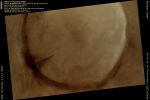
ESP_014296_1255_RED_abrowse.jpgClear signs of a recent Seepage (Natural Colors; credits: Lunexit)60 visitenessun commentoMareKromiumNov 06, 2009
|
|
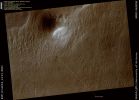
ESP_014264_2235_RED_abrowse-00.jpgSigns of a possible (and recent) "Mid-Air Meteor Strike" (CTX Frame - Natural Colors; credits: Lunexit)63 visitenessun commentoMareKromiumNov 06, 2009
|
|
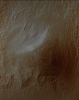
ESP_014264_2235_RED_abrowse-01.jpgSigns of a possible (and recent) "Mid-Air Meteor Strike" (EDM - Natural Colors; credits: Dr G. Barca & Lunexit)62 visiteIn questo EDM, ottimamente curato - come sempre - dal nostro Dr Barca, si può vedere l'evidente "scurimento" (che qualcuno potrebbe anche chiamare "bruciatura") del suolo, senza che però sia possibile scorgere un (anche di modestissime dimensioni) cratere da impatto.
Questa situazione (bruciatura del suolo, presenza di veri detriti di origine indeterminabile e mancanza di cratere) abbiamo deciso di battezzarla come "Mid-Air Meteor Strike", ossìa effetto di collisione meteorica avvenuta a mezz'aria (ergo, SENZA impatto - se non altro nel senso più tecnico della parola).
Una curiosità: la NASA ha classificato/titolato questo frame come "New Crater with Ice". Curioso: poichè noi non riusciamo a vedere nè il cratere in questione (tantomeno un cratere che sia "new"...), nè il ghiaccio (il quale, vista la Latitudine di cui si parla, comunque risulterebbe difficilmente visibile in superficie - se non altro in assenza di nevicate recenti).
Cosa ne pensiamo? Che anche alla NASA sbagliano...MareKromiumNov 06, 2009
|
|
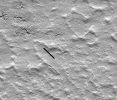
ESP_014282_0930_RED_abrowse-02.jpgSpiders (EDM n.1 - credits: Dr G. Barca)57 visitenessun commentoMareKromiumNov 05, 2009
|
|
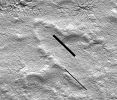
ESP_014282_0930_RED_abrowse-03.jpgSpiders (EDM n.2 - credits: Dr G. Barca)69 visite...Si, a questo punto è certo: si trattava di un image-artifact. Senza dubbi. Grandi complimenti al nostro sempre puntualissimo Dr Barca per la pazienza avuta!MareKromiumNov 05, 2009
|
|

ESP_014285_1825_RED_abrowse.jpgUnnamed Crater flooded with Landslides (Natural Colors; credits: Lunexit)58 visitenessun commentoMareKromiumNov 04, 2009
|
|
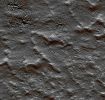
ESP_014282_0930_RED_abrowse-01.jpgSpiders (EDM - Natural Colors; credits: Lunexit)62 visiteIl bizzarro dettaglio segnalatoci dal nostro Amico e Partner, Dr Gualtiero la Fratta, non sembra risolversi in un qualcosa di agevolmente definibile: in attesa di processare la porzione di frame in oggetto dal formato JP2, quindi, possiamo solo fare due supposizioni.
La prima (razionale), in virtù della quale si può dire che stiamo osservando un image-artifact; la seconda (un pò più immaginifica) che ci suggerisce la possibilità per cui il rilievo bizzarro che si distingue davanti a noi potrebbe risolversi in due fratture lineari della supercfiie le quali - tutto sommato - potrebbero costituire due "bocche" di un medesimo geyser - di dimensioni davvero modestissime.MareKromiumNov 04, 2009
|
|
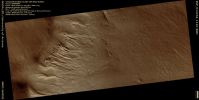
ESP_014358_1310_RED_abrowse.jpgUnnamed Southern Crater with deeply incised Gullies (Natural Colors; credits: Lunexit)59 visitenessun commentoMareKromiumNov 03, 2009
|
|

ESP_014424_1845_RED_abrowse.jpgBright Deposits and an anomalous Circular Feature - maybe a VERY fresh Impact Crater or a vertical collapse pit (Natural Colors; credits: Lunexit)57 visitenessun commentoMareKromiumNov 03, 2009
|
|
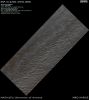
ESP_014282_0930_RED_abrowse-00.jpgSpiders (CTX Frame - Natural Colors; credits: Lunexit)58 visitenessun commentoMareKromiumNov 03, 2009
|
|

ESP_014284_2045_RED_abrowse.jpgUnnamed Crater in Mawrth Vallis Region (Natural Colors; credits: Lunexit)63 visitenessun commentoMareKromiumNov 03, 2009
|
|
| 2237 immagini su 187 pagina(e) |
 |
|
|
|
|
100 | |
|
|
|
|





