| Ultimi arrivi - The Universe Inside |

Earth___Mars.jpgEarth and Mars212 visiteDa "NASA - Picture of the Day" del 12 Aprile 2005:"Which image is Earth and which is Mars? One of the above images was taken by the robot Spirit Rover currently climbing Husband Hill on Mars. The other image was taken by a human across the desert south of Morocco on Earth. Both images show vast plains covered with rocks and sand. Neither shows water or obvious signs of life. Each Planet has a surface so complex that any one image does not do that planet justice. Understanding either one, it turns out, helps understand the other. Does the one on the left look like home? Possibly not, but it is Earth".
Una splendida immagine, un'intelligente comparazione, una ovvia domanda: siamo proprio certi che Marte sia un Pianeta "morto"?!?Apr 12, 2005
|
|

Sun___clouds.jpgThe eclipse is real, but this picture is just a fake!75 visiteDa "NASA - Picture of the Day" del giorno 11 Aprile 2005:" (...) The above image composite was taken with a handheld digital camera. After a day of rain in Mt. Holly, North Carolina, USA, a partially eclipsed Sun momentarily peaked through a cloudy sky. After taking a sequence of images, the best eclipse shot was digitally combined with a less good eclipse shot that featured a passing airplane".
Nota: è deprimente vedere come gli Amici della NASA dìano spazio e valore ad un semplice "falso" ("digital combination of different images" significa solo "FABBRICARE UN FALSO").
Stiamo esagerando? Pensate: le fotografie, sino a qualche anno fa, rappresentavano un "istante cristallizzato" del mondo reale. Ora - così come avviene in questo specifico frame - ciò che viene "cristallizzato" è un evento che, nel mondo reale, NON E' MAI accaduto!
L'uso di jargon tecnologico potrà impressionare gli sprovveduti, ma la verità è che il confine fra 'Realtà' e 'Ricostruzione Simulata della Realtà' si è fatto sottilissimo...Apr 11, 2005
|
|

BlackSun in Antarctica.jpgBlack Sun in Antarctica (November 2003)154 visitenessun commentoApr 07, 2005
|
|

Titan-Huygens Lens.jpgThe Discovery of Titan90 visiteIl 25 Marzo 1655 l'Astronomo Olandese Christiaan Huygens scopriva "Luna Saturni" - ossia Titano. In questo frame vediamo tutto ciò che resta del telescopio che egli usò (nota: telescopio concepito e costruito in collaborazione con suo fratello, Constantijn Huygens): la lente.
Essa ha un diametro di 57 mm e reca sul bordo la dicitura "X 3 FEBR. MDCLV": si tratta della lunghezza focale e della data di completamento del lavoro (e cioé la "lucidatura" della lente stessa): il 3 February 1655.
Si leggono altresì (in alto) questi versi di Ovidio, "Admovere Oculis Distantia Sidera Nostris".
Un pizzico di romanticismo? No, solo la porzione di un anagramma: un semplice gioco enigmistico (molto comune ai suoi tempi) che riportava alcuni dettagli della sua scoperta (data inclusa).
Decodificato e tradotto l'anagramma di Huygens recita "Una luna orbita intorno a Saturno in 16 giorni e 4 ore".
Oggi sappiamo che il periodo orbitale di Titano è pari a poco meno di 16 giorni.Mar 25, 2005
|
|
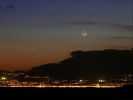
MoonMercMonaco_jacques_full.jpgThe Moon and Mercury, from Monaco (FRA)157 visiteUna falce di Luna ed una piccola scintilla, piuttosto alta nel cielo della sera: Mercurio.
Una bella immagine che ci arriva dalla Francia e che ha trovato spazio anche nella Rubrica "NASA - Picture of the Day".
Questa la caption originale:"Low on the western horizon after sunset, a slender crescent Moon and wandering planet Mercury join the lights of Menton and Monaco along the French Riviera. Astronomer Vincent Jacques took advantage of this gorgeous photo opportunity a week ago on March 11, when the Moon and Mercury were separated in the sky by just 3°. Of course, the Moon in a slender crescent phase is always seen near the horizon, as is Mercury - a bright planet which can be difficult to glimpse as it never strays far from the Sun in Earth's sky. In the coming days good views of Mercury will indeed be fleeting as the Solar System's innermost planet is rapidly dropping closer to the glare of the setting Sun".Mar 18, 2005
|
|

ZZ-Sun Halo.jpgA Sun "Halo" in Tennessee94 visiteDal "NASA - Picture of the Day" del 9 Marzo 2005:"Sometimes it looks like the Sun is being viewed through a large lens. In the above case there are actually millions of lenses: ice crystals. As water freezes in the upper atmosphere, small, flat, six-sided, ice crystals might be formed. As these crystals flutter down, much time is spent with their faces flat, parallel to the ground. An observer may pass through the same plane as many of the falling ice crystals near sunrise or sunset. During this alignment, each crystal can act like a miniature lens, refracting sunlight into our view. Dramatically visible behind neighborhood houses and trees and above the cloud deck is the 22° halo created by sunlight reflecting off of atmospheric ice crystals".
L'alone è spiegato in modo preciso ed accurato, ma esso non è l'unico fenomeno visibile in questa foto: alla Vostra Sx si vedono - e bene! - 2 scie chimiche. E quelle come le spieghiamo? Vapori e cristalli?!?Mar 09, 2005
|
|

Venus Belt.jpgThe "Belt of Venus"170 visiteCaption originale NASA da "Astronomy Picture of the Day" del 27 Gennaio 2005:"A nearly full Moon and planet Earth's shadow set together in this scene captured from snowy Mt. Jelm, home of the Wyoming Infrared Observatory. For early morning risers (and late to bed astronomers), shadow set in the western sky is a daily apparition whose subtle beauty is often overlooked in favor of the more colorful eastern horizon. Extending through the dense atmosphere, Earth's setting shadow is seen in this picture as a "dark blue band" along the distant horizon, bounded above by a pinkish glow or antitwilight arch. Also known as the "Belt of Venus", the arch's lovely color is due to backscattering of reddened light from the rising Sun. The setting Moon's light is also reddened by the long sight-line through the atmosphere and echoes the dawn sky's yellow-orange hues".
Allora: che ne dite della "Cintura di Venere"? Affascinante, vero?!?...Gen 27, 2005
|
|

Milky_Way.jpgThe Milky Way: a picture or a drawing?277 visiteThis panorama view of the sky is really a drawing. It was made in the 1940s under the supervision of astronomer Knut Lundmark at the Lund Observatory in Sweden. To create the picture, draftsmen used a mathematical distortion to map the entire sky onto an oval shaped image with the plane of our Milky Way Galaxy along the center and the north galactic pole at the top. 7.000 individual stars are shown as white dots, size indicating brightness. The "Milky Way" clouds, actually the combined light of dim, unresolved stars in the densely populated galactic plane, are accurately painted on, interrupted by dramatic dark dust lanes. The overall effect is photographic in quality and represents the visible sky. Can you identify any familiar landmarks or constellations? For starters, Orion is at the right edge of the picture, just below the galactic plane and the Large and Small Magellanic Clouds are visible as fuzzy patches in the lower right quadrant.Gen 02, 2005
|
|

ZW-The Moon and Jupiter.jpgMoon and Jupiter144 visiteUn'immagine amatoriale davvero eccellente che ci arriva dalla cittadina di Atmore - Alabama, USA - e pubblicata sul Sito NASA - Picture of the Day del giorno 9 Dicembre 2004.
Ben visibili, accanto a Giove, guardando il versante superiore della Luna (e, per l'esattezza, quella sua parte che ci appare debolmente illuminata a causa del "chiaro di Terra"), riusciamo a vedere due "Satelliti Galileiani": Ganymede (quello più prossimo a Giove) e Callisto.
Complimenti al Sig. Westlake per l'immagine!Dic 09, 2004
|
|

Aurora Borealis.jpgAurora over Wisconsin120 visiteLo "spettacolo" delle Aurore Boreali che stanno manifestandosi un pò ovunque in Nord America non accenna a diminuire: questa si è verificata nel Wisconsin. Ecco la caption originale da "NASA - Picture of the Day" del 17 Novembre 2004:"The auroral displays of the past week are being reported as some of the most beautiful in memory. In particular, impressive auroral bands fanned out over much of eastern North America after sunset on November 8. The multicolored aurora pictured above was caught reflecting in one of the many small lakes in central Wisconsin near that time. Continued solar activity might create more aurora visible over the next few nights as the Leonids meteor shower peaks". Non comprendiamo, a dire il vero, la curiosa relazione implicita che ci sembra essere stata fatta tra il verificarsi di queste Aurore ed i prossimo picco delle Leonidi.
Forse non abbiamo capito bene o magari ci sta semplicemente sfuggendo qualcosa...Nov 17, 2004
|
|

Moon, Venus and Jupiter from Earth.jpgThe Moon, Venus and Jupiter from Shiraz (Iran)179 visiteDa "NASA - Picture of the Day" del giorno 13.11.2004: " Early morning risers around the world have enjoyed the sight of bright planets in this week's predawn skies - further enhanced by the celestial spectacle of the waning crescent Moon. From some locations the Moon was seen to pass in front of Jupiter or Venus, a lunar occultation. Recorded near sunrise on November 10th from Shiraz, Iran, this eastern horizon view finds Jupiter (top) and a brilliant Venus in line with the Moon, a lovely conjunction of the three brightest objects in the night sky. Although the Moon has now fallen out of the early morning scene, Venus and Jupiter (along with a much fainter Mars) still precede the rising Sun above the eastern horizon". Una fotografia molto simile a quella ripresa dalla Turchia (Bursa) - già pubblicata nella Sezione dedicata a Giove - la quale ci mostra e dimostra che non è poi così difficile "cristallizzare" un particolare (e suggestivo) momento del Cielo.Nov 13, 2004
|
|
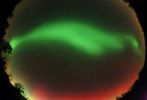
Aurora_Borealis-Coronal_Aurora.jpgCoronal Aurora near Warrensbourg - Missouri (USA)92 visiteIn relazione a quanto detto e scritto solo pochi giorni fa, ecco una nuova Aurora la quale, oltre ad essere stata particolarmente intensa (come potete ben vedere), è accaduta ad un latitudine che di Polare o presso-Polare non ha proprio nulla. La NASA dice che è un fenomeno inusuale ma "normale", vista l'attività solare di questi giorni. Permetteteci, a questo riguardo, una battuta: è proprio il fatto che sia la NASA a dire di non preoccuparci che ci fa preoccupare... EccoVi il commento originale da "NASA - Picture of the Day" del giorno 12.11.2004: "(...) Amazing! Unbelievable!, The best I've ever seen! ... They aren't talking about a movie, though. Instead, even casual sky critics are remarking on November's stunning auroral displays, visible with surprising intensities well beyond the confines of high latitudes where auroral activity is normally observed (...)". Vedete?!? Entusiasmo, eccitazione, linguaggio più da show che da Scienza e dintorni: è il nuovo corso della NASA...Nov 12, 2004
|
|
| 496 immagini su 42 pagina(e) |
 |
|
|
|
|
|
|
|
40 | |
|








