| |

| Ultimi arrivi - The Universe Inside |
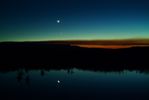
Inner_Worlds-jul8_westlake_f.jpgInner Worlds, in the Sunset...142 visiteDa "NASA - Picture of the Day" del 15 Luglio 2005:" Only Mars is missing from this reflective view of the major rocky bodies of the Inner Solar System. Captured on July 8th, the serene, twilight picture looks out over the Flat Tops Wilderness area from near Toponas, Colorado, USA and includes planets Mercury, Venus, Earth and Earth's large natural satellite, the Moon. The Moon is in a young crescent phase about 3° above bright planet Venus. Forest fires contribute to a layer of smoke in Earth's sky that almost hides planet Mercury, still visible very near the horizon.
Just a week earlier Venus and Mercury were joined by Saturn, forming a notable grouping in the West also enjoyed by skygazers across planet Earth".Lug 15, 2005
|
|
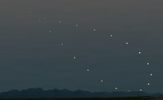
ZZ-ZZ-ZZ-ZZ-LunarAnalemma_richins_f.jpgMoon's analemma (New Mexico)184 visiteDa "NASA - Picture of the Day" del 13 Luglio 2005:"An analemma is an 8-like curve that is gotten when you mark the position of the Sun at the same time each day for 1 year. To imaging an analemma of the Moon it is necessary to understand that, on average, the Moon returns to the same position in the sky about 51' later each day. So, photographing the Moon 51' later on successive days, over one lunation (or Lunar month) it will trace out an analemma-like curve as the actual position of the Moon wanders compared to the average - due to the Moon's tilted and elliptical orbit. (...) Multiple exposure image required some digital manipulation, particularly to include thin crescent phases in daytime skies".Lug 13, 2005
|
|

ZZ-ZZ-The Sun over K.jpgIs this Earth?99 visiteAvevamo proposto un'immagine altrettanto enigmatica nella Sezione dedicata al Pianeta Venere, allorché la "Stella della Sera" veniva ripresa dalla sommità di una montagna in compagnia della Luna, così generando un effetto davvero molto particolare.
Ora è la volta di un'alba, vista dal Monte Kilimanjaro. Sono stati usati filtri speciali? Forse i colori sono stati ritoccati al computer? No, su tutta la linea. Questa è una foto scattata dalla Terra, in colori reali, che riprende l'alba.
Adesso capite meglio perché la problematica dei 'Colori dello Spazio' non è accademica né peregrina? Se, in determinate condizioni di illuminazione, ergo a diverse ore del giorno, anche la Terra può apparire un Mondo Alieno (tipo Marte o Venere) allora, date le medesime variabili, anche un Mondo Alieno potrebbe, a diverse ore del giorno, apparire come la Terra e non ci sarebbe nulla di straordinario nel dirlo e nel mostrarlo. Ma, a quanto pare, la NASA non "vede" (ed é proprio il caso di dirlo...) le cose come le vediamo noi..Lug 11, 2005
|
|

ZZ-ZZ-SunFromMaunaKea.jpgThe Sun from Mauna Kea: an alien landscape180 visiteDa "NASA - Picture of the Day" del 4 Luglio 2005:"Typically, views from Mauna Kea are up and dark. That's because the famous dormant volcano in Hawaii is arguably Earth's premier observing platform of the complex and ever changing night sky. However, this daytime view is across and bright. White snow and white clouds seem to blend together to make an alien landscape. Cinder cones from extinct volcanic outbursts dominate the foreground. Scrolling right will reveal structures visually incongruous even here: an armada of the largest optical telescopes on Earth. The observatories seen include Subaru and Keck. In the distance on the far left is Mauna Loa, Earth's largest volcano".Lug 04, 2005
|
|

ZZ-ZZ-ZZ-Venus_Co_.jpgVenus, Mercury and Saturn from Brighton (Australia)103 visiteDa "NASA - Picture of the Day" del 2 Luglio 2005:"On Tuesday, June 28th, the setting Sun flooded the horizon with a beautiful warm light in this view from the beach beside the pier at Brighton in Adelaide, South Australia. The Sun also illuminated 3 planets gathered in the Western Sky, such as Mercury, Venus and Saturn. From this perspective Mercury is at the highest point in the celestial triangle, brilliant Venus is just below, and Saturn stands farther to the left and below the close pair. Of course, the Planets only appear close together on the sky but are actually quite far apart in space. The orbits of Mercury and Venus are both interior to Earth's orbit, while gas giant Saturn lies in the outer Solar System, over 9 AU from the Sun. Late next week, Venus and Mercury will share Western Skies with the young crescent Moon".Lug 02, 2005
|
|

ZP-Mercuryandfriends.jpgMercury, Venus and Saturn in the Western Sky...Again!91 visiteDa "NASA - Picture of the Day" del 30 Giugno 2005:"Venus, Mercury, and Saturn wandered close together in western evening skies last week. On Saturday, June 25, astronomer R. Jay GaBany recorded this snapshot of their eye-catching planetary conjunction, from historic Lick Observatory on Mt. Hamilton, California, USA. The view looks toward the Pacific shortly after sunset with the lights of San Jose and the southern San Francisco Bay area in the foreground. Of course, Venus is the brightest of the trio. Mercury is nearby on the right and Saturn is below and left, closest to the horizon. Farther to the right of the planetary triangle are Pollux and Castor, twin stars of Gemini, with Regulus, bright star of the constellation Leo, at the very upper left corner of the picture. In the coming days, Venus and Mercury remain close, while Saturn continues to drop below them, toward the horizon".Giu 30, 2005
|
|

ZO-Westlake3Planets061905.jpgMercury, Venus and Saturn in the Western Sky83 visiteDa "NASA - Picture of the Day" del 24 Giugno 2005: " This weekend three planets will grace the Western Sky, forming a lovely trio easily visible shortly after sunset. Saturday evening in particular will find Saturn, Venus and Mercury all within a 2° circle (about the size of your thumb held at arm's length) above the Western Horizon.
Recorded last Sunday, June 19, this image shows the same 3 planets arrayed along the ecliptic plane above a Colorado Rocky Mountain skyline. Venus is easiest to pick out of the twilight, the brightest celestial beacon below picture center, with Saturn above and to the left of Venus and Mercury closest to the horizon, right of prominent Pinnacle Peak. By Saturday, the wandering planets will draw even closer together (...)".Giu 24, 2005
|
|

Moonrise.jpgThe "Moon Illusion"...From Cape Sounion229 visiteDa "NASA - Picture of the Day" del 23 Giugno 2005:"The Moon was full this month on June 22nd, only a day after the northern hemisphere's summer solstice. Since this solstice marked the northernmost point of the Sun's annual motion through planet Earth's sky, the full Moon rising near the ecliptic plane opposite the Sun was at its farthest south for the year. Only a month earlier, on May 23rd, astronomer Anthony Ayiomamitis recorded this picture of another southerly full Moon rising above Cape Sounion, Greece. The twenty-four hundred year old Temple of Poseidon lies in the foreground, also visible to sailors on the Aegean Sea. In this well-planned, single exposure, a long telephoto lens makes the Moon loom large, but even without optical aid casual skygazers often find the full Moon looking astonishingly large when seen near the horizon.
That powerful visual effect is known as the Moon Illusion". Giu 23, 2005
|
|

YoungMoon.jpgYoung Moon150 visite'Luna Giovane'. L'ultima 'Luna Giovane' risale al 9 Maggio scorso (AD 2005) e questa fotografia la riprende mentre essa è giunta alla sua 34ma ora (e 18') di 'vita'.
In effetti, quando si calcola l'età della Luna durante una completa lunazione (ossia un intero "ciclo di tutte le sue fasi") - dalla Luna Nuova alla Luna Piena e quindi ancora alla Luna Nuova - la Luna non 'invecchia' mai più di 29 giorni e 12 ore.
A parte questa piccola curiosità, ci piace sottolineare che la Luna Giovane, quando appare come una sottilissima falce nel nostro cielo, non è solo un grande spettacolo offerto dalla Natura (ed un grande piacere 'visivo'!), ma è anche un momento assai propizio - come accade durante le eclissi - per cercare di vedere dei TLP o anche di cogliere dei bagliori da impatti sul suo lato in ombra.
Certo, ci vuole una grande dose di fortuna per cogliere questi rarissimi fenomeni mentre accadono ma...Se non si prova neppure quando il momento è favorevole, allora non si riuscirà mai a vederli!
O no?!?Mag 13, 2005
|
|

MOONRISE.jpgMoonrise175 visiteUna delle tante 'immagini artistiche' che ci aiutano a ricordare quanto la Natura sia misteriosa e, nel contempo, assolutamente affascinante ed inesplicabile.Mag 08, 2005
|
|

MOON OVER VIENNA.jpgSolar eclypse over Vienna97 visiteUn'immagine bellissima: non servono altri commenti.Mag 08, 2005
|
|

Moon_Venus.jpgVenus and the Moon315 visiteSembra un Sistema Stellare Binario, ripreso dalla superficie di un pianeta sconosciuto, posto ben oltre i limiti della nostra capacità di vedere, di comprendere e, forse, anche solo di immaginare e invece...
Invece si tratta del binomio Luna-Venere, con entrambi gli astri ampiamente sovraesposti - in modo tale da conferire loro un'apparenza 'quasi-stellare' - ripresi dalle sommità di una montagna degli USA.Mag 08, 2005
|
|
| 496 immagini su 42 pagina(e) |
|
|
|
|
|
|
|
39 | |
|
|
|
|








