| Ultimi arrivi - The Universe Inside |
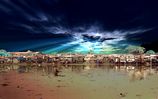
The_Floodway_2005.jpgThe Flood-Way (by Michael Wirtz)2960 visiteIncontro fra paesaggio reale (Filippine) e fantasia (il Cielo)Ott 27, 2005
|
|

Il Volo~0.jpgIl Volo214 visiteTecnica realizzativa: mista (acquarelli e china)
Dimensioni: 100 x 70
Realizzato su: cartoncino
Ott 27, 2005
|
|

Moon and Companions~0.jpgMoon, Mars and Venus159 visiteDa "NASA - Picture of the Day" del 19 Ottobre 2005:"On another October 19, in 1899, a 17 year-old Robert Goddard climbed a cherry tree on a beautiful autumn afternoon in Worcester, Massachusetts. Inspired by H.G. Wells' "War of the Worlds" and gazing out across a meadow, young Goddard imagined it would be wonderful to make a device that had the possibility of ascending to Mars. Forever more he felt his life had a purpose and in the following years his diary entries record October 19th as "Anniversary Day", the anniversary of his ascent into the cherry tree. By 1926 he had designed, built, and flown the world's first liquid fuel rocket. Mars is just visible through the trees at the lower right in this dramatic sky view that also features the Moon and Venus - all visited by liquid fuel rockets constructed on principles developed by Goddard".Ott 19, 2005
|
|
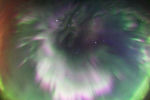
Aurora_Borealis-Coronal_Aurora-sep11aurora_moussette_f.jpgNorthern Lights over Canada78 visiteSo far, the Aurora Borealis - or "Northern Lights" - have made some remarkable visits to September's Skies. The reason, of course, is the not-so-quiet Sun. In particular, a large solar active region now crossing the Sun's disk has produced multiple, intense flares and a large Coronal Mass Ejection (CME) that triggered wide spread auroral activity just last weekend. This colorful example of spectacular curtains of aurora was captured with a fish-eye lens in skies over Quebec, Canada, on September 11, 2005.
Also featured is the planet Mars, the brightest object above and left center. Seen near Mars (just below and to the right) is the tightly knit Pleiades star cluster.
Although they can appear to be quite close, the Northern Lights actually originate at extreme altitudes, 100 Km or so above the Earth's surface.Set 16, 2005
|
|

Richat_Crater.jpgRichat Crater200 visiteEd ecco il Richat Crater, a colori, che ci rammenta - caso mai ce ne fosse bisogno - che la "nostra" Terra è, in fondo, come Venere, come Marte e come infiniti altri Corpi Celesti dell'Universo.
Il "messaggio nella bottiglia" che ci viene consegnato attraverso questa splendida immagine del cratere Richat dice, a nostro parere, solo queste poche parole:
"Il nostro Pianeta non è un eccezione alle Regole e noi non siamo un'eccezione alle Regole.
Il nostro Pianeta non è diverso da altri pianeti appartenenti a diversi Sistemi Solari e noi non siamo diversi da altri pianeti del nostro Sistema Solare.
Il nostro Pianeta non è speciale nell'Universo è e noi non siamo speciali rispetto al resto dell'Universo.
Morale: la Terra NON E' UNICA e noi NON SIAMO UNICI".Set 14, 2005
|
|

Moon and Companions.jpgMoon & Friends, from Great Salt Lake - Utah (USA)182 visiteDa "NASA - Picture of the Day" del 13 Settembre 2005:"(...) This busy quadruple 'coincidence sky' was visible last week all over the World. The easiest object to spot is the crescent Moon, which is easily the brightest sky orb in the above image. Venus is the highest Planet in the sky, with Jupiter to its right. The bright star Spica completes the quadruple just below Venus. The 'streak' on the far right is an airplane. (...)".
Nota: osservate lo "streak in the sky" lasciato dall'aeroplano (come la NASA stessa precisa) e poi provate a riguardare l'immagine Spirit relativa allo "Streak in the Sky" che alla NASA (ed anche in Italia, grazie al Corsera ed al Dr Caprara) venne immediatamente risolto come "vecchia sonda che precipita" (cfr.: "Another Spirit in the Sky?!?" - Sez. "Mars Spirit Anomalies and Maps"). Bene, allora se tanto ci dà tanto, vorremmo chiedere alla NASA "quale sonda - ripresa dal Sig. Wilson - stava precipitando nei cieli dello Utah, la sera del 6 Settembre u.s.?".
E scusateci l'ironia...Set 13, 2005
|
|

Moon River.jpgThe Moon over St. Lawrence River137 visiteDa "NASA - Picture of the Day" del 9 Settembre 2005:"Shortly after sunset on September 6th, sky gazers around the world were treated to a lovely crescent Moon in western skies - joined by bright planets Venus and Jupiter.
In this colorful telephoto view from near Quebec City, Canada, the Moon is nestled just above the wide St. Lawrence River. Lights on the horizon are along the river's southern shore. Also known as the evening star, Venus is at the upper left and Jupiter at the upper right, while another prominent celestial beacon, Spica, can be seen shining through the twilight below Venus.
Spica, actually a very close pair of hot blue stars some 260 LY away, is the brightest star in the constellation Virgo".Set 09, 2005
|
|

Sunset-PCF-00.jpgSunset from Legnano (Natural Colors; credits: Dr Paolo C. Fienga)214 visitenessun commentoSet 08, 2005
|
|

Sunrise.jpgCrepuscular Rays Over Utah86 visiteDa "NASA - Picture of the Day", del 31 Agosto 2005:"What could cause such rays of dark? Dark sky rays were caught in spectacular fashion earlier this month above Utah, USA. The cause is something surprisingly familiar: shadows. Clouds near the horizon can block sunlight from reflecting off air, making columns outward from the Sun appear unusually dark. Cloud shadows can be thought of the complement of the more commonly highlighted crepuscular rays, also visible above, where sunlight pours though cloud holes. Sometimes, on the opposite side of the sky, anticrepuscular rays can also be seen".Ago 31, 2005
|
|

Tepe_in_Malik_Shah-1937.jpgThe "Face" of Cydonia...On Earth!!!193 visiteGrazie alla collaborazione, precisa ed arguta, del nostro Lettore - il Sig. Massimo Granzo -, abbiamo scoperto che una "Faccia di Marte" esiste anche sulla Terra ed infatti...Eccola qui: siamo in Iran. La caption originale al frame che pubblichiamo ci dice "Malik Shah, close-up View of the Tepe, from an altitude of 350 mt - November 12, 1937".
Inutile dire che la somiglianza fra questa collina e la Sfinge di Cydonia è davvero incredibile...Talmente incredibile che, grazie alla pazienza ed all'attenzione del Sig. Granzo, viene naturale ripetere ancora un semplice concetto: non cerchiamo risposte fantastiche in pseudo-artefatti i quali, anche in ragione delle tecniche di ripresa adottate, sono per definizione ambigui; guardiamo con più attenzione i dettagli degli enormi quantitativi di materiale che abbiamo!
La Sfinge di Cydonia, a nostro parere, è solo il simbolo della Curiosità e della Fantasia Umana che si stendono oltre i confini della Terra.
La Ricerca della Vita e della Verità, probsbilmente è altrove.Ago 27, 2005
|
|

ZZ-ZZ-ZZ-ZZ-ZZ-LunarGreenFlash_laveder_f.jpgA "green flash" over the Moon145 visiteDa "NASA - Picture of the Day" del 26 Agosto 2005:"July's Full Moon looks strangely darkened and distorted in this remarkable telescopic view. The image is one of a series recorded when the Moon was very near the horizon. The long sight-line through a turbulent atmosphere gives rise to the tantalizing optical effects, including the thin "mirage" shape that seems to float just above the Moon's upper edge. Also seen (more easily in the inset), along the Moon's upper edge is a noticeable green rim. Substantial atmospheric refraction produces this prism-like effect -- related to the more commonly witnessed green flash of the setting Sun. Careful inspection of the full image reveals a corresponding red rim along the lower edge, another intriguing signature of atmospheric refraction".Ago 26, 2005
|
|

ZZ-ZZ-ZZ-Venus, Mercury and Saturn.jpgVenus, Mercury and Saturn from Cerro Paranal (Chile)94 visiteDa "NASA - Picture of the Day" del 17 Agosto 2005:"Very bright planets and very large telescopes are part of this sunset view of Paranal Observatory. The observatory's four, massive 8,2 meter telescope units are situated on top of the 2.600 meter high mountain, Cerro Paranal, in the dry Atacama Desert in northern Chile. The individual unit telescopes can be used separately or in combination and are named Antu, Kueyen, Melipal and Yepun. Together they are fittingly known as the European Southern Observatory's Very Large Telescope. Of course, the very bright planets are Venus (near center), joined by Mercury (below) and Saturn (left) in late June's western evening skies".Ago 17, 2005
|
|
| 496 immagini su 42 pagina(e) |
 |
|
|
|
|
|
38 | |
|
|
|








