| Ultimi arrivi - The Universe Inside |
Over Clouds.jpgOver-Clouds366 visite"...Animus hominis quidquid sibi imperat, obtinet..."
(P. Siro)Dic 16, 2005
|
|

Moon Ecyipse - Stonehenge.jpgEclipse over an ancient observatory...113 visiteImmagine amatoriale molto bella e decisamente suggestiva...Dic 16, 2005
|
|

Moon-1.jpgThe Moon over a "Red Planet"105 visiteOriginal caption:"Near its Northernmost declination, tonight's Full Moon (Dec. 15, 2005) will be a special one, arcing high in Northern Hemisphere skies. But a Full Moon won't occur on this calendar date for another 19 years, a period known as the Lunar Metonic Cycle (...)".Dic 15, 2005
|
|

Moon and Companions~1.jpgMoon and Venus from Missouri95 visiteUn'immagine carina che ci mostra un quarto di Luna (diremmo più che ampiamente sovraesposto) che si "incontra" con la Stella della Sera (e cioè Venere), il tutto in un quadretto autunnale. Anche questa immagine è stata estrapolata dalla rubrica "NASA - Picture of the Day" la quale, a nostro parere, sta iniziando a diventare leggermente ripetitiva anche nella proposizione di fotografie artistiche, sìano esse professionali o amatoriali.Dic 09, 2005
|
|

M 4~0.jpgEarth-like planet and Neutron Star inside Globular Cluster M-4407 visiteDic 02, 2005
|
|
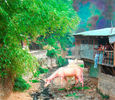
TayTayCanal_unicorn_345kb.jpgThe Year of the Unicorn (by Michael Wirtz)1664 visiteAncora un'Opera Digitale (anche se sarebbe meglio dire una 'visione') dell'Amico Michael Wirtz: si tratta di una splendida veduta pomeridiana - con Unicorno e "Cielo Alieno" - del Tay-Tay Canal (nei pressi di Manila - Filippine).
Nov 25, 2005
|
|

MoonoverAntarctica.jpgAlien Landscape (Moon over Antarctica)134 visiteDa "NASA - Picture of the Day" del 25 Novembre 2005:"Last week, the nearly Full Moon set along the Northern Horizon - as seen from Davis Station, Antarctica. The squashed orange pumpkin shape just silhouettes the peak of a distant iceberg in this stunning view.
The Moon's apparently squashed shape is due to atmospheric bending of light or refraction - an effect which is more severe closer to the horizon. Skimming low along the stark features of the frozen landscape, the Moon's lower edge appears noticeably more distorted than the upper limb. Along with about 70 others present at Davis Station, Dr. Jim Behrens had a chance to enjoy the view while studying the ongoing detachment of a large iceberg known as "Loose Tooth". Nov 25, 2005
|
|

ZZ-ZZ-ZZ-ZZ-ZZ-ZZ-ZZ-ZZ-ZZ-ZZ-ZZ-ZZ-ZZ-ZZ-PIA07997-2-plusRover-A667R1.jpgVirtual Presence in Space111 visiteThis synthetic image of the Spirit MER on top of a rock called "Jibsheet" was produced using "Virtual Presence in Space" technology. Developed at NASA's Jet Propulsion Laboratory, Pasadena, Calif., this technology combines visualization and image-processing tools with Hollywood-style special effects. The image was created using a photorealistic model of the Rover and a false-color mosaic. The size of the Rover in the image is approximately correct and was based on the size of the Rover tracks in the mosaic. The mosaic was assembled from frames taken by the Pan-Cam on the Rover's 489th Martian day (May 19, 2005); see PIA07997.
Because this synthesis provides viewers with a sense of their own "virtual presence" (as if they were there themselves), such views can be useful to mission teams in planning exploration by enhancing perspective and a sense of scale.Nov 21, 2005
|
|

Aurora Borealis~0.jpgAurora Borealis over North Dakota90 visiteDa "NASA - Picture of the Day" del 20 Novembre 2005:"This aurora was a bit of a surprise. For starters, on this Friday morning in August 2002, no intense auroral activity was expected at all. Possibly more surprising, however, the aurora appeared to show an usual structure of green rays from some locations. In the above image, captured from North Dakota, USA, a picket fence of green rays stretches toward the horizon. Mirroring the green rays is a red band, somewhat rare in its own right. Lights from the cities of Bismarck and Mandan are visible near the horizon. Large sunspot groups indicate that activity from an active Sun is relatively likely, possibly causing other streams of energetic particles to cascade onto the Earth and so causing more auroras".Nov 20, 2005
|
|
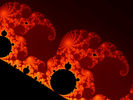
Mandelbrot Set.jpgThe "Mandelbrot Set"1143 visiteA fractal is a geometric object which is rough or irregular on all scales of length, and so which appears to be 'broken up' in a radical way. Some of the best examples can be divided into parts, each of which is similar to the original object. Fractals are said to possess infinite detail and some of them have a self-similar structure that occurs at different levels of magnification. In many cases, a fractal can be generated by a repeating pattern, in a typically recursive or iterative process. The term fractal was coined in 1975 by Benoît Mandelbrot, from the Latin fractus or "broken". Before Mandelbrot coined his term, the common name for such structures (the Koch snowflake, for example) was "Monster Curve".
Fractals of many kinds were originally studied as mathematical objects and Fractal Geometry is the branch of mathematics which studies the properties and behaviour of fractals. It describes many situations which cannot be explained easily by classical geometry, and has often been applied in science, technology, and computer-generated art. The conceptual roots of fractals can be traced to attempts to measure the size of objects for which traditional definitions based on Euclidean geometry or calculus fail.Nov 16, 2005
|
|

Coscientia.jpgCoscientia213 visite"...Sublata Conscientia, iacent omnia..."
(Cicerone)Nov 06, 2005
|
|
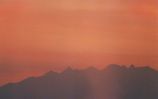
Mars-Earth.jpgAn old Sunset over the Alps... (Natural Colors - Credits: Dr Paolo C. Fienga/LXTT/IPF) 13286 visiteUna fotografia ingannevole: si tratta di un tramonto terrestre; non sono stati usati filtri di sorta: i colori sono assolutamente genuini. In origine questa immagine era stata rubricata con un seriale NASA "anomalo" il quale faceva pensare a frames Spirit e/o Opportunity "pirata".
La verità è che si tratta di una (semplice) interpretazione della realtà: a volte Marte sembra la Terra ed a volte la Terra sembra Marte: nessun trucco e nessun inganno.
Solo la Natura...Ott 27, 2005
|
|
| 496 immagini su 42 pagina(e) |
 |
|
|
|
|
37 | |
|
|
|
|








