| Ultimi arrivi - The Universe Inside |

ALANBEAN-MANKINDROCK.jpgMankind Rock123 visiteThis is Gene Cernan as he was near the end of the third moonwalk of Apollo 17. He and astronaut-geologist Jack Schmitt had completed most of their work and were just gathering final equipment and samples, putting them aboard the lunar module. At this point, Gene turned toward the television camera and said, "Jack has picked up a very significant rock, composed of many fragments of many sizes and many shapes, probably from all parts of the Moon, probably billions of years old, but a rock of all sizes and shapes and even colors that had grown together to become a cohesive rock, outlasting the nature of space, sort of living together in a very coherent, very peaceful manner. We'd like to share a piece of this rock with many of the countries throughout the world. We hope that this will be a symbol of what our feelings are." Then they continued their preparations for leaving the Moon.
Gene knew he would be the last man on the Moon for quite a long time. As he closed his checklist and prepared for his ascent up the ladder, he said, "As we leave the Moon at Taurus-Littrow, we leave it as we came and, God willing, we shall return with peace and hope for all mankind." Gene Cernan, last man on the Moon, 5:34 a.m. GMT, December 14, 1972.
I felt this was such a fitting and proper occasion in the history of manned lunar exploration that I created two nearly identical paintings of this moment.
Feb 12, 2006
|
|

ALANBEAN-LASTMAN.jpgThe Last of the "Twelve"...95 visitenessun commentoFeb 12, 2006
|
|

ALANBEAN-MOONLIGHT.jpgThe Moon119 visitenessun commentoFeb 12, 2006
|
|

ALANBEAN-MOTHEREARTH.jpgMother Earth124 visitenessun commentoFeb 12, 2006
|
|

ALANBEAN-SELFPORTRAIT.jpgIn the dust...103 visiteAutoritratto, nella polvere (o nella "nebbia dei ricordi"...) dell'Astronauta Alan Laverne Bean.Feb 12, 2006
|
|

ALANBEAN-LUNARROVER.jpgLunar "Grand Prix"89 visiteApollo 16 Commander John Young is putting the Lunar Rover through a full test. This was the second mission with the Rover onboard and this Lunar Grand Prix would allow John to evaluate the performance of the Rover in the light gravity and the dusty, cratered, and rocky surface of the Moon.
His companion, Charlie Duke, is photographing it all with the 16-mm Data Acquisition Camera normally mounted on the Rover, but hand-held temporarily to document the Rover motion.
John later said:"The tendency was to drive wide open or very close to that and take what you got. The best reference to speed control was the speedometer, as I really didn't have a feel for the difference between 7 and 10 Km per hour."
Later, he demonstrated a sharp turn at ax speed, about 10 Km per hour. I made the Rover end break out to show the engineers how it looked.
It is no problem as all I had to do was cut back like I do when driving in snow...I didn't get up to any great speed, maybe 10 clicks at the most, but the terrain around there was too rough and rocky for that kind of foolishness..."
Charlie, who was filming it all, told Houston, "...man, Indy has never seen a driver like this."
Feb 12, 2006
|
|
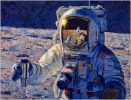
ALANBEAN-CORETUBE.jpgCore-Tube131 visiteDalla Galleria Pittorica dell'Astronauta Alan Laverne Bean: un Omaggio alla Luna ed a quei pochi che ebbero il coraggio, la fortuna ed il privilegio di camminarci sopra.
Ma lasciamo che sia "Alan" a raccontarci questa storia: la "Sua Storia"...
"...When my book, "Apollo, An Eyewitness Account", was published in October of 1998, I felt an overall sense of satisfaction. I was, in fact, preserving some of my special memories of the Apollo Program. This was the reason I resigned from NASA to become an artist.
I was moving right along but I noticed my goals for the future were even more ambitious. I wanted to paint the Moon more beautifully than I had done so far, as colorful as it could be painted, and still look like the Moon to me, a worthy but elusive goal.
I stopped painting commissions and began painting several series of studies to explore and develop new color techniques and combinations. This intense and dedicated effort consumed me for the better part of a year with the resulting changes first coming to full fruition in this painting.
Sometimes when I look at this painting I wonder if the changes were all that much. I question if anyone other than me can see them or even care? I don't know. Was it worth the time? I hope so...".Feb 12, 2006
|
|
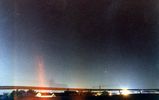
TAURUS.jpgTaurus (Natural Colors - Credits: Dr Paolo C. Fienga/LXTT/IPF)13306 visite"...Aequa tellus
Pauperi recluditur
Regumque pueris..."
(Orazio)
"...The impartial Earth is opened alike for the pauper and the children of kings..."Gen 24, 2006
|
|

Soviet-LTP-Map1.jpgThe Moon over Moscow...103 visiteI suoi occhi erano chiari e belli
Brillanti, come le notti di Luna piena
E le sue labbra, amaramente dolci
Come uno spicchio di arancio verde
Come una lacrima caduta nello zucchero ...
Le sue mani erano fresche e sicure
Mi stringevano, ma senza farmi male
E la sua pelle, così liscia e calda
Come la sabbia di un vicino deserto
Come le onde di un prossimo mare ...
Quante menzogne, per salvare i ricordi
La voglia di partire e di cercarla
Sapendo che è laggiù, da qualche parte
E lei non sa che io le penso ancora
Ed io non so che lei è andata via ...
Ed è bello pensare a quello che accade
Quando tutto sembra definito, ecco
Il Destino ci viene incontro
E ci prende per mano, leggermente
E ci accompagna, laggiù, dove vorremmo andare ...
Ed è bello pensare a quello che accade
Quando tutto sembra ormai deciso, ecco
Il Destino ci viene incontro
E ci prende per mano, leggermente
E ci porta via, laggiù, dove dobbiamo tornare...
Paolo C. Fienga – “Poesie”Gen 24, 2006
|
|

Moon and Companions~2.jpgHappy New Year from the Moon and Venus85 visiteDa "NASA - Picture of the Day" del 4 Gennaio 2006:"Fading sunlight, a young crescent Moon, and brilliant Venus shared the Western Sky in this view of 2005's final sunset from the top of Mount Haleakala, on Maui, Hawaii. Also known as the Sacred House of the Sun, Haleakala, is Maui's dormant volcano.
At 10.000 feet, the Summit is an ideal site for astronomical observatories, and this scene also features the silhouette of the Northern Hemisphere Faulkes Telescope. It can be of particular interest to students the fact that the Faulkes Telescope (a 2-meter diameter instrument, dedicated to astronomy education), can be remotely operated over the internet.
The Project is a joint effort between the Dill Faulkes Educational Trust and the University of Hawaii - Institute for Astronomy (...)". Gen 04, 2006
|
|
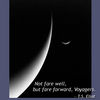
voyager.jpgVoyager826 visite"...Noi siamo solo Viaggiatori: Viaggiatori dello Spazio e del Tempo.
Ed il nostro Viaggio, come il Gaudio nel Paradiso e come la Dannazione all'Inferno, non avrà mai fine..."
Paolo Catello Fienga (Storie Brevi)Dic 30, 2005
|
|
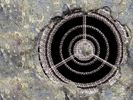
Pseudo-Crater.jpgPseudo-Crater <-- or --> True-Crater159 visite"...Laddove non c'è Verità non ci può neppure essere Bellezza..."
P.C. Floegers
Dic 21, 2005
|
|
| 496 immagini su 42 pagina(e) |
 |
|
|
|
|
36 | |
|
|
|
|








