| |

| Ultimi arrivi - The Universe Inside |

Railway to the Moon.jpgLet's go to the Moon!...135 visite"...Ricordati che la Strada che porta al Cielo, passa sempre per questa Terra..."
P.C. Floegers - "Memories"Apr 18, 2006
|
|

Sun Halo-2.jpgBright Sun, Dark Sky79 visiteCaption originale:"Have you ever seen a halo around the Sun? This fairly common sight occurs when high thin clouds containing millions of tiny ice crystals cover much of the sky. Each ice crystal acts like a miniature lens. Because most of the crystals have a similar elongated hexagonal shape, light entering one crystal face and exiting through the opposing face refracts 22 degrees, which corresponds to the radius of the Sun Halo. A similar Moon Halo may be visible during the night. The picture was taken in Gunlock, Utah, USA. A flock of birds was caught by chance in the foreground. Exactly how ice-crystals form in clouds remains under investigation".
Nota: si tratta di un'immagine molto bella, senza alcun dubbio, ma una piccola annotazione va fatta. Vedete il colore del cielo attorno al Sole? Vi sembra naturale? No, ovviamente: non è affatto naturale.
Esso è molto scuro, di colore incerto (grigio), molto simile al cielo di Marte (come si vede nei frames NASA). Ma perchè questo "strano cielo" anche sulla Terra? Diciamo che si tratta di una combinazione di fattori (su tutti il - probabile - filtro/colore usato e la circostanza per cui, scattando foto come questa e quindi sovraesponendo il Sole, automaticamente si rende più scuro tutto il resto del paesaggio).
Morale: se non si vedessero degli uccelli in transito, questa bella immagine potrebbe tranquillamente rappresentare un tramonto (o un'alba) su Marte.
La nostra deduzione è che il fatto di credere a quello che si vede in una fotografia (terrestre, marziana o lunare) e commentarlo, sta diventando sempre più una questione di "Fede" e non - purtroppo - di effettiva oggettività.Apr 11, 2006
|
|

Umbra Fugax-1.jpgUmbra Fugax97 visiteSiamo al termine della spettacolare eclissi totale del 29 Marzo 2006 e l'ombra della Luna sta già lasciando il posto al Sole. Se osservate il frame a schermo pieno e con una certa attenzione dovreste riuscire a notare che, in alcune zone del cielo - già quasi del tutto libere dalla "notte" - si intravedono ancora dei corpi luminosi puntiformi che, ad una prima e sommaria occhiata, potrebbero sembrare delle stelle molto luminose che stanno per svanire nella luce del giorno. Ma non è così: si tratta, a nostro parere, di un abbastanza consueto e caratteristico photoartifact.
In ogni caso, un frame davvero molto bello.
Caption originale:"During the March 29, 2006 total Solar Eclipse, the Moon's dark central shadow (or "umbra") is vanishing beyond the horizon in this dramatic view of the landscape a few km South-East of Incesu, Anatolia, Turkey. The large, snow covered mountain in the distance is 3.250 mt high volcano Hasan Dag. The foreground is growing brighter as eclipse watchers are just beginning to see rays of sunlight peek around the lunar limb, while the mountains on the horizon, left of Hasan Dag, are still completely shadowed by the Moon. For the watchers along this part of the shadow track, the total phase of the eclipse lasted less than 4', as the umbra raced over them at more than 3000 Km per hour". Apr 08, 2006
|
|

Aurora Borealis - Norway.jpgBlack Aurora over Norway95 visiteDa "NASA - Picture of the Day" del 29 Marzo 2006:"What causes gaps between aurora curtains? These unusual gaps can make auroral displays appear more detailed and intricate. Research using data from four Cluster Spacecraft orbiting the Earth has likely found the secret: auroral gaps, sometimes knows as "black auroras", are actually anti-auroras. In normal auroras, electrons and/or predominantly negatively charged particles fall toward Earth along surfaces of constant magnetic field. They ionize the Earth's atmosphere on impact, causing the bright glows. In auroral gaps, however, negatively charged particles may be sucked out from the Earth's ionosphere along adjoining magnetic field lines. These dark anti-auroras can climb to over 20.000 Km and last for several minutes. Pictured above, a series of well-defined auroral gaps is seen dividing green aurora curtains high above Harstad, Norway, earlier this month".Apr 02, 2006
|
|

Super-Earths.jpgSuper-Earths?116 visiteda "NASA - Picture of the Day" del giorno 20 Marzo 2006:"Are Super-Earths common around other star systems? Quite possibly. Unexpected evidence for this came to light recently when a planet orbiting a distant star gravitationally magnified the light of an even more distant star. Assuming the planet's parent star is normal red dwarf, the brightening is best explained if the planet is about 13 times the mass of the Earth and orbiting at the distance of the asteroid belt in our own Solar System. Given the small number of objects observed and similar determinations already obtained for other star systems, these super-Earths might be relatively common. Astronomers speculate that the planet might have grown into a Jupiter-sized planet if its star system had more gas. Since the planet was not observed directly, significant uncertainty remains in its defining attributes and future research will be aimed at better understanding this intriguing system (...)". Mar 20, 2006
|
|

South Polar Halo.jpgSouth Polar Halo91 visiteWhen Sunlight reflects and refracts off of tiny ice crystals in the atmosphere, the result can be ice crystal halos, which are related to rainbows (the latter being produced when Sunlight reflects and refracts from water droplets).
In Antarctica the temperatures are cold and the air is dry, so snow crystals grow very slowly. This slow growth tends to produce very clean hexagonal prisms, which are well suited for producing beautiful atmospheric displays. The example here is a South Pole halo, showing a rich variety of arcs and halos.
Halos arise from the way minute ice crystals in the atmosphere scatter Sunlight (or Moonlight!) into different angles.
The quality of a halo depends on the type and quality of the ice crystals that produce it. Mar 05, 2006
|
|

Sun Pillars.jpgLight Pillars' Parade86 visiteDa "NASA - Picture of the Day" del 5 Marzo 2006:"How can an aurora appear so near the ground? Pictured above are not aurora but nearby light pillars, a local phenomenon that can appear as a distant one. In most places on Earth, a lucky viewer can see a Sun-pillar, a column of light appearing to extend up from the Sun caused by flat fluttering ice-crystals reflecting sunlight from the upper atmosphere. Usually these ice ice crystals evaporate before reaching the ground. During freezing temperatures, however, flat fluttering ice crystals may form near the ground in a form of light snow, sometimes known as a crystal fog. These ice crystals may then reflect ground lights in columns not unlike a Sun-pillar. In the above picture, the colorful lights causing the light pillars surround a ice-skating ring in Fairbanks, Alaska".Mar 05, 2006
|
|

Multiuniverse.jpgThe "Universe", inside...140 visite...Tutto avremmo potuto immaginare, tranne che il Sito "NASA - Picture of the Day" giungesse a mostrare un fantasyframe che esprime il medesimo concetto della nostra Sezione "The Universe Inside". Ora i casi sono due (se ci passate la battuta): o gli Ideatori e Curatori del Sito NASA ci hanno copiato in maniera palese, o - come peraltro è già accaduto in passato - gli Ideatori ed i Curatori di "Lun-Ex-It" e di "NASA - Picture of the Day", talvolta (ma sempre più spesso), hanno proprio le stesse idee ed intuizioni...
Caption originale:"Do nearly exact copies of you exist in other universes? If one or more of the multiverse hypotheses is correct, then quite possibly they do. In the above computer-enhanced illustration, independent universes are shown as independent circles or spheres. Spheres may be causally disconnected from all other spheres, meaning no communications can pass between them. Some spheres may contain different realizations of our universe, while others may have different physical laws. An entire set of parallel universes is called a multiverse. The human eye might represent the possibility that realizations of some multiverse hypotheses might only exist in the human mind. One criticism of multiverse hypotheses is that they are frequently difficult to test. Some multiverse hypotheses may therefore be great fun to think about but not practically falsifiable and therefore have no predictive scientific value".Mar 01, 2006
|
|

CollidingGalaxies-PIA02180_modest.jpgHearts of Glass131 visiteThis artist's concept shows delicate greenish crystals sprinkled throughout the violent core of a pair of colliding galaxies. The white spots represent a thriving population of stars of all sizes and ages. NASA's Spitzer Space Telescope detected more than 20 bright and dusty galactic mergers like the one depicted here, all teeming with the tiny gem-like crystals.
When galaxies collide, they trigger the birth of large numbers of massive stars. Astronomers believe these blazing hot stars act like furnaces to produce silicate crystals in the same way that glass is made from sand. The stars probably shed the crystals as they age, and as they blow apart in supernovae explosions.
At the same time the crystals are being churned out, they are also being destroyed. Fast-moving particles from supernova blasts easily convert silicates crystals back to their amorphous, or shapeless, form.
How is Spitzer seeing the crystals if they are rapidly disappearing? Astronomers say that, for a short period of time at the beginning of galactic mergers, massive stars might be producing silicate crystals faster than they are eliminating them. When our own galaxy merges with the Andromeda galaxy in a few billion years, a similar burst of massive stars and silicate crystals might occur.
Crystal Storm in Distant Galaxy
The graph (see inset above) of infrared data from NASA's Spitzer Space Telescope tells astronomers that a distant galaxy called IRAS 08752+3915 is experiencing a storm of tiny crystals made up of silicates. The crystals are similar to the glass-like grains of sand found on Earth's many beaches.
The data were taken by Spitzer's infrared spectrograph, which splits light open to reveal its rainbow-like components. The resulting spectrum shown here reveals the signatures of both crystalline (green) and non-crystalline (brown) silicates.
Spitzer detected the same crystals in 20 additional galaxies, all belonging to a class called ultraluminous infrared galaxies. These extremely bright and dusty galaxies usually consist of two galaxies in the process of smashing into each other. Astronomers believe massive stars at the hearts of the galaxies are churning out clouds of silicate crystals. This phenomenon may represent a short-lived phase in the evolution of galactic mergers.
Feb 23, 2006
|
|

FreeFall-1.jpgFree-Fall170 visiteDa "NASA - Picture of the Day" del 20.02.2006:"...Like a scene from a space mystery movie, a spacesuit floated away from the International Space Station earlier this month, but no investigation was needed. It was pushed out by the space station crew. Dubbed Suitsat-1, the unneeded Russian Orlan spacesuit filled mostly with old clothes was fitted with a faint radio transmitter and released to orbit the Earth. Suitsat-1 will orbit once every 90 minutes until it burns up in the Earth's atmosphere within a few weeks. The suit circled the Earth twice before its radio signal became unexpectedly weak. Pictured above, the lifeless spacesuit was photographed as it drifted away from the Earth-orbiting space station earlier this month..."
Nota: anche se la caption originale NASA si guarda bene dal dirlo, non siamo davanti nè ad uno scherzo, nè ad un gioco, ovviamente.
Questo esperimento, come in molti avranno già capito, è stato effettuato al solo scopo di vedere che cosa accadrebbe (e, di conseguenza, come si potrebbe intervenire) qualora un Astronauta "sfuggisse" agli ormeggi e si allontanasse - irreversibilmente - dalla Stazione Spaziale Internazionale.
Conseguenze a breve: l'Astronauta diventa un "satellite" ed inizia ad orbitare.
Nel tempo (esaurimento delle scorte di O2 a parte), questo "satellite umano" inizia a perdere quota e poi finisce con l'avviare una vera e propria "fase di rientro".
Ma l'Astronauta non è una Navicella Spaziale dotata di schermature protettive: il rientro, ovviamente, non si compirebbe mai ed il malcapitato Astronauta finirebbe bruciato (vivo o morto, ma presumibilmente morto) già negli strati superiori dell'atmosfera (ricordate il film "Mission to Mars"?).Feb 20, 2006
|
|
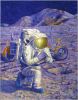
ALANBEAN-PRAYER.jpgLunar Prayer198 visitenessun commentoFeb 19, 2006
|
|

ALANBEAN-FANTASY.jpg"Buddies" forever112 visitePete Conrad, Dick Gordon and I were assigned by head astronaut Deke Slayton as the backup crew for Apollo 9. This was super news because this meant we would fly three missions subsequent and make one of the first Moon landings.
The most experienced astronaut was designated commander, in charge of all aspects of the mission including flying the lunar module. Prudent thinking suggested that the next most experienced crew member be assigned to take care of the command module since it had a heat shield and was our only way back home. This left the least experienced to accompany the commander. Pete Conrad had flown two Gemini flights, the second with Dick Gordon as his crew mate. I had not flown at all.
During training, Pete and I frequently practiced our lunar surface activities such as emplacing experiments, gathering rock samples, or making observations. We were excited. We were going to have the ultimative adventure someone in our profession could experience. But while we did, Dick Gordon would be orbiting 60 miles above us. We often fantasized Dick joining us on the Moon for all the fun, but we could never really find a way. But now I'm an artist and in my paintings I can have it my way. Now, at last, our best friend has come the last 60 miles.
One last story. Dick was the more experienced astronaut, yet I got the prize assignment. In the three years of training preceding our mission, he never once said: "It's not fair, I wish I could walk on the Moon too." I do not have his unwavering discipline or strength of character.
Feb 12, 2006
|
|
| 496 immagini su 42 pagina(e) |
|
|
|
|
|
35 | |
|
|
|
|
|
|








