| Ultimi arrivi - The Universe Inside |

Gliese-581-1.jpgSunrise from Gliese 581c110 visitenessun commentoMareKromiumMag 02, 2007
|
|

M_45_and_the_Moon.jpgThe Pleiades "obscured" by the Moon102 visite"...There is no point to Life; though there is a point to Art..."
frase attribuita a Kingsley Amis (1922 - 1995)MareKromiumApr 30, 2007
|
|

M-45~0.jpgM 45 and Venus94 visite"...L'Opium agrandit ce qui n'a pas de bornes,
Allonge l'Illimité,
Approfondit le Temps, creuse la Volupté,
Et de plaisirs noirs et mornes
Remplit l'ame au-delà de sa capacité..."
Charles Baudelaire (1821 - 1867) - "Le Poison" (1857)Apr 14, 2007
|
|

AuroraBorealis-Alaska.jpgAurora over Alaska86 visiteCaption NASA:"Higher than the highest mountain, higher than the highest airplane, lies the realm of the aurora. Aurora rarely reach below 60 Km, and can range up to 1000. Aurora light results from solar shockwave causing energetic electrons and protons to striking molecules in the Earth's atmosphere. Frequently, when viewed from space, a complete aurora will appear as a circle around one of the Earth's magnetic poles. The above digitally enhanced photograph was taken in 2005 January shows a spectacular aurora borealis above the frozen landscape of Bear Lake, Alaska, USA.
The above image was voted Wikipedia Commons Picture of the Year for 2006".Apr 09, 2007
|
|

CometHale-Bopp-970401C_lodriguss.jpgOn the edge of Oblivion...81 visite"...Mi dispiace vedere che gran parte delle persone vivano la loro Vita non secondo un modello personale - magari discutibile, ma proprio -, bensì secondo il modello creato solo ed esclusivamente dalla televisione (o da chi per essa).
Un modello orrendo e della razza peggiore.
Certo, non esiste un modello predefinito di "Vita" e allora ognuno di noi cresce assieme a quello che gli sta attorno, aiutandosi con quanto si trova in giro. Però...
Però vedo sempre più maiali inconsapevoli di viaggiare verso il mattatoio e, anche se dovrei (forse) preoccuparmi più di me stesso, questa visione - un pò - mi duole..."
Giorgio Picciau - "Lettere"MareKromiumApr 03, 2007
|
|

Eternity.jpgBeyond...74 visite"...A well-written Life is almost as rare as a well-spent one..."
Thomas Carlyle (1795 - 1881) - "Critical and Miscellaneous Essays" (1838) MareKromiumMar 30, 2007
|
|

The_Sun~0.jpgNorouz...87 visiteCaption NASA:"Clouds covered the eastern horizon on Monday, when the Sun rose over the expansive Touran Wildlife Reserve in North-Eastern Iran. Of course, on that day the Moon rose with the Sun, creating a widely enjoyed partial solar eclipse. Along with a mountainous horizon, the cloud cover lent a dramatic aspect to this eclipse sunrise and made it possible for astronomer Babak Tafreshi to record these telephoto images without using a filter. Advancing north in planet Earth's sky, the Sun itself was also approaching the equinox, the astronomical marker for the first day of Northern Hemisphere Spring and the beginning of Norouz, the Persian New Year".Mar 23, 2007
|
|

The_Sun.jpgPartial Eclipse84 visiteCaption NASA:"On Monday, March 19, 2007, shortly before the Equinox, locations in Asia and the Arctic were favoured by the New Moon's shadow during a partial Solar Eclipse. Although the view from Goa, India, found the eclipsed Sun near the horizon, photographer Joerg Schoppmeyer was still able to capture this lovely image, combining celestial with terrestrial silhouettes.
The next eclipse season will begin in late August this year, featuring a total Lunar Eclipse on August 28, and another partial solar eclipse on September 11. Compared to the March 19th eclipse, the September 11th eclipse will be seen on the other side of our fair planet, from parts of South America and Antarctica".Mar 22, 2007
|
|

Rising_Moon.jpgRising Moon84 visiteCaption NASA:"What's happening to the Moon? Drifting around the Earth in 2006 July, astronauts from the International Space Station (ISS) captured a crescent Moon floating far beyond the horizon. The captured above image is interesting because part of the Moon appears blue, and because part of the moon appears missing.
Both effects are created by the Earth's atmosphere. Air molecules more efficiently scatter increasingly blue light, making the clear day sky blue for ground observers, and the horizon blue for astronauts.
Besides reflecting sunlight, these atmospheric molecules also deflect moonlight, making the lower part of the Moon appear to fade away. As one looks higher in the photograph, the increasingly thin atmosphere appears to fade to black".Mar 20, 2007
|
|

Earth_Eclipse.jpgThe "Diamond Ring"...from the Moon!99 visiteUno splendido montaggio che ci mostra una ipotetica veduta dalla Luna di un Eclisse Totale di Sole. Bellissima ricostruzione, davvero, ma...c'è un errore davvero grande in questa "Scena di fantasia": durante una eclissi totale di Sole (ed anche nel momento in cui si forma l'Anello di Diamante - come in questa immagine) la superficie della Luna si troverebbe immersa nella più totale oscurità e quindi risulterebbe ai nostri occhi solo appena distinguibile, in forma di vaghe e quasi indefinibili ombre scure, con le stelle ben visibili nel cielo.
Ma va bene lo stesso...
Caption NASA:"Parts of Saturday's (March 3) lunar eclipse will be widely visible. For example, skywatchers in Europe, Africa, and western Asia will be able to see the entire spectacle of the Moon gliding through Earth's shadow, but in eastern North America the Moon will rise already in its total eclipse phase. Of course if you traveled to the Moon's near side, you could see the same event as a solar eclipse, with the disk of our fair planet Earth completely blocking out the Sun. For a moon-based observer's view, graphic artist Hana Gartstein (Haifa, Israel) offers this composite illustration. In the cropped version of her picture, an Apollo 17 image of Earth is surrounded with a red-tinted haze as sunlight streams through the planet's dusty atmosphere. Earth's night side remains faintly visible, still illuminated by the dark, reddened Moon, but the disk of the Earth would appear almost four times the size of the Sun's disk, so the faint corona surrounding the Sun would be largely obscured. At the upper left, the Sun itself is just emerging from behind the Earth's limb".MareKromiumMar 02, 2007
|
|

Orion.jpgPersian Orion...72 visitenessun commentoFeb 03, 2007
|
|
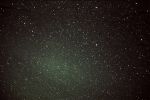
Counter-glow.jpgThe Gegenshein (or "Counter Glow") Effect in Pisces80 visiteDa "NASA - Picture of the Day", del 26 Dicembre 2006:"If you look carefully enough, you can even see the glow of the Sun in the opposite direction. At night this glow is known as the Gegenschein (German for "Counter Glow"), and can be seen as a faint glow in an extremely dark sky. The Gegenschein is sunlight back-scattered off small interplanetary dust particles. These dust particles are millimeter sized splinters from asteroids and orbit in the ecliptic plane of the planets.
Pictured above, the gegenschein is seen superposed toward the constellation of Pisces. The Gegenschein is distinguished from Zodiacal Light by the high angle of reflection. During the day, a phenomenon similar to the Gegenschien - called "The Glory" - can be seen in reflecting air or clouds opposite the Sun from an airplane".MareKromiumDic 26, 2006
|
|
| 496 immagini su 42 pagina(e) |
 |
|
|
|
|
28 | |
|
|
|
|








