| Ultimi arrivi - The Universe Inside |

LonelyQuasar.gifLonely Quasar...122 visite"...It was just before dawn,
One miserable morning in black, '44,
When the forward commander was told to sit tight
When he asked that his men be withdrawn,
And the generals gave thanks
As the other ranks
Held back the enemy tanks for a while,
And the Anzio bridgehead was held for the price
Of a few hundred ordinary lives..."
Pink Floyd - "When The Tigers Broke Free"MareKromiumOtt 12, 2007
|
|

The_Galxy_Survey.gifLooking Southward...74 visite"...Do not fling away your fearless confidence for it carries a great and glorious compensation of reward.
You have need of steadfast patience and endurance, ...enjoy to the full what is promised..."
(Heb. 10:35-36)MareKromiumOtt 07, 2007
|
|

SOL1329-2P244351741EFFAVAQP2285R1M1-3.jpgMartian Sunshine (Fantasy; elab. Lunexit)70 visite"...Semper bonus homo tiro est..."
(Marziale)
"...L'uomo buono (nella Vita) è sempre un ingenuo (in balìa dei furbi)..."MareKromiumOtt 03, 2007
|
|
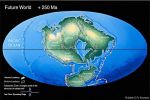
PangeaUltima_scotese_big.jpgA VERY far, distant and yet possible Future: Pangea Ultima76 visiteIs this what will become of the Earth's surface? The surface of the Earth is broken up into several large plates that are slowly shifting.
About 250 MY ago, the plates on which the present-day continents rest were positioned quite differently, so that all the landmasses were clustered together in one supercontinent now dubbed Pangea. About 250 MY from now, the plates are again projected to reposition themselves so that a single landmass dominates.
The above simulation from the PALEAOMAP Project shows this giant landmass: Pangea Ultima.
At that time, the Atlantic Ocean will be just a distant memory, and whatever beings inhabit Earth will be able to walk from North America to Africa.MareKromiumSet 26, 2007
|
|

The_Moon.jpgThe Hunter's Moon...75 visite"...Caelum, avarus, in coeno quaerit..."
(Binder)
"...L'avaro (inteso anche come chi è "moralmente misero") cerca il Cielo nel fango..."MareKromiumSet 26, 2007
|
|

Zodiacal_beletsky_big.jpgZodiacal Light and the False Dawn73 visite"...Do not pronounce judgment before the time, before the Lord comes, who will bring to light the things now hidden in darkness and will disclose the purposes of the heart..."
- 1 Corinthians 4:5MareKromiumSet 25, 2007
|
|

JustlikeIo.jpgJust like Io!124 visiteCaption NASA:"Volcano Tungurahua erupted spectacularly last year. Pictured above, molten rock so hot it glows visibly pours down the sides of the 5000-meter high Tungurahua, while a cloud of dark ash is seen being ejected toward the left.
Wispy white clouds flow around the lava-lit peak, while a star-lit sky shines in the distance.
The above image was captured last year (2006) as ash fell around the adventurous photographer. Located in Ecuador, Tungurahua has become active roughly every 90 years since for the last 1300 years. Volcano Tungurahua has started erupting again this year and continues erupting at a lower level even today".
Nota: i colori sono stati alterati dallo STAFF Lunexit, così da rendere l'immagine più esotica e, a nostro parere, più simile a quello che potrebbe essere un vulcano situato sulla Luna Galileiana "Io".
Chiediamo scusa al Dr Tashler (l'Autore dell'immagine originale) per la manipolazione.MareKromiumSet 23, 2007
|
|

StairWaytoHaeven.jpgStairway to Haeven...68 visite"...Ciò che mi muove, in questa Vita, è la curiosità.
La curiosità di "vedere che cosa c'é oltre".
Oltre questa Terra, questo Mare, questo Cielo...Oltre questo Oggi ed oltre il Domani che verrà.
Oltre le nostre idee, le nostre paure, le nostre ipotesi e le nostre convinzioni.
Ti faccio un esempio: se, un giorno, mi capitasse di imbattermi in una scala che, poggiata sulla terra nuda, si alza verso l'Infinito, non credo che mi porrei troppe domande sulla sua Origine ed i suoi Scopi.
Penso che la guarderei, per qualche istante, e poi inizierei a salire, così, un gradino dopo l'altro, senza guardare giù...
Così: tanto per vedere sino a che punto sarei capace di arrivare, prima di sentire un brivido scorrere lungo la schiena ed il collo, e quindi rendermi conto che il mio Tempo, al pari del mio Cammino, è finito..."
P.C. Floegers - "Conversations"MareKromiumSet 23, 2007
|
|

Voyagers-00.gifTowards the "Terra Incognita" (1)90 visiteInterstellar Mission - Mission Objective
The mission objective of the Voyager Interstellar Mission (VIM) is to extend the NASA exploration of the Solar System beyond the neighborhood of the outer planets to the outer limits of the Sun's sphere of influence, and possibly beyond. This extended mission is continuing to characterize the outer Solar System environment and search for the heliopause boundary, the outer limits of the Sun's magnetic field and outward flow of the solar wind. Penetration of the heliopause boundary between the solar wind and the interstellar medium will allow measurements to be made of the interstellar fields, particles and waves unaffected by the solar wind.
The VIM is an extension of the Voyager primary mission that was completed in 1989 with the close flyby of Neptune by the Voyager 2 spacecraft. Neptune was the final outer planet visited by a Voyager spacecraft. Voyager 1 completed its planned close flybys of the Jupiter and Saturn planetary systems while Voyager 2, in addition to its own close flybys of Jupiter and Saturn, completed close flybys of the remaining two gas giants, Uranus and Neptune.
At the start of the VIM, the two Voyager spacecraft had been in flight for over 12 years having been launched in August (Voyager 2) and September (Voyager 1), 1977. Voyager 1 was at a distance of approximately 40 AU (Astronomical Unit - mean distance of Earth from the Sun, 150 million kilometers) from the Sun, and Voyager 2 was at a distance of approximately 31 AU.
As of July 2007, Voyager 1 was at a distance of 15.4 Billion Kilometers (103 AU) from the sun and Voyager 2 at a distance of 12.4 Billion kilometers (83 AU).
Voyager 1 is escaping the solar system at a speed of about 3.6 AU per year, 35 degrees out of the ecliptic plane to the north, in the general direction of the Solar Apex (the direction of the Sun's motion relative to nearby stars). Voyager 2 is also escaping the solar system at a speed of about 3.3 AU per year, 48 degrees out of the ecliptic plane to the south.
Both Voyagers are headed towards the outer boundary of the solar system in search of the heliopause, the region where the Sun's influence wanes and the beginning of interstellar space can be sensed. The heliopause has never been reached by any spacecraft; the Voyagers may be the first to pass through this region, which is thought to exist somewhere from 8 to 14 billion miles from the Sun. In December 2004 Voyager 1 crossed an area known as the termination shock. This is where the million-mile-per-hour solar winds slows to about 250,000 miles per hour—the first indication that the wind is nearing the heliopause. Voyager 2 is currently observing preshock phenomena, indicating that it is close to the termination shock. The Voyagers should cross the heliopause 10 to 20 years after reaching the termination shock. The Voyagers have enough electrical power and thruster fuel to operate at least until 2020. By that time, Voyager 1 will be 12.4 billion miles (19.9 billion KM) from the Sun and Voyager 2 will be 10.5 billion miles (16.9 billion KM) away. Eventually, the Voyagers will pass other stars. In about 40,000 years, Voyager 1 will drift within 1.6 light years (9.3 trillion miles) of AC+79 3888, a star in the constellation of Ophiucius. In some 296,000 years, Voyager 2 will pass 4.3 light years (25 trillion miles) from Sirius, the brightest star in the sky . The Voyagers are destined—perhaps eternally—to wander the Milky Way. For current distances, check: Mission Weekly Reports
MareKromiumSet 08, 2007
|
|

Voyagers-01.gifTowards the "Terra Incognita" (2)104 visiteIt is appropriate to consider the VIM as three distinct phases: the termination shock, heliosheath exploration, and interstellar exploration phases. The two Voyager spacecraft began the VIM operating, and are still operating, in an environment controlled by the Sun's magnetic field with the plasma particles being dominated by those contained in the expanding supersonic solar wind. This is the characteristic environment of the termination shock phase. At some distance from the Sun, the supersonic solar wind will be held back from further expansion by the interstellar wind. The first feature to be encountered by a spacecraft as a result of this interstellar wind/solar wind interaction will be the termination shock where the solar wind slows from supersonic to subsonic speed and large changes in plasma flow direction and magnetic field orientation occur.
Passage through the Termination Shock ends the Termination Shock Phase (TSP) and begins the Heliosheath Exploration Phase (HEP). Voyager 1 in 2004 completed the TSP of the mission when the spacecraft was 94 AU from the Sun. After passage through the Termination Shock, the spacecraft will be operating in the Heliosheath environment which is still dominated by the Sun's Magnetic Field and particles contained in the Solar Wind. The HEP ends with passage through the Heliopause which is the outer extent of the Sun's Magnetic Field and Solar Wind. The thickness of the Heliosheath is uncertain and could be tens of AU thick taking several years to traverse. Passage through the Heliopause begins the Interstellar Exploration Phase (IEP) with the spacecraft operating in an interstellar wind dominated environment. This interstellar exploration is the ultimate goal of the Voyager Interstellar Mission.MareKromiumSet 08, 2007
|
|

Voyagers-02.jpgMessage in a "Bottle"...92 visiteCaption NASA:" Launched 30 years ago, NASA's Voyager 1 and 2 Spacecraft are now respectively 15 and 12,5 BKM from the Sun, equivalent to about 14 and 11,5 Light-Hours distant. Still functioning, the Voyagers are being tracked and commanded through the Deep Space Network. Having traveled beyond the outer planets, they are only the third and fourth spacecraft from planet Earth to escape toward interstellar space, following in the footsteps of Pioneer 10 and 11.
A 12" gold plated copper disk (a phonograph record) containing recorded sounds and images representing human cultures and life on Earth, is affixed to each Voyager - a Message in a Bottle, cast into the Cosmic Sea.
The recorded material was selected by a committee chaired by astronomer Carl Sagan. Simple diagrams on the cover symbolically represent the Spacecraft's origin and give instructions for playing the disk. The exotic construction of the disks should provide them with a long lifetime as they coast through the interstellar space". MareKromiumSet 08, 2007
|
|

Phobos_Eclipsing_Victoria.jpgPhobos eclipsing Victoria Crater's Region (elab. Lunexit)77 visitenessun commentoMareKromiumAgo 27, 2007
|
|
| 496 immagini su 42 pagina(e) |
 |
|
|
|
|
26 | |
|
|
|
|








