| Ultimi arrivi - The Universe Inside |

TheMoon_Mars.jpgCompanions84 visitenessun commentoMareKromiumDic 23, 2007
|
|

Martian_Sunset-MF-LXTT.jpgCold Sunset156 visitenessun commentoMareKromiumDic 21, 2007
|
|

The-Holographic-Principle.gifThe Holo...what?!?123 visiteNella caption NASA (che leggerete a fine intervento), ecco un esempio di quella che alcuni chiamano "Psico-Fisica", ossìa una sorta di StranaScienza che viaggia a metà strada fra la Razionalità, l'Irrazionalità e le baggianate da "Lab-Rats".
Per quanto attiene la nozione ed il contenuto del Principio Olografico, i riferimenti fatti dalla NASA nella caption Vi saranno sufficienti per trovare abbondanti informazioni al riguardo; per quanto attiene le implicazioni fisiche del suddetto Principio, invece...Vi suggeriamo di non sforzarVi troppo.
Siamo nel regno della Meccanica Quantistica (secondo i Fisici Classici), o della Fisica Teorica (a detta dei – chiamiamoli così – “Filosofi” della Fisica).
Oppure siamo in quello, molto più vasto e variegato, della Fisica da “Bar dell’Ateneo”: un regno fatto di baggianate suggestive ma indimostrabili e popolato da “scienziati” più vicini alle favole New Age piuttosto che a Planck, Bohr o ad Einstein (e, a proposito, un consiglio: attenzione a quelli che parlano e scrivono di “Oloscienza”…).
Morale: riempirsi la bocca di parole, a quanto pare, conferisce tono, carisma e popolarità (sia ai Grandi della Scienza, sia ai Politici); tuttavia si può comunque notare che non sempre una bocca piena di parole, se si ascolta con la dovuta attenzione ed il necessario spirito, riesce ad esprimere un concetto (che sia uno) di senso compiuto.
Pensiamoci e pensateci sopra...
Caption NASA:”Is this picture worth a thousand words? According to the Holographic Principle, the most information you can get from this image is about 3x1065 bits for a normal sized computer monitor. The Holographic Principle, yet unproven, states that there is a maximum amount of information content held by regions adjacent to any surface. Therefore, counter-intuitively, the information content inside a room depends not on the volume of the room but on the area of the bounding walls. The principle derives from the idea that the Planck length, the length scale where quantum mechanics begins to dominate classical gravity, is one side of an area that can hold only about one bit of information. The limit was first postulated by physicist Gerard 't Hooft in 1993.
It can arise from generalizations from seemingly distant speculation that the information held by a black hole is determined not by its enclosed volume but by the surface area of its event horizon. The term "holographic" arises from a hologram analogy where three-dimension images are created by projecting light though a flat screen. Beware, other people looking at the above image may not claim to see 3 x 1065 bits -- they might claim to see a teapot”.
MareKromiumDic 16, 2007
|
|

Iridescent_Cloud.jpgIridescent Cloud114 visiteCaption NASA:"Why would a cloud appear to be different colors? A relatively rare phenomenon known as "Iridescent Clouds" can show unusual colors vividly or a whole spectrum of colors simultaneously. These clouds are formed of small water droplets of nearly uniform size. When the Sun is in the right position and mostly hidden by thick clouds, these thinner clouds significantly diffract sunlight in a nearly coherent manner, with different colors being deflected by different amounts. Therefore, different colors will come to the observer from slightly different directions. Many clouds start with uniform regions that could show iridescence but quickly become too thick, too mixed, or too far from the Sun to exhibit striking colors.
This iridescent cloud was photographed above Boulder, Colorado last week".MareKromiumNov 25, 2007
|
|

Aurora_Borealis.jpgAurora Borealis over Chena Lakes72 visiteCaption NASA:"Sometimes, after your eyes adapt to the dark, a spectacular sky appears. In this case, a picturesque lake lies in front of you, beautiful green aurora flap high above you, brilliant stars shine far in the distance, and, for a brief moment, a bright meteor streaks by. This digitally fused breathtaking panorama was captured late last month across one of the Chena Lakes in North Pole, Alaska, USA, and includes the Pleiades open cluster of stars on the image right. The shot is unusual not only for the many wonders it has captured simultaneously, but because lakes this far north tend to freeze and become non-reflecting before a sky this dark can be photographed".MareKromiumNov 19, 2007
|
|

Aurora_Borealis-2.jpgAurora Borealis over Juneau75 visiteCaption NASA:"Some auroras can only be seen with a camera. They are called sub-visual and are too faint to be seen with the unaided eye. The reason is that the human eye only accumulates light for a fraction of a second at a time, while a camera shutter can be left open indefinitely. When photographing an already picturesque scene above Juneau, Alaska, USA, a camera caught green sub-visual aurora near the horizon. Auroras are sparked by energetic particles from the Sun impacting the magnetic environment around the Earth. Resultant energetic particles such as electrons and protons rain down near the Earth's poles and impact the air.
The impacted air molecules temporarily lose electrons, and when oxygen molecules among them reacquire these electrons, they emit green light. Auroras are known to have many shapes and colors". MareKromiumNov 19, 2007
|
|

CometHolmes-UZ~0.gifForest and Sky85 visitenessun commentoMareKromiumNov 19, 2007
|
|

EyesintheSky-W00037024.jpgLike "Eyes", in the Space of Saturn...76 visite"...Nec te quaesiveris extra..."
(Persio)
"...Non cercarti fuori da te stesso..."MareKromiumNov 14, 2007
|
|

CosmicRays.jpgCosmic Rays86 visiteWhere do Cosmic Rays come from? A major step toward answering this century old question may have just come in from the Auger Observatory Project, the world's premier Cosmic Ray Observatory. That high energy fundamental particles are barreling through the Universe has been known for about a century.
Because ultra high energy cosmic rays are so rare and because their extrapolated directions are so imprecise, no progenitor objects have ever been unambiguously implied. New results from Auger, however, indicate that 12 of 15 ultra high energy cosmic rays have sky directions statistically consistent with the positions of nearby active galactic nuclei. These galactic centers are already known to emit great amounts of light and are likely powered by large Black Holes. The Auger results also indicate that the highest energy cosmic rays are protons, since the electric charge of higher energy nuclei would force the Milky Way Galaxy's magnetic field to deflect and effectively erase progenitor source direction. MareKromiumNov 12, 2007
|
|
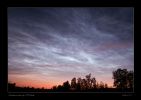
NoctilucentClouds.jpgNoctilucent Clouds over Sweden86 visiteCaption NASA:"Sometimes it's night on the ground but day in the air. As the Earth rotates to eclipse the Sun, sunset rises up from the ground.
Therefore, at sunset on the ground, sunlight still shines on clouds above. Under usual circumstances, a pretty sunset might be visible, but unusual noctilucent clouds float so high up they can be seen well after dark.
Pictured above last month (September 2007), a network of noctilucent clouds cast a colorful but eerie glow after dusk near Vallentuna, Sweden.
Although noctilucent clouds are thought to be composed of small ice-coated particles, much remains unknown about them. Satellites launched to help study these clouds includes Sweden's Odin and NASA's AIM.
Recent evidence indicates that at least some noctilucent clouds result from freezing water exhaust from Space Shuttles".MareKromiumOtt 29, 2007
|
|

Puzzle-Cook.jpgOne piece after another...80 visite"...Ed alla fine non restano che ricordi.
Sorrisi, lacrime, sensazioni di caldo e di freddo.
L'ultimo - e più prezioso - patrimonio che non potrò mai lasciare in eredità: la mia Memoria…"
P.C. Floegers - "Conversations for Tomorrow"MareKromiumOtt 26, 2007
|
|

MilkyWayRoad.jpgThe "Milky Way Road"78 visite"...Dominus dedit, Dominus abstulit..."
(Giobbe - 1, 21)
"...Dio diede, Dio tolse..."MareKromiumOtt 20, 2007
|
|
| 496 immagini su 42 pagina(e) |
 |
|
|
|
|
25 | |
|
|
|
|








