| Ultimi arrivi - Mariner, Viking & MGS's Maps & Mars in the '70s |

ZM-Viking2-Rocks.3jpg.jpgViking's unusual rocks (2)223 visiteAllora: stiamo guardando delle 'rovine' o dei 'ventifacts'? Voi che cosa ne pensate?Mag 01, 2005
|
|

ZM-Rocks-p98b.jpgViking's unusual rocks (1)216 visiteEd ecco un altro frame che ci mostra tutti gli altri "artifacts" (o "ventifacts"?!?) che Eredità Cydonia avrebbe trovato negli archivi NASA/Viking "segreti" (la "Owl Head", il "Cement Artifact", il "Broken Dome" etc.).
Potete verificare Voi stessi anche in questo caso: quanto si vede in questo frame lo ritroverete nel primo dei tre frames Eredità Cydonia pubblicati nella Sezione "Mars and His Moons".Mag 01, 2005
|
|

ZL-Viking2-Rocks.2jpg.jpgHorizon (4)179 visiteIl "ventifact" - un bellissimo neologismo 'made in NASA' creato per indicare le rocce che acquisiscono fattezze tali da renderle simili a manufatti grazie all'azione del vento - che viene indicato nel frame precedente è, a nostro parere, lo stesso 'oggetto' che il Gruppo Italiano "Eredità Cydonia" ha chiamato "The Hat" (e cioè il 'cappello'). Provate a verificare Voi stessi: dovete guardare il secondo frame Eredità Cydonia che abbiamo pubblicato nella Sezione "Mars and His Moons".
Per Vostra informazione, questi frames non li abbiamo rintracciati dentro Archivi NASA 'segreti' (come invece raccontano di aver fatto i signori di Eredità Cydonia), bensì nel Sito "SP-425 - The Martian Landscape" by the Viking Lander Imaging Team.
Ogni ulteriore commento è veramente superfluo.Mag 01, 2005
|
|

ZI-Viking2-Rocks.jpgHorizon (3)149 visiteCommenti originali:"The following frames are 2 views of the same area in front of the spacecraft looking toward the North to Northeast, both taken with camera 2 but at different times of day. Linear accumulations of fine grained sediment have planar surfaces that are sharply delineated by shadow and reflected light. The small pyramidal rock in the lower left is a good example of a ventifact, a rock with multiple facets eroded by the wind".Mag 01, 2005
|
|
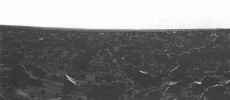
ZI-Viking2-DarkHorizon.jpgHorizon (2)115 visitevedi il commento al frame precedenteMag 01, 2005
|
|

ZI-Viking2-BrightHorizon.jpgHorizon (1)160 visiteUna serie di frames panoramici ripresi dal Viking 2 Lander i quali, attraverso riprese effettuate in diverse ore del giorno ed usando diversi filtri/colore, ci mostrano i dintorni della Navicella (anzi, sarebbe forse più corretto dire i dintorni del 'minilaboratorio'). Prima viene inquadrato l'orizzonte più lontano, poi le rocce che circondano il Lander e che, da svariati punti di vista, ci ricordano le rocce che vediamo quotidianamente sulle Columbia Hills.
Commenti originali:"These pictures show horizon ridges photographed at 3 different times of the day. Predictably, change in illumination results in different reflections from the broad slopes. Only by reference to all the available pictures a viewer can gain a true impression of the complex detail in the distance".Mag 01, 2005
|
|

ZD-VikingLander1-p131b.jpgFrom the "Viking Archive" - Viking 1: Solar Eclypse on Mars147 visitePossibly the most unusual of all Viking Lander pictures records the passage of Phobos' shadow during a solar eclipse. On Earth the apparent size of the Moon is exactly the same as that of the much larger but more distant Sun. Consequently, direct sunlight is completely blocked out during a total solar eclipse. On Mars, Phobos covers only 1/4 of the solar disc. However, passage of the penumbral shadow causes a general drop in light level that is instrumentally detectable. This frame is a repeated line scan image looking back across Viking Lander 1. The colors have been distorted purposely to enhance detail. The blue and white horizontal stripes correspond to test chart patches. The brownish stripes in the middle represent the martian surface visible above the spacecraft. Note a decrease in light levels in the sky midway through the imaging event. The darkening, caused by the passage of the penumbral shadow of Phobos, is present over approx. 100 vertical lines. Moving at about 2 Km/sec, the shadow took about 20 sec to pass over the Lander.Apr 26, 2005
|
|

ZD-VikingLander1-landscape-2-12d08x.jpgFrom the "Viking Archive" - Viking 1: full panorama (2)205 visiteprosecuzione del panorama iniziato con il frame precedente.Apr 26, 2005
|
|

ZD-VikingLander1-landscape-1-12d08x.jpgFrom the "Viking Archive" - Viking 1: full panorama (1)247 visiteQuesto frame, al pari dei seguenti, fa parte degli Archivi NASA relativi alle Missioni Viking Lander 1 e 2.
Si tratta, come potrete constatare Voi stessi, di frames molto vecchi (il Viking Lander 1 arrivò il 20 Luglio 1976 ed il Viking Lander 2 il 7 Agosto dello stesso anno), elaborati in 'colori realistici' e senza troppi artifici ultra-tecnologici, come invece avviene oggi con i frames che ci giungono dai Rover Spirit ed Opportunity.
I risultati di queste elaborazioni - forse 'artigianali', ma sempre "Made by NASA" - sono, ove ragguagliati ai frames a colori che ci raccontano delle Aree di Gusev Crater e di Meridiani Planum, del tutto strabilianti. Quello che emerge dai color-frames Viking è un Marte diverso: non sapremmo dire se si tratta di un Marte più vero o più falso di quello che ci viene 'proposto' oggi.
E' un Marte diverso e basta.
Guardatelo e studiatelo: gli argomenti per avviare discussioni e dibattiti, sono abbondanti...Apr 26, 2005
|
|

ZH-Viking2-vlfmos21.jpgFrom the "Viking Archive" - Viking 2: full panorama161 visiteCaption NASA originale:"The Viking Lander 2 site in Utopia Planitia has more and larger blocks of stone than does the Viking Lander 1 site in Chryse Planitia. The stones are probably ejecta from impact craters near the Lander 2 site. Many of the rocks are angular and are thought to be only slightly altered by the action of wind and other forms of erosion. Drifts of sand and dust are smaller and less noticeable at the Lander 2 site. The overall red/orange coloring of the Martian terrain is due to the presence of oxidized iron in the regolith. The pink color of the sky is caused by extremely fine dust that is suspended in Mars' thin atmosphere".
Nota: 1) il cielo, in questa immagine in "almost true colors", noi lo vediamo verdastro e non rosa; 2) se l'atmosfera Marziana fosse davvero sottilissima, il cielo dovrebbe apparire MOLTO più SCURO di quanto invece non appare nelle immagini (rosso/arancio scuro nelle ore del giorno pieno - e cioè fra le 10 e le 15 MLT -, azzurro scuro con il "dimming").Apr 26, 2005
|
|

ZD-I-Viking1-12a168corr.jpgFrom the "Viking Archive" - Viking Lander 1: Spacecraft's Features and Surroundings174 visitenessun commentoApr 26, 2005
|
|

ZF-I-Viking2-22a158corr-LF.jpgFrom the "Viking Archive" - Viking 2: antenna, sky and horizon (natural colors; credits: NASA)166 visitenessun commentoApr 26, 2005
|
|
| 115 immagini su 10 pagina(e) |
 |
|
|
|
|
|
8 | |
|








