| Ultimi arrivi - The Sun: just a star, like many others... |
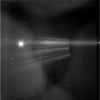
The Sun-W00011347.jpgThe Sun from Cassini66 visiteOriginal caption:"W00011347.jpg was taken on October 23, 2005 and received on Earth October 24, 2005. The camera was pointing toward SATURN-E-RING at approximately 6.847.402 kilometers away and the image was taken using the CL1 and IRP0 filters. This image has not been validated or calibrated".
Secondo noi questa è un'immagine del Sole e non un'istantanea relativa all'Anello E di Saturno. Un'immagine ottenuta casualmente: uno scatto nel buio, mentre una delle fotocamere di Cassini "cercava" l'Anello E.Ott 25, 2005
|
|

ZZ-ZZ-Annular_seip_big.jpgThe "Annular Eclipse" of October, 3rd, 2005 (HR)71 visiteDa "NASA - Picture of the Day" del 5 Ottobre 2005:"On Monday, part of the Sun went missing. The missing piece was no cause for concern because the Moon was only momentarily in the way. The event was not a total eclipse of the Sun for any Earth-bound sky enthusiast but rather, at best, an annular eclipse, where the Moon blocked most of the Sun. Because of the relatively large distance to the Moon during this Earth-Moon-Sun alignment, the Moon did not have a large enough angular size to block the entire Sun. Those who witnessed the solar eclipse from a narrow path through Spain and Africa, however, were lucky enough to see the coveted Ring of Fire, a dark Moon completely surrounded by the brilliant light of the distant Sun. Pictured above is a Ring of Fire captured two days ago in unusually HR above Spain. The resulting image shows details of the granular solar surface as well as many prominences around the Sun".Ott 05, 2005
|
|
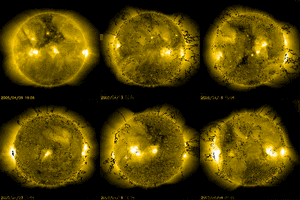
00-The Sun.gifThe Sun260 visite"It is in the Human Nature", qualcuno ha scritto, "to take everything for granted...Until you loose it".
Anche il Sole fa parte di quello che "diamo per scontato", come ovvio, ed è per questo che Vi offriamo questo piccolo filmato GIF - opera del Dr A. Feltri: per ricordare e ricordarVi grazie a 'che cosa', oggi, sin dal momento della nostra nascita e sino all'istante della nostra morte, possiamo dire di essere vivi e, quindi, possiamo vedere, respirare, avere esperienze, fare delle scelte, evolvere o regredire, ridere o piangere etc.
E' il Sole: la nostra Stella, ma solo una delle tante...Set 09, 2005
|
|

The Sun from SOHO.jpgAnagliph of the Sun86 visitenessun commentoSet 01, 2005
|
|

Coronal Loops-TRACE.jpgCoronal loops84 visiteDa "NASA - Picture of the Day" del 14 Agosto 2005:"Why is the Corona of the Sun so hot? Extending above the photosphere or visible surface of the Sun, the faint, tenuous Solar Corona can't be easily seen from Earth, but it is measured to be hundreds of times hotter than the photosphere itself. Astronomers have long sought the source of the Corona's heat in magnetic fields which loft monstrous loops of solar plasma above the photosphere. Detailed observations of coronal loops from the orbiting TRACE satellite are pointing more closely to the unidentified energy source. Recorded in extreme ultraviolet light, this and other TRACE images indicate that significant heating occurs low in the corona, near the bases of the loops as they emerge from and return to the solar surface. This tantalizing TRACE image shows clusters of the majestic, hot coronal loops which span 30 or more times the diameter of planet Earth".Ago 14, 2005
|
|
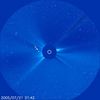
Sun-Saturn-IMG001612-br500.jpgSaturn's "superior conjunction"69 visiteIn this SOHO image taken July 21, 2005, the Sun is represented by the white circle in the center. Saturn is the bright object to the left of the Sun. Interestingly, the streak accompanying Saturn is not the rings but a distortion caused by Saturn's brightness. Saturn is approaching "superior conjunction," that is, it will be almost directly behind the Sun from Earth - thus the Cassini spacecraft, in orbit around Saturn, will not be able to send or receive transmissions normally. Regular science data collection has been temporarily suspended.
As Cassini passes closest by the limb of the Sun on July 24 PDT, all the communications will be impossible because of the Sun's radio noise. The spacecraft will regain full communication with Earth on July 27, once again returning Saturn science data. In the meantime, controllers are sending approximately 100 commands per day to test communication status. Cassini radio scientists are taking advantage of this opportunity to study the Sun's corona from its effects on the radio signals that reach Earth.
SOHO (Solar and Heliospheric Observatory Satellite) orbits the Sun parked in one of the five gravitational-neutral spots, called Lagrange Points. This specific spot, called L1, stays in the same place relative to the Sun and the Earth, offering a continuously uninterrupted view of the Sun.
Lug 23, 2005
|
|

ZZ-ZZ-HybridEclypse-Heinsius_Panama_tse2005_1.jpgAn unusual "Hybrid Solar Eclipse" (2)76 visiteDa "NASA - Picture of the Day" del 6 Maggio 2005:"(...) But for Stephan Heinsius, near the end of the shadow track at Penonome Airfield, Panama, the Moon's apparent size had shrunk enough to create an anular eclipse, showing a complete anulus of the Sun's bright disk as a dramatic "Ring of Fire".
(...) How rare is such a Hybrid Eclipse?
Calculations show that during the 21st century just 3,1% (7 out of 224) of Solar Eclipses are hybrid while hybrids comprise about 5% of all Solar Eclipses over the period from 2.000 BC to AD 4.000". Mag 06, 2005
|
|

ZZ-ZZ-HybridEclypse-Espenak_tse2005_1.jpgAn unusual "Hybrid Solar Eclipse" (1)70 visiteDa "NASA - Picture of the Day" del 6 Maggio 2005:"April's spectacular geocentric celestial event was a rare Hybrid Eclipse of the Sun - such as a total or an annular eclipse could be seen depending on the Observer's location.
For Fred Espenak, aboard a gently swaying ship within the middle of the Moon's shadow track about 2.200 Km west of the Galapagos, the eclipse was total, the lunar silhouette exactly covering the bright solar disk for a few brief moments.
His camera captured a picture of totality revealing the extensive Solar Corona and prominences rising above the Sun's edge". Mag 06, 2005
|
|

ZZ-The Sun.jpgAutumnal Equinox 199469 visiteDa "NASA - Picture of the Day" del 20 Marzo 2005:"Today, the Sun crosses the celestial equator heading North, marking the Vernal Equinox - such as the 1st day of Spring in the Northern Hemisphere and Autumn in the south. Equinox means equal night and with the Sun on the celestial equator, Earthlings will experience 12 hours of daylight and 12 hours of darkness. For those in the Northern Hemisphere, the days will continue to grow longer with the Sun marching higher in the sky as Summer approaches. A few weeks after the northern Autumnal Equinox of 1994, the Crew of the Shuttle Endeavor recorded this image of the Sun poised above the Earth's limb. Glare illuminates Endeavor's vertical tail (pointing toward the Earth) along with radar equipment in the payload bay. The space shuttle is expected to return to flight later this year with the launch of STS-114".Mar 20, 2005
|
|

The Solar Spectrum_noao.jpgThe Solar Spectrum and the "missing colors"...70 visiteDa "NASA - Picture of the Day" del 27 Febbraio 2005:"It is still not known why the Sun's light is missing some colors. Shown above are all the visible colors of the Sun, produced by passing the Sun's light through a prism-like device. The above spectrum was created at the McMath-Pierce Solar Observatory and shows, first off, that although our yellow-appearing Sun emits light of nearly every color, it does indeed appear brightest in yellow-green light. The dark patches in the above spectrum arise from gas at or above the Sun's surface absorbing sunlight emitted below. Since different types of gas absorb different colors of light, it is possible to determine what gasses compose the Sun. Helium, for example, was first discovered in 1870 on a solar spectrum and only later found here on Earth. Today, the majority of spectral absorption lines have been identified - but not all".Feb 27, 2005
|
|

ZZ-PIA00450.jpgThe Sun from 4 Billion Miles - Voyager 283 visiteCaption NASA originale:"This image of the Sun was taken by the Voyager 1 on Feb. 14, 1990, when it was approximately 32° above the plane of the ecliptic and at a slant-range distance of approximately 4BM. It is the first - and may be the only - time that we will ever see our Solar System from such a vantage point. This image is a portion of a wide-angle image containing the Sun and the region of space where the Earth and Venus were at the time. The wide-angle was taken with the camera's darkest filter (a methane absorption band) and the shortest possible exposure (5/1000 sec.) to avoid saturating the camera's vidicon tube with scattered sunlight. The Sun is not large in the sky as seen from Voyager's perspective at the edge of the Solar System but is still 8M times brighter than the brightest star in Earth's sky: Sirius.
The result of the brightness is a bright burned out image with multiple reflections from the optics in the camera. The "rays" around the Sun are just a diffraction effect".Feb 16, 2005
|
|

A - The Sun.jpgThe Sun (and a "Sun-Grazer") from Soho81 visiteSun Data and Statistics
Mass (kg) = 1.989e+30
Mass (Earth = 1) = 332,830
Equatorial radius = 695.000 Km
Equatorial radius (Earth = 1) = 108,97
Mean density (gm/cm^3) = 1,410
Rotational period (days) = from 25 up to 36
Escape velocity = 618,02 Km per second
Luminosity (ergs/sec) = 3.827e33
Magnitude (Vo) = - 26,8
Mean surface temperature = 6.000°C
Age (billion years) = approx. 4.5
Principal chemistry: Hydrogen 92,1%; Helium 7,8%; Oxygen 0,061%; Carbon 0,030%; Nitrogen 0,0084%; Neon 0,0076%; Iron 0,0037%; Silicon 0,0031%; Magnesium 0,0024%; Sulfur 0,0015%; others 0,0015%Dic 15, 2004
|
|
| 144 immagini su 12 pagina(e) |
 |
|
|
|
|
|
|
9 | |
|
|








