| Ultimi arrivi - The Sun: just a star, like many others... |

Sunspot-reversed-1.jpgSunspot-905: a sign of an incoming new "Solar Cycle"? (2)68 visiteDa "NASA - Picture of the Day" del 30 Agosto 2006:"An indicator that the Sun's magnetic field is reversing is the appearance of sunspots with the reverse magnetic polarity.
A few weeks ago, one small candidate "reverse sunspot" was sited but faded quickly. Now, however, a larger sunspot with negative polarity is being tracked. This sunspot, numbered 905, appears as the unusual white spot in the above magnetic image of the Sun taken with the SOHO spacecraft a few days ago. In the past few days, Sunspot-905 has actually begun to break apart and might also become the source of coronal mass ejections and explosive solar flares.
Solar astronomers predict that the coming Solar Maximum will be unusually active".Ago 30, 2006
|
|
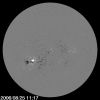
Sunspot-reversed-0.jpgSunspot-905: a sign of an incoming new "Solar Cycle"? (1)75 visiteDa "NASA - Picture of the Day" del 30 Agosto 2006:"Why is sunspot-905 backwards? Perhaps it is a key marker for the beginning of a new Magnetic Cycle on our Sun.
Every 11 years, our Sun goes through a Magnetic Cycle, at the end of which its overall magnetic orientation is reversed. An 11-year Solar Cycle has been observed for hundreds of years by noting peaks and valleys in the average number of sunspots.
Just now, the Sun is near Solar Minimum, and likely to start a long progression toward the most active time, called Solar Maximum, in about 5,5 years".Ago 30, 2006
|
|

Solar Prominence.jpgSolar "Blow"...78 visiteDa "NASA - Picture of the Day" del 7 Agosto 2006:"Our Sun is still very active. In the year 2000, our Sun went though Solar Maximum, the time in its 11-year cycle where the most sunspots and explosive activities occur. Sunspots, the Solar Cycle, and Solar Prominences are all caused by the Sun's changing magnetic field.
Pictured above is a solar prominence that erupted in 2002, July, throwing electrons and ions out into the Solar System.
The above image was taken in the ultraviolet light emitted by a specific type of Ionized Helium, a common element on the Sun. Particularly hot areas appear in white, while relatively cool areas appear in red. Our Sun should gradually quiet down until Solar Minimum occurs, and the Sun is most quiet. No one can precisely predict when Solar Minimum will occur, although some signs indicate that it has started already".Ago 07, 2006
|
|

UV Sun.jpgUltraviolet Sun70 visiteDa "NASA - Picture of the Day" del 10 Luglio 2006:"Is this our Sun?
Yes. Even on a normal day, our Sun is sizzling ball of seething hot gas. Unpredictably, regions of strong and tangled magnetic fields arise, causing sunspots and bright active regions. The Sun's surface bubbles as hot Hydrogen gas streams along looping magnetic fields. These active regions channel gas along magnetic loops, usually falling back but sometimes escaping into the Solar Corona or out into space as the solar wind. Pictured above is our Sun in three colors of ultraviolet light. Since only active regions emit significant amounts of energetic ultraviolet light, most of the Sun appears dark. The colorful portions glow spectacularly, pinpointing the Sun's hottest and most violent regions. Although the Sun is constantly changing, the rate of visible light it emits has been relatively stable over the past 5 BY, allowing life to emerge on Earth".Lug 10, 2006
|
|

Sunspot.jpgSunspots' Region 87594 visiteCaption NASA originale (da "NASA - Picture of the Day" del 2 Maggio 2006):"An unusually active Sunspot Region is now crossing the Sun.
The Region, numbered 875, is larger than the Earth and has produced several Solar Flares over the past week. It should take a few more days for Sunspot 875 to finish crossing the solar disk. The above image of the Sun was taken last Wednesday in a very specific color of red light to bring up detail. Sunspot 875, in the midst of erupting a large "Class C" Solar Flare, can be seen as the dark region to the upper right. In the above image, relatively cool regions appear dark while hot regions appear bright.
On the far left, solar prominences are visible hovering above the Sun's surface".Mag 02, 2006
|
|

Solar Flare.jpgLoops over the Sun72 visiteCaption originale:"How can gas float above the Sun? Twisted magnetic fields arching from the Solar Surface can trap ionized gas, suspending it in huge looping structures. These majestic plasma arches are seen as prominences above the Solar Limb. In September 1999, this dramatic and detailed image was recorded by the EIT experiment on board the space-based SOHO observatory in the light emitted by ionized Helium. It shows hot plasma escaping into space as a fiery prominence breaks free from magnetic confinement a hundred thousand kilometers above the Sun. These awesome events bear watching as they can affect communications and power systems over 100 MKM away on Planet Earth".Apr 16, 2006
|
|

Solar Corona.jpgThe 2006 Total Solar Eclipse: the Solar Corona64 visiteDa "NASA - Picture of the Day", del 7 Aprile 2006:"During a total Solar Eclipse, the Sun's extensive outer atmosphere (or Corona) is an awesome and inspirational sight. The subtle shades and shimmering features of the corona that engage the eye span a brightness range of over 10.000 to 1, making them notoriously difficult to capture in a single picture. But this composite of 33 digital images ranging in exposure time from 1/8000 to 1/5th of second comes very close to revealing the crown of the Sun in all its glory. The telescopic views were recorded from Side, Turkey, during the March 29, 2006, Solar Eclipse, a geocentric celestial event that was widely seen under nearly ideal conditions.
The composite also captures a pinkish prominence extending just beyond the upper edge of the eclipsed Sun".Apr 07, 2006
|
|

Solar Eclipse 2006.jpgFrom Space, from Earth...70 visiteDa "NASA - Picture of the Day" del 31 Marzo 2006:"Neither rain, nor snow, nor dark of night can keep the space-based SOlar Heliospheric Observatory (SOHO) from watching the Sun. In fact, from its vantage point 150 MKM sunward of planet Earth, SOHO's cameras can always monitor the Sun's Outer Atmosphere, or Corona.
But only during a total solar eclipse can earth-based observers see the lovely coronal streamers and structures - such as when the Moon briefly blocks the overwhelmingly bright solar surface.
In this composite view, SOHO's uninterrupted view of the Solar Corona above the Solar Photosphere (center) and Corona far beyond the Sun's disk, are shown in orange hues. The middle, donut-shaped region is the Corona as recorded by the Williams College Eclipse Expedition to Kastelorizo Island, Greece during the March 29th, 2006 total solar eclipse.
Merging ground and space-based views allows astronomers to trace features in the Corona that reach from just above the Sun's surface into the Solar Wind".Mar 31, 2006
|
|

Solar Eclypse 2006-tse2006_ayiomamitis_f.jpgThe "Diamond Ring"70 visiteDa "NASA - Picture of the Day" del 30 Marzo 2006:"The track of totality for the first solar eclipse of 2006 began early yesterday on the East coast of Brazil and ended half a world away at sunset in Western Mongolia. In between, the shadow of the Moon crossed the Atlantic Ocean, Northern Africa, central Asia and so came for a moment to the small Greek island of Kastelorizo in the Eastern Aegean.
Astronomer Anthony Ayiomamitis reports that the islanders and many eclipse-watching visitors were indeed treated to an inspiring display of the beautiful Solar Corona as totality lasted about 3 minutes.
As the total phase of the eclipse ended, he was able to capture this striking "Diamond Ring" image. In it, the first rays of sunlight shining through edge-on lunar valleys create the fleeting appearance of glistening diamonds set in a bright ring around the Moon's silhouette".Mar 30, 2006
|
|

The Sun-P-021-01450.jpgJapanese Sun68 visitenessun commentoMar 25, 2006
|
|
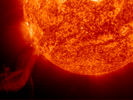
SunFlame-Soho.jpgSolar Prominence75 visiteCaption NASA originale:"What happened to the Sun? Nothing very unusual: the strange-looking solar appendage on the lower left is actually just a spectacular looking version of a common solar prominence. A solar prominence is a cloud of solar gas held above the Sun's surface by the Sun's magnetic field. Pictured above in 2002 October, NASA's Sun-orbiting SOHO spacecraft imaged an impressively large prominence hovering over the surface, informally dubbed a flame. Over 40 Earths could line up along the vast length of the fireless flame of hovering hot gas. A quiescent prominence typically lasts about a month, and may erupt in a Coronal Mass Ejection (CME) expelling hot gas into the Solar System. Although somehow related to the Sun's changing magnetic field, the energy mechanism that creates and sustains a Solar prominence is still a topic of research".Nov 09, 2005
|
|
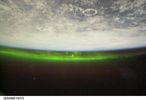
Coronal Aurora - ISS.jpgCoronal Aurora from Space79 visiteOriginal caption:"From the ground, spectacular auroras seem to dance high above. But the International Space Station (ISS) orbits at nearly the same height as many auroras, sometimes passing over them, and sometimes right through them. Still, the auroral electron and proton streams pose no direct danger to the ISS. In 2003, ISS Science Officer Don Pettit captured the green aurora, pictured above in a digitally sharpened image. From orbit, Pettit reported that changing auroras appeared to crawl around like giant green amoebas. Over 300 Km below, the Manicouagan Impact Crater can be seen in northern Canada, planet Earth".Nov 05, 2005
|
|
| 144 immagini su 12 pagina(e) |
 |
|
|
|
|
|
8 | |
|
|
|








