| Ultimi arrivi - The Sun: just a star, like many others... |

The_Sun-PIA09328.jpgThe North Pole of the Sun73 visiteNASA's Solar TErrestrial RElations Observatory (STEREO) satellites have provided the first three-dimensional images of the Sun. For the first time, scientists will be able to see structures in the Sun's atmosphere in 3D.
The new view will greatly aid scientists' ability to understand solar physics and thereby improve space weather forecasting.
The EUVI imager is sensitive to wavelengths of light in the extreme ultraviolet portion of the spectrum.
EUVI bands at wavelengths of 304, 171 and 195 Angstroms have been mapped to the red blue and green visible portion of the spectrum; and processed to emphasize the temperature difference of the solar material.
In this picture, a large spicule can be seen. MareKromiumMag 23, 2007
|
|

The_Sun_in_3D.jpg3-D Sun72 visiteCaption NASA:"What does the Sun look like in all three spatial dimensions? To find out, NASA launched two STEREO satellites to perceive three dimensions on the Sun much like two eyes allow humans to perceive three dimensions on the Earth.
Such a perspective is designed to allow new insight into the surface of the rapidly changing Sun, allowing humans to better understand and predict things like Coronal Mass Ejections and solar flares that affect the Earth as well as satellites and astronauts orbiting the Earth. Pictured above are two simultaneous images of the Sun taken by STEREO A and STEREO B, now digitally combined to give one of the first 3-D pictures of the Sun ever taken. To fully appreciate the image, one should view it with 3-D red-blue glasses. The teeming and bubbling solar surface can be seen sporting a prominent solar prominence near the top of the image".MareKromiumApr 24, 2007
|
|

Sunspot~0.jpgAn Active Sunspot Viewed Sideways79 visiteCaption NASA:"Why are there dark spots on the Sun? Although noted for thousands of years, sunspots have been known for decades to be regions of the Sun that are slightly depressed and cooled by the Sun's complex and changing Magnetic Field.
High resolution pictures like the above image from Japan's new Sun-watching Hinode satellite, however, are helping to increase modern understanding. In the center of the above image is a sunspot, but not seen in the usual orientation - this sunspot is seen sideways.
Of particular interest is erupting glowing gas that shows how the Sun's Magnetic Field comes right out of the spot center, but curves markedly around the spot edges. Better understanding of how the Sun ejects particles into space may result in more accurate predictions of solar storms that affect satellites, astronauts and even power grids on Earth".Apr 02, 2007
|
|

The_Sun_from_SOHO_-_Coronal_Mass_Ejection.jpgCoronal Mass Ejection66 visiteCaption NASA originale:"What's happening to our Sun? Another Coronal Mass Ejection (CME)!
The Sun-orbiting SOHO spacecraft has imaged many erupting filaments lifting off the active solar surface and blasting enormous bubbles of magnetic plasma into space. Direct light from the sun is blocked in the inner part of the above image, taken in 2002, and replaced by a simultaneous image of the Sun in ultraviolet light.
The field of view extends over 2 MKM from the Solar Surface. While hints of these explosive events, called Coronal Mass Ejections or CMEs, were discovered by spacecraft in the early 70s, this dramatic image is part of a detailed record of this CME's development from the presently operating SOHO spacecraft.
Near the minimum of the Solar Activity Cycle CMEs occur about once a week, but near solar maximum rates of two or more per day are typical. Strong CMEs may profoundly influence space weather. Those directed toward our Planet can have serious effects". Feb 06, 2007
|
|
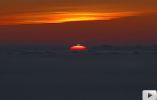
Green-Sun.jpgGreen flash from Italy72 visiteCaption originale, da "NASA - Picture of the Day" del 29 Gennaio 2007:"How could the Sun turn green? Difficult to observe, the momentary green flash above the rising or setting Sun has been documented as a phenomenon caused by the atmospheric bending or refraction of sunlight.
Like a weak prism, the Earth's atmosphere breaks white sunlight into colors, bending red colors slightly and green and blue colors through increasingly larger angles.
When the sky is (VERY) clear, a green flash just above the Sun's edge can sometimes be seen for a second or so, when the sun is close to a distant horizon. Still, from a site atop Mt. Autore (altitude 1.850 mt) in Italy, astrophotographer Danilo Pivato captured this dramatic green flash movie. The time between frames varies from over one minute in the beginning to about one second as the flash becomes visible".Gen 29, 2007
|
|

Sun_Shock-Wave.gifThe "Moreton Wave"76 visiteCaption NASA originale:"Tsunamis this large don't happen on Earth. One week ago (Dec. 2006), a large solar flare from an Earth-sized sunspot produced a tsunami-type shock wave that was spectacular even for the Sun. Pictured above, the tsunami wave was captured moving out from active region AR 10930 by the Optical Solar Patrol Network (OSPAN) telescope in New Mexico, USA. The resulting shock wave, known technically as a Moreton Wave, compressed and heated up gasses including Hydrogen in the photosphere of the Sun, causing a momentarily brighter glow.
The above image was taken in a very specific red color emitted exclusively by hydrogen gas. The rampaging tsunami took out some active filaments on the Sun, although many re-established themselves later.
The solar tsunami spread at nearly 1 MKM per hour, and circled the entire Sun in a matter of minutes".MareKromiumDic 13, 2006
|
|

The_Sun_and_Mercury.jpgThe Sun and Mercury76 visiteEnjoying the transit of Mercury from Dallas, Texas, astronomer Phil Jones recorded this detailed image of the Sun. Along with a silhouette of the innermost Planet, a network of cells and dark filaments can be seen against a bright solar disk with spicules and prominences along the Sun's edge. The composited image was taken through a telescope equiped with an H-alpha filter that narrowly transmits only the red light from Hydrogen atoms. Such images emphasize the Solar Chromosphere, the region of the Sun's atmosphere immediately above its Photosphere or normally visible surface. Left of center, the tiny disk of Mercury seems to be imitating a small sunspot that looks a little too round. But in H-alpha pictures, sunspot regions are usually dominated by bright splotches (called plages) on the Solar Chromosphere.Nov 10, 2006
|
|

Earth&Sun-001-magfieldG_b.jpgMagnetic Fields... (2)65 visitenessun commentoOtt 22, 2006
|
|

Earth&Sun-000-sunearth_01G.jpgMagnetic Fields... (1)83 visitenessun commentoOtt 22, 2006
|
|

The Sun-UvcseitG_c.jpgOur "restless" Sun... (12)76 visitenessun commentoOtt 02, 2006
|
|

The Sun-TricutG-1.jpgOur "restless" Sun... (11)68 visitenesun commentoOtt 02, 2006
|
|

The Sun-Suncombo1G.jpgOur "restless" Sun... (10)67 visitenessun commentoOtt 02, 2006
|
|
| 144 immagini su 12 pagina(e) |
 |
|
|
|
6 | |
|
|
|
|
|








