| Ultimi arrivi - The Sun: just a star, like many others... |

Sunspot-10982.jpgSunspot 1098269 visiteDa "NASA - Picture of the Day", del giorno 6 Febbraio 2008:"A new Solar Cycle has begun on our Sun. Over the past year, the Sun's Magnetic Field has reset and now a new 11 year period is beginning.
Pictured above in a specific color of light emitted by Hydrogen is Sunspot 10982, one of the first sunspots of the new Solar Cycle. The two dark lines visible just above and to either side of the bright sunspot are cool filaments held aloft by the Sun's Magnetic Field. Hot and cold regions are shown as regions of relative light and dark, respectively.
A Solar Cycle is caused by the changing Magnetic Field, and varies from Solar Maximum (when sunspots, coronal mass ejections and flare phenomena are most frequent), to Solar Minimum (meaning when such activity is relatively infrequent).
Solar Minima occurred in 1996 and 2007, while the last Solar Maximum occurred in 2001 (...)".MareKromiumFeb 06, 2008
|
|

Sunjet.jpgA Jet from the Sun90 visiteCaption NASA:"What powers the Solar Wind? Our Sun is known to emit a powerful wind of particles with gusts that can even affect astronauts and satellites orbiting Earth. The cause of the Solar Wind has been debated for decades but is thought to be rooted in Alfvén Waves generated by the ever changing Magnetic Field of the Sun.
Newly released images from the Japanese Hinode satellite appear to bolster this hypothesis, imaging an average of 240 daily plasma jets that are excellent candidates to fuel the outwardly moving Alfvén Waves.
The jets and waves are themselves ultimately created by magnetic reconnection events, rapid events where lines of constant magnetic field suddenly move extremely rapidly, dragging electrons and protons along with them.
On the image left, one such jet is visible in X-ray light. Bright spots show relatively energetic regions elsewhere on the Sun".MareKromiumDic 10, 2007
|
|

Solar-Cycle.jpgA "Full Solar Cycle", from SOHO (extreme UV Light)72 visiteCaption NASA:"Every 11 years, our Sun goes through a Solar Cycle.
A complete Solar Cycle has now been imaged by the Sun-orbiting SOHO Spacecraft, celebrating the 12th anniversary of its launch yesterday (December, 12th, 2007).
A Solar Cycle is caused by the changing Magnetic Field of the Sun, and varies from Solar Maximum, when Sunspot, Coronal Mass Ejection, and Flare phenomena are most frequent, to Solar Minimum, when such activity is relatively infrequent.
Solar Minimums occurred in 1996 and 2007, while the last Solar Maximum occurred in 2001.
Pictured above is a SOHO image of the Sun in extreme ultraviolet light for each year of the last Solar Cycle, with images picked to illustrate the relative activity of the Sun".MareKromiumDic 03, 2007
|
|

The_Sun-Coronal_Hole.jpgCoronal Hole68 visiteCaption NASA:"The dark expanse below the Equator of the Sun is a Coronal Hole, such as a Low Density Region extending above the surface, where the Solar Magnetic Field opens freely into interplanetary space.
Shown in false color, the picture was recorded on September 19th, 2007, in Extreme Ultraviolet Light by the EIT instrument onboard the space-based SOHO observatory. Studied extensively from space since the 1960s in ultraviolet and x-ray light, Coronal Holes are known to be the source of the high-speed Solar Wind, atoms and electrons that flow outward along the open magnetic field lines.
The Solar Wind streaming from this coronal hole triggered colorful auroral displays on planet Earth begining late last week, enjoyed by spaceweather watchers at high latitudes".MareKromiumSet 27, 2007
|
|

The_Sun.jpgNever too close, never too far...65 visiteCaption NASA:"When is the Sun most distant from Earth? It happened again just this past weekend.
A common misconception is that the Sun is most distant during the Winter, when it's the coldest. In truth, however, the seasonal temperatures are more greatly influenced by the number of daylight hours and how high the Sun rises.
For example, during Northern Winter, the tilt of the Earth causes the Sun to be above the horizon for a shorter time and remain lower in the sky than in Northern Summer. The picture compares the relative size of the Sun during Earth's closest approach in January (Northern Winter) on the left, and in July (Northern Summer) on the right. The angular size of the Sun is noticeably smaller during July, when it is farther away. If the Earth's orbit was perfectly circular, the Sun would always appear to be the same size.
These two solar images were taken from Spain during 2006, but the same effect can be seen in any year from any Earth-bound location".MareKromiumLug 09, 2007
|
|

The_Sun-PIA09324.jpgCloser View of the Equatorial Region of the Sun (March 24, 2007)64 visitenessun commentoMareKromiumMag 23, 2007
|
|

The_Sun-PIA09322.jpgClose-up View of an Active Region of the Sun (March 23, 2007)81 visitenessun commentoMareKromiumMag 23, 2007
|
|

The_Sun-PIA09321.jpgDisk Image of the Sun, March 26, 2007 (Anaglyph)66 visitenessun commentoMareKromiumMag 23, 2007
|
|

The_Sun-PIA09320.jpgFull Disk Image of the Sun (March 26, 2007)81 visitenessun commentoMareKromiumMag 23, 2007
|
|

The_Sun-PIA09332.jpgLeft Limb of North Pole of the Sun (March 20, 2007)78 visitenessun commentoMareKromiumMag 23, 2007
|
|
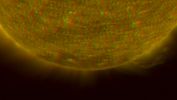
The_Sun-PIA09331.jpgThe South Pole of the Sun66 visiteThis image is a composite of left and right eye color image pairs taken by the SECCHI Extreme UltraViolet Imager (EUVI) mounted on the STEREO-B and STEREO-A Spacecraft.
STEREO-B is located behind the Earth, and follows the Earth in orbit around the Sun, This location enables us to view the Sun from the position of a virtual left eye in space.
STEREO-A is located ahead of the Earth, and leads the Earth in orbit around the Sun, This location enables us to view the Sun from the position of a virtual right eye in space.
The EUVI imager is sensitive to wavelengths of light in the extreme ultraviolet portion of the spectrum.
EUVI bands at wavelengths of 304, 171 and 195 Angstroms have been mapped to the red blue and green visible portion of the spectrum and processed to emphasize the three-dimensional structure of the solar material.MareKromiumMag 23, 2007
|
|

The_Sun-PIA09330.jpgThe South Pole of the Sun79 visiteSTEREO, a two-year mission, launched October 2006, will provide a unique and revolutionary view of the Sun-Earth System. The two nearly identical observatories -- one ahead of Earth in its orbit, the other trailing behind -- will trace the flow of energy and matter from the Sun to Earth. They will reveal the 3D structure of coronal mass ejections; violent eruptions of matter from the sun that can disrupt satellites and power grids, and help us understand why they happen. STEREO will become a key addition to the fleet of space weather detection satellites by providing more accurate alerts for the arrival time of Earth-directed solar ejections with its unique side-viewing perspective. MareKromiumMag 23, 2007
|
|
| 144 immagini su 12 pagina(e) |
 |
|
|
5 | |
|
|
|
|
|
|








