| Ultimi arrivi - The Sun: just a star, like many others... |

The_Sun-SS-HST.jpgThe Sun, Atlantis and Hubble72 visiteCaption NASA, da "NASA - Picture of the Day" del giorno 16 Maggio 2009:"On Wednesday, May 13th 2009, two, tiny, fast moving spots crossed an otherwise featureless Solar Disk. Not Sunspots though, the dark blemishes were silhouettes of the shuttle orbiter Atlantis and the Hubble Space Telescope side by side.
To record this sharp picture of the orbiting pair against the face of the Sun, astronomer Thierry Legault carefully set up his camera and telescope near the center of a 5 Km wide path of visibility about 100 Km South of Kennedy Space Center in Florida. He opened the shutter for 1/8000th second at 12:17 EDT, catching Atlantis and Hubble at a range of 600 Km while they were moving at a relative speed of about 7 Km-per-second.
The total duration of the transit (Sun crossing) was 0,8". Atlantis (top) is approaching Hubble prior to capturing the space telescope. Thursday (May 14, 2009), Astronauts began a series of spacewalks to perform the maintenance as part of the final mission to Hubble".MareKromiumMag 17, 2009
|
|

The_Sun.JPGCold Sun? (All Filters; credits: SOHO & Dr M. Faccin)78 visitenessun commentoMareKromiumApr 04, 2009
|
|

Solar_Prominence.jpgSolar Prominence77 visiteCaption NASA, da "NASA - Picture of the Day" del giorno 15 Marzo 2009:"What's happened to our Sun? It was sporting a spectacular -- but not very unusual -- Solar Prominence.
A Solar Prominence is a cloud of solar gas held above the Sun's Surface by the Sun's Magnetic Field. In 2004, NASA's Sun-orbiting SOHO Spacecraft imaged an impressively large prominence hovering over the surface, pictured above.
The Earth would easily fit under the hovering curtain of hot gas.
A quiescent Prominence typically lasts about a month, and may erupt in a Coronal Mass Ejection (CME) expelling hot gas into the Solar System. Although somehow related to the Sun's changing Magnetic Field, the energy mechanism that creates and sustains a Solar Prominence is still a topic of research".MareKromiumMar 16, 2009
|
|
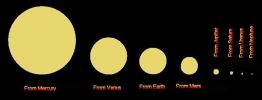
000-The_Sun_from_Space.JPGThe Sun from all the Planets of the Solar System183 visiteCome appare (o meglio: "Quanto grande" dovrebbe apparire) il Disco Solare allorchè osservato da un Mondo diverso dalla Terra?
Senza pretesa di assolutezza matematica, questa Tavola dovrebbe fornirVi un'idea più precisa della questione su cui tanto ci siamo arrovellati sino ad ora.
Nota: i diversi diametri sono stati ipotizzati ragionando in termini di UA (Unità Astronomiche), laddove 1 UA = distanza Sole / Terra = 149.597.970 Km
ergo la distanza fra il Sole e Mercurio viene fatta mediamente pari a (circa *) 0,4 UA
fra il Sole e Venere è mediamente pari a (circa) 0,7 UA
fra il Sole e Marte è mediamente pari a (circa) 1,5 UA
fra il Sole e Giove è mediamente pari a (circa) 5,2 UA
fra il Sole e Saturno è mediamente pari a (circa) 9,5 UA
fra il Sole ed Urano è mediamente pari a (circa) 19,6 UA
fra il Sole e Nettuno è mediamente pari a (circa) 30 UA
fra il Sole ed il Sistema Binario Plutone-Caronte è mediamente pari a (circa) 39 UA
* diciamo circa perchè le orbite dei diversi Pianeti attorno al Sole NON descrivono cerchi perfetti (e quindi con raggio - distanza dal Sole - fisso), bensì delle ellissi più o meno allungate (le quali implicano l'esistenza di un "perielio" - o punto di massima vicinanza del Corpo Celeste considerato rispetto al Sole - ed un "afelio" - o punto di massima lontananza del Corpo Celeste considerato rispetto al Sole.MareKromiumFeb 06, 2009
|
|

The_Sun-01.jpgThe Sun in 3D81 visitenessun commentoMareKromiumOtt 17, 2008
|
|
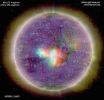
The_Sun-00.jpgThe Sun in 3D105 visitenessun commentoMareKromiumOtt 17, 2008
|
|

Solar_Prominence-304erupt_crop.jpgSolar Eruption!76 visiteCaption NASA:"On September 29, 2008, this magnificent eruptive Solar Prominence lifted away from the Sun's Surface, unfurling into space over the course of several hours.
Suspended in twisted Magnetic Fields, the hot plasma structure is many times the size of planet Earth and was captured in this view by the Sun-watching STEREO (Ahead) Spacecraft.
The image was recorded in extreme ultraviolet light emitted by ionized Helium, an element originally identified in the Solar Spectrum. Seen against the brilliant Solar Surface in visible light, such prominences appear as dark filaments because they are relatively cool. But they are bright themselves when viewed against the blackness of space, arcing above the Sun's edge".MareKromiumOtt 04, 2008
|
|

Solar_Eclipse-Tse2008_200_mo1_big.jpgAugust 2008 Total Solar Eclipse79 visiteCaption NASA:"For a moment on August 1st, the daytime sky grew dark along the path of a Total Solar Eclipse. While watching the geocentric celestial event from Mongolia, photographer Miloslav Druckmuller recorded multiple images with two separate cameras as the Moon blocked the bright solar disk and darkened the sky.
This final composition consists of 55 frames ranging in exposure time from 1/125 to 8 seconds. It spans nearly 12°, with the relative position of the Moon and Sun corresponding to mid-eclipse. On the left is bright planet Mercury, but many stars are also visible, including the Praesepe Star Cluster (also known as M44 or the Beehive Cluster) in Cancer, above and to the right of the silhouetted Moon. Remarkably, the nearly perfect conditions and wide range in individual exposures allow the composite picture to register the lunar surface and follow the delicate solar corona out to a distance of nearly 20 times the radius of the Sun. In fact, the composite presents a range in brightness beyond what the eye could see during the eclipse".MareKromiumSet 27, 2008
|
|

Sunspot-1002.jpgActive Region 100276 visiteCaption NASA:"Why has the Sun been so quiet recently? No one is sure. Our Sun has shown few active regions -- that house even fewer associated sunspots -- for over a year now, and such a period of relative calm is quite unusual.
What is well known is that our Sun is in a transitional period between solar cycles called a Solar Minimum, where solar activity has historically been reduced.
The stark lack of surface tumult is unusual even during a Solar Minimum, however, and activity this low has not been seen for many decades. A few days ago, however, a "Bona-Fide Active Region! -- complete with Sunspots --appeared and continues to rotate across the Sun's face. Visible above, this region, dubbed "Active Region 1002" (AR 1002), was imaged in ultraviolet light yesterday by the SOHO Spacecraft, which co-orbits the Sun near the Earth.
Besides the tranquility on the Sun's surface, recent data from the Ulysses Spacecraft, across the Solar System, indicate that the intensity of the Solar Wind blowing out from the Sun is at a 50 year low. Predictions hold, however, that our Sun will show more and more active regions containing more and more Sunspots and Flares until Solar Maximum occurs in about 4 years from now (such as in the year 2012)".MareKromiumSet 25, 2008
|
|

Solar_Corona.jpgIt's a "Corona", but it is not a "Beer", it's a "Crown", but is not a "Cola"...76 visiteDa "NASA - Picture of the Day", del giorno 8 Agosto 2008:"During a Total Solar Eclipse, the Sun's extensive Outer Atmosphere, or Corona, is an inspirational sight. The subtle shades and shimmering features of the Corona that engage the eye span a brightness range of over 10000 to 1, making them notoriously difficult to capture in a single picture. But this composite of 28 digital images - ranging in exposure time from 1/1000th to 2" - comes close to revealing the Crown of the Sun in all its glory.
The telescopic views were recorded near Kochenevo, Russia during the August 1 total Solar Eclipse and also show Solar Prominences extending just beyond the edge of the eclipsed Sun. Remarkably, features on the dark near side of the New Moon can also be made out, illuminated by sunlight reflected from a Full Earth".MareKromiumAgo 08, 2008
|
|

The_Sun_-_Eclipse.jpgAt the Sun's Edge74 visiteCaption NASA:"A train trip on the Trans-Siberian railway to Novosibirsk resulted in this stunning view along the edge of the Sun, recorded during the August 1st, 2008, total Solar Eclipse.
The picture is a composite of two images taken at special moments in the eclipse sequence, corresponding to the very beginning and the very end of the total eclipse phase.
Those times are known to eclipse chasers as 2nd and 3rd contact.
Bright beads around the Moon's dark silhouette are rays of sunlight shining through lunar valleys at the edge of the Lunar Disk.
But the composite view also captures Solar Prominences, such as "looping structures" of hot plasma suspended in magnetic fields, extending beyond the Sun's edge".MareKromiumAgo 07, 2008
|
|
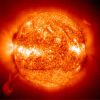
SunFlare-prom1743_eit_big.jpgA Twisted Solar Eruptive Prominence67 visiteCaption NASA:"Ten Earths could easily fit in the "claw" of this seemingly solar monster. The monster, though, visible on the lower left, is a huge Eruptive Prominence seen moving out from our Sun. The above dramatic image taken early in the year 2000 by the Sun-orbiting SOHO satellite. This large prominence, though, is significant not only for its size, but its shape. The twisted figure eight shape indicates that a complex magnetic field threads through the emerging solar particles. Differential rotation inside the Sun might help account for the surface explosion.
Although large prominences and energetic Coronal Mass Ejections (CMEs) are relatively rare, they are occurred more frequently near Solar Maximum, the time of peak sunspot and solar activity in the eleven-year Solar Cycle".MareKromiumGiu 01, 2008
|
|
| 144 immagini su 12 pagina(e) |
 |
|
4 | |
|
|
|
|
|
|
|








