| |

| Ultimi arrivi - The Sun: just a star, like many others... |

Athmosferic_Corona-Schneider.jpgDiamond Ring and Shadow Bands81 visiteDalla Rubrica "NASA - Picture of the Day" del giorno 24 Luglio 2010:"As the total phase of July ,11th, 2010 Solar Eclipse came to an end, Sunlight streaming past the edge of the Moon's silhouette created the fleeting appearance of a glistening Diamond Ring in the sky.
Seen through a thin cloud layer from the French Polynesian atoll of Hao it also produced remarkable Shadow Bands, flickering across the dramatic scene. Projected onto the cloud layer, the Shadow Bands are parallel to the sliver of Sunlight emerging from behind the Moon's edge.
Caused by turbulence in Earth's Atmosphere refracting the sliver of Sunlight, the narrow bands were captured in this brief, 1/400th second exposure. Shining through the cloud droplets, the Sunlight also produced a luminous atmospheric corona, not to be confused with the Solar Corona seen during Eclipse Totality.
The Atmospheric Corona is centered on the bright diamond of emerging Sunlight".MareKromiumLug 27, 2010
|
|

The_Sun-Texture.jpgThe "Texture" of the Sun66 visiteUp close, the Solar Surface is a striking patch work of "granules" in this very High Resolution picture of the quiet Sun. Caused by convection, the granules are hot, rising columns of plasma edged by dark lanes of cooler, descending plasma. But the HR view reveals that the dark lanes are dotted with many small, contrasting bright points. Constantly present on the Solar Surface, the bright points do not seem to be related to Sunspots that come and go with the Magnetic Solar Cycle.
Nonetheless, the bright points are regions of concentrated Magnetic Fields and are bright because the magnetic pressure opens a window to hotter deeper layers below the Photosphere. For scale, the white bar at the lower left corresponds to approx. 5000 Km across the Sun's Surface.
The sharp, narrow-band image was recorded in September, 2007 using the Swedish Solar Telescope on the astronomical island of La Palma.MareKromiumMag 05, 2010
|
|

The_Sun_in_Extreme_UV.jpgThe Sun in Extreme UV67 visiteThis wild-looking portrait of the Sun was made on March 30th, 2010, by the recently launched Solar Dynamics Observatory (SDO).
Shown in false-color, the composite view covers Extreme UltraViolet wavelengths and traces hot plasma at temperatures approaching 1 million Kelvins. At full resolution, SDO image data is intended to explore solar activity in unprecedented detail. In fact, SDO will send 1.5 terabytes of data back each day, equivalent to a daily download of about half a million MP3 songs.MareKromiumMag 04, 2010
|
|

Solar_Prominence~0.jpgSolar Prominence85 visiteCaption NASA, da "NASA - Picture of the Day" del giorno 23 Marzo 2010:"Dramatic Prominences can sometimes be seen looming just beyond the edge of the Sun.
Such was the case last week as a Giant Prominence, visible above on the right, highlighted a Sun showing increased activity as it comes off an unusually quiet Solar Minimum. A changing carpet of hot gas is visible in the Chromosphere of the Sun in the above image taken in a very specific color of light emitted by Hydrogen.
A Solar Prominence is a cloud of Solar Gas held just above the Surface by the Sun's Magnetic Field. The Earth would easily fit below the Prominence on the right. Although very hot, Prominences typically appear dark when viewed against the Sun, since they are slightly cooler than the Surface.
A quiescent Prominence typically lasts about a month, and may erupt in a Coronal Mass Ejection (CME) expelling hot gas into the Solar System. The next day, the same prominence looked slightly different".MareKromiumMar 23, 2010
|
|

Solar_Eclipse-2010.jpgMillennium's Annular Solar Eclipse80 visiteDa "NASA - Picture of the Day" del giorno 22 Gennaio 2010:"The Moon's shadow raced across planet Earth on January 15, 2010.
Observers within the central shadow track were able to witness an Annular Solar Eclipse as the Moon's apparent size was too small to completely cover the Sun. A visually dramatic "Ring of Fire", the annular phase lasted up to 11' and 8", depending on location: the longest Annular Solar Eclipse for the next 1000 years.
This picture of the Moon's silhouette just before mid-eclipse was taken within the eclipse path from the city of Kanyakumari at the southern tip of India. The telescopic image was made through a filter that blocks most Visible Light, but still transmits light from Hydrogen Atoms.
As a result, detailed mottling, or granulation, caused by heat convection in the Sun's Atmosphere can be seen around the dark Lunar Disk".MareKromiumGen 22, 2010
|
|

Sungrazer-2010-SOHO.jpgSungrazer66 visiteCaption NASA:"Intense and overwhelming, the direct glare of the Sun is blocked by the smooth occulting disk in this image from the Sun-staring SOHO Spacecraft. Taken on January 3rd, 2010, an extreme UltraViolet image of the Sun to scale, is superimposed at the center of the disk. Beyond the disk's outer boundary, is a Sungrazer Comet, one of the brightest yet seen by SOHO.
The comet was discovered by an Australian Amateur Astronomer, Alan Watson, while examining earlier images from another Sun-watching Spacecraft, STEREO-A. Based on their orbits, Sungrazers are believed to belong to the Kreutz family of comets, created by successive break ups from a single large Parent Comet that passed very near the Sun in the twelfth century.
Subjected to strong Tidal Forces and intense Solar Heat, this Sungrazer did not survive its close encounter".MareKromiumGen 17, 2010
|
|

BlueSun.jpgBlue Sun81 visiteDa "NASA - Picture of the Day" del giorno 4 Novembre 2009:"Our Sun may look like all soft and fluffy, but it is not. Our Sun is an extremely large ball of bubbling hot gas, mostly Hydrogen gas. The above picture of our Sun was taken last month in a specific red color of light emitted by Hydrogen gas called "Hydrogen-alpha" and then color inverted to appear blue.
In this light, details of the Sun's Chromosphere are particularly visible, highlighting numerous thin tubes of magnetically-confined hot gas known as spicules rising from the Sun like bristles from a shag carpet.
Our Sun glows because it is hot, but it is not on fire. Fire is the rapid acquisition of Oxygen, and there is very little Oxygen on the Sun. The energy source of our Sun is the nuclear fusion of Hydrogen into Helium deep within its core. No Sunspots or large active regions were visible on the Sun this day, although some Solar Prominences are visible around the edges".MareKromiumNov 04, 2009
|
|

Solar_Prominence-STEREO.jpgHuge Solar Prominence67 visiteCaption NASA:"What does a Solar Prominence look like in three dimensions? To help find out, NASA launched the STEREO satellites to keep a steady eye on the Sun from two different vantage points.
The STEREO satellites orbit the Sun nearly along Earth's orbit, but one (dubbed "Ahead" ---> Avanti) currently leads the Earth, while the other (dubbed "Behind" ---> "Dietro") currently trails. Three weeks ago, a powerful Prominence erupted and remained above the Sun for about 30 hours, allowing the STEREO satellites to get numerous views of it from different angles.
Pictured above is a High-Resolution image of the event from the STEREO "Ahead" satellite.
A video of the Prominence erupting as seen from both Spacecrafts can be found at http : // www . youtube . com / watch?v = _RjswBx6ysQ.
The unusually quiet nature of the Sun over the past two years has made large prominences like this relatively rare. The combined perspective of STEREO will help astronomers better understand the mechanisms for the creation and evolution of Prominences, Coronal Mass Ejections, and Solar Flares".
MareKromiumOtt 21, 2009
|
|

Solar_Eclipse~0.jpgA "Diamond Ring" among the clouds69 visiteDa "NASA - Picture of the Day" del giorno 8 Agosto 2009:"Cloudy skies over Wuhan, China hid the delicate Solar Corona during July's Total Eclipse of the Sun. Still, the Moon's silhouette was highlighted by these glistening diamonds as the Total Eclipse Phase ended. Caused by bright Sunlight streaming through dips and valleys in the irregular terrain along the Moon's edge, the effect is known as Baily's Beads, named after Francis Baily who called attention to the phenomenon in 1836.
The dramatic appearance of the beads at the beginning or end of a Total Solar Eclipse is also known as the Diamond Ring effect. In this remarkable image, a small, pinkish solar prominence can also be seen along the edge, below the diamonds".MareKromiumAgo 08, 2009
|
|

Solar_Corona_vangorp_big.jpgSolar Corona83 visiteDa "NASA - Picture of the Day" del giorno 26 Luglio 2009:"Most photographs don't adequately portray the magnificence of the Sun's Corona. Seeing the Corona first-hand during a Total Solar Eclipse is best. The human eye can adapt to see features and extent that photographic film usually cannot.
Welcome, however, to the digital age. The above picture is a combination of 33 photographs that were digitally processed to highlight faint features of a Total Eclipse that occurred in March of 2006. The images of the Sun's Corona were digitally altered to enhance dim, outlying waves and filaments. Shadow seekers need not fret, though, since as yet there is no way that digital image processing can mimic the fun involved in experiencing a Total Solar Eclipse.
Last week, a spectacular Total Solar Eclipse occurred over Southern Asia, while the the next Total Solar Eclipse will be visible from the South Pacific on July, 11, 2010".MareKromiumLug 26, 2009
|
|
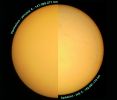
PerihelionAphelion_cervignon800.jpgPerihelion and Aphelion65 visiteDa "NASA - Picture of the Day" del giorno 3 Luglio 2009:"This year Aphelion, the point in Earth's elliptical orbit when it is farthest from the Sun, occurs tomorrow, July 4th.
Of course, that doesn't affect the seasons on our fair Planet, because those are determined by the tilt of Earth's Axis of Rotation and not Earth's distance from the Sun: so July is still Winter in the South and Summer in Northern Hemisphere. But it does mean that on July 4th the Sun will be at its smallest apparent size. This composite neatly compares two pictures of the Sun taken with the same telescope and camera on the dates of Perihelion (closest approach) and Aphelion in 2008.
The image labels include Earth's distance in kilometers from the Sun on the two dates.
Otherwise difficult to notice, the change in the Sun's apparent diameter between Perihelion and Aphelion is clear. The difference amounts to a little over 3%".MareKromiumLug 05, 2009
|
|

Sunspots-090602.jpgSunspots and Clouds in Solar Cycle 2475 visiteDa "NASA - Picture of the Day" del giorno 4 Giugno 2009:"On June 2nd, 2009, clouds over Stuttgart, Germany parted to reveal what has become a relatively rare sight, spots on the Sun. In fact, the roughly 11-year solar activity cycle is still in a surprisingly deep minimum and the years 2008 and 2009 have had the lowest Sunspot counts since the 1950s. Even the latest prediction is that the new cycle, Solar Cycle 24, will reach a maximum in May 2013 with a below-average sunspot count. The Solar Cycle 24 Sunspots recorded here are in active region AR 1019.
Previously, only two cycle 24 active regions with Sunspots, AR 1018 and AR 1017, were seen in May".MareKromiumGiu 04, 2009
|
|
| 144 immagini su 12 pagina(e) |
|
3 | |
|
|
|
|
|
|
|
|
|
|








