| Ultimi arrivi - The Sun: just a star, like many others... |

ZA-Sunspot.jpgSunspot and Solar "granules" (detail mgnf)99 visiteCaption NASA originale:"Sometimes, small regions of the Sun appear unusually dark. Visible above is a close-up picture of a sunspot, a depression on the Sun's face that is slightly cooler and less luminous than the rest of the Sun. Sunspots can be larger than the Earth and usually last for only a few days. As you can see, the Sun's face is a bubbling sea of separate cells of hot gas. These cells are known as "granules" and a solar "granule" is about 1000 Km across and "lives" for + or - 10 minutes, then explodes".Set 09, 2004
|
|

Sun-PIA03149_modest.jpgSolar Flares from Soho89 visiteCaption NASA originale:"Extreme Ultraviolet Imaging Telescope (EIT) image of a huge, handle-shaped prominence taken on Sept. 14,1999 taken in the 304 angstrom wavelength - Prominences are huge clouds of relatively cool dense plasma suspended in the Sun's hot, thin corona. At times, they can erupt, escaping the Sun's atmosphere. Emission in this spectral line shows the upper chromosphere at a temperature of about 60,000 degrees K. Every feature in the image traces magnetic field structure. The hottest areas appear almost white, while the darker red areas indicate cooler temperatures".Ago 26, 2004
|
|
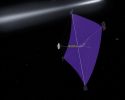
ZA-Solar Sail.jpgThe "Solar Sail"83 visiteNelle more del lancio del vettore Cosmos 1 (realizzato dalla Planetary Society in collaborazione con lo Space Research Institute -IKI- di Mosca), il quale dovrebbe portare nello spazio la prima sonda capace di usare il Vento Solare quale strumento di propulsione, noi ci domandiamo se questa trovata sia davvero un colpo di genio, oppure una delle "bufale" che, ogni tanto, la NASA o qualche altra Agenzia Spaziale si inventa per giustificare la spendita di fondi e gettare fumo negli occhi del pubblico...Ago 21, 2004
|
|

The Sun in Hydrogen-Alpha light.jpgThe Sun in "Hydrogen-alpha" light114 visiteCaption NASA originale:"The above picture was taken in a specific color of light emitted by Hydrogen gas called Hydrogen-alpha. Granules cover the solar photosphere surface like shag carpet, interrupted by bright regions containing dark sunspots. Our Sun glows because it is hot, but it is NOT on fire. Fire is the rapid acquisition of oxygen, and there is VERY LITTLE O2 on the Sun! The energy source of the Sun is the nuclear fusion of Hydrogen into Helium (4H--->1He) deep within its core". Ago 18, 2004
|
|

The corona.jpgThe Sun's corona from TRACE (Transition Region and Coronal Explorer Satellite)112 visitenessun commentoAgo 18, 2004
|
|

A-The Sun from Soho~0.jpgA colorful Sun, a Solstice celebration148 visiteCaption NASA originale: "This composite image combines Extreme Ultravoilet Imaging Telescope (EIT)images from three wavelengths(171, 195 and 284 angstrom) into one that reveals solar features unique to each wavelength. Since the EIT images come to us from the spacecraft in black and white, they are color coded for easy identification. For this image, the nearly simultaneous images from May 1998 were each given a color code (red, yellow and blue) and merged into 1. SOHO is a project of international cooperation between ESA and NASA".Ago 05, 2004
|
|

A-THE SUN-FLUXTUBE.jpgA very unusual "fluxtube" from the Sun123 visiteCaption originale NASA, da "NASA - Picture of the Day" dell'11 Gennaio 1999: "The Earth's orbit is not a perfect, sun-centered circle. At aphelion, the most distant point in Earth's orbit, the Sun is 150 MKMs away and at perihelion, the closest point, Earth approaches the Sun to within about 147 MKMs. While aphelion occurs in July, perihelion for planet Earth comes in January. In fact, inhabitants of the Northern Hemisphere, particularly those wearily weathering winter storms, may be surprised to learn that Earth reached its closest point to the Sun on early January, usually the coldest month of the year. This false-color picture recorded near perihelion is from the earth-orbiting Yohkoh Solar Observatory. It shows an increasingly active Sun in the light of X-rays. A negative color scheme is used, darker colors representing more intense X-ray light". Da notare che il commento NASA non menziona nè spiega - guarda caso... - il dettaglio più intrigante dell'immagine: il "tubo" di plasma e di gas...Ago 05, 2004
|
|

A-A SUNFLARE.jpgA beautiful Solar Flare244 visitenessun commentoAgo 05, 2004
|
|

A-THE SUN-SOHO.jpgThe Sun, stars and planets from Soho167 visite...che si vede con grande chiarezza nell'immagine più grande, circa ad ore 01:00 del disco solare.
Ricordate quanto scrivemmo, nella Sezione dedicata a Mercurio, a proposito di un enigmatico "corpo celeste" il quale orbiterebbe intorno al Sole lungo un'orbita ancora più interna rispetto a quella dello stesso Mercurio? Ecco, l'immagine da alcuni Studiosi ritenuta come una prova fondamentale dell'esistenza di "qualcosa" nelle immediate vicinanze del Sole (il Decimo Pianeta) è proprio quella che Vi abbiamo offerto nel frame precedente. Ago 05, 2004
|
|

A-The Sun - filament_trace_big.jpgSun's filaments152 visiteCaption originale NASA: "The filament, although small compared to the overall size of the Sun, measures over 100.000 Km in height, so that the entire Earth could easily fit into its outstretched arms. Gas in the filament is funneled by the complex and changing magnetic field of the Sun. After lifting off from the Sun's surface, most of the filamentary gas will eventually fall back". Ago 05, 2004
|
|
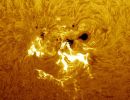
A-The Sun - sunspot_newton_big.jpgSunspots229 visitenessun commentoAgo 05, 2004
|
|

A-The Sun from Spitzer - spicules_sst_big.jpgSun "Spicules" from the Sptizer Space Telescope (SST)145 visiteCaption NASA originale: "Pictured above is perhaps the highest resolution image yet of the enigmatic "Solar Flux Tubes" known as "Spicules". Spicules dot the above frame of solar active region, but they are particularly evident as a carpet of dark tubes on the right. Time-sequenced images have recently shown that spicules "Life-span" is of about 5 minutes, starting out as tall tubes of rapidly rising gas but eventually fading as the gas peaks and falls back down to the Sun". Ago 05, 2004
|
|
| 144 immagini su 12 pagina(e) |
 |
|
|
|
|
|
|
|
|
12 |
|








