| Ultimi arrivi - The Sun: just a star, like many others... |

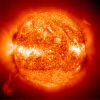
The Sun in Hydrogen-Alpha light (2).jpgThe Sun in Hydrogen-Alpha light87 visiteCaption NASA originale:"The above image, taken in a single color of light called Hydrogen Alpha, records a great amount of detail of the simmering surface of our parent star. The gradual darkening towards the Sun's edge, called limb darkening, is caused by increased absorption of relatively cool solar gas. Further over the edge, a giant prominence is visible, while a different prominence can be seen in silhouette as the dark streak near the image center. Two active areas of the Sun are marked by bright plages. The above amateur photograph of the Sun was taken just through a small telescope and a standard digital camera". Set 16, 2004
|
|

Sunspots - SST.jpgSunspots76 visiteCaption NASA originale:"This stunning image shows remarkable and mysterious details near the dark central region of a planet-sized sunspot in one of the sharpest views ever of the surface of the Sun. Just released, the picture was made using the Swedish Solar Telescope now in its first year of operation on the Canary Island of La Palma. Along with features described as hairs and canals are dark cores visible within the bright filaments that extend into the sunspot, representing previously unknown and unexplored solar phenomena". Set 15, 2004
|
|

Solar Flares.jpgSolar Flares82 visiteCaption NASA originale:"On June, 14th, 1999, SOHO observatory recorded this stunning view of an immense prominence erupting from the Sun's southern latitudes. The false-color image was made in the extreme Ultraviolet light produced by ionized Helium atoms in the solar plasma". Set 14, 2004
|
|

Sunflare.jpgA Sunflare from the Skylab86 visiteUn'immagine d'epoca: l'anno è il 1973 e dallo Skylab (allora conosciuto come "Il Laboratorio Spaziale") ci arriva l'immagine di una "fiaccola" o, se preferite, di un "Solar Flare".Set 14, 2004
|
|

Coronal Mass Ejection.jpgA "Coronal Mass Ejection"82 visiteCaption NASA originale:"Magnetic fields buckle releasing previously constrained hot material from the upper atmosphere of the Sun. As a result, hot gas streams out into the Solar System, impacting planets, moons, spacecraft, and making space a dangerous place for astronauts. Known as "Coronal Mass Ejections" (CMEs), billions of tons of scathing plasma can be accelerated to millions of miles per hour. CMEs are more common but less intense than solar flares".Set 14, 2004
|
|

Sun & Comet (dtl-mgnf).jpgA comet approaching the Sun (from SOHO) - detail mgnf83 visiteCaption NASA originale:"Based on their similar orbits, as first worked out by 19th century German astronomer Heinrich Kreutz, all "sungrazers" are believed to originate from a single large "parent comet" which broke up during a perihelion passage perhaps 2.000 years ago. Over time, pieces have continued to split off producing a family of smaller comets which seem to travel in the same orbit". Set 14, 2004
|
|

Sun & Comet (2).jpgA comet approaching the Sun (from SOHO)72 visiteCaption NASA originale:"SOHO, the space-based SOlar and Heliospheric Observatory, has become by far the reigning champion facility for discovering comets, its total having reached more than 200. As might be expected of a solar observatory, most of the SOHO discovered comets are "sungrazers", such as comets destined to dive within a mere 50.000 Km or so of the solar photosphere.
At that range the intense heat and gravitational forces make it unlikely these primitive chunks of ice and dust will survive".Set 14, 2004
|
|

Sun & Comet.jpgA comet approaching the Sun (from SOHO)72 visiteCaption NASA originale:"These 3 frames from SOHO's coronograph were taken two hours apart from each other on April 29, 2000. They show a "sungrazer" (SOHO comet discovery number 111) with a long, bright tail headed toward its fiery encounter.
The Sun itself is hidden behind the coronograph's occulting disk at each frame's upper right". Set 14, 2004
|
|

Sun-Equinox 2002.jpgThe Sun during the 2002 Equinox63 visiteCaption NASA originale:"The active Sun near the March Equinox, the beginning of Autumn in the south and Spring in the northern hemisphere. Recorded in a band of extreme ultraviolet light emitted by highly ionized iron atoms, the Sun's upper atmosphere (or solar corona) shines with an array of active regions and plasma loops suspended in magnetic fields. The bright coronal structures and loops seen here have temperatures of about 1.500.000° K".Set 13, 2004
|
|
Sun-prom1743_eit_big.jpgAnother "Solar Prominence" from Soho94 visiteCaption NASA originale:"This large prominence is significant not only for its size, but also for its shape. The picture was taken early in the year 2000 by the Sun-orbiting SOHO satellite. Although large prominences and energetic Coronal Mass Ejections (CMEs) are relatively rare, they are occurred more frequently near Solar Maximum, such as the time of peak sunspot and solar activity in the 11 year solar cycle". Set 09, 2004
|
|

A-The Sun-Solar flare from Soho.jpgPowerful solar flare from Soho69 visiteCaption originale NASA: "Seen through the electromagnetic spectrum, the Sun briefly becomes over than 100 times brighter (in the X-rays wavelength) than normal. This is a so-called "Solar Flare" and, when it happens, energetic particles which are emitted from the Sun strike the Earth causing malfunctions in satellite communications or, in some specific areas, a very unusual (and yet very impressive) phoenomenon known as "Aurora Borealis".Set 09, 2004
|
|

The Sun from Soho.jpgA "Solar Prominence" from Soho79 visiteCaption NASA originale:"A 'Solar Prominence' is a cloud of solar gas held above the Sun's surface by the Sun's magnetic field. The Earth would easily fit under the hovering curtain of hot gas (like the one pictured above). A quiescent prominence typically lasts about one month, and may erupt in a Coronal Mass Ejection (CME) expelling hot gas into the Solar System. Although somehow related to the Sun's changing magnetic field, the energy mechanism that creates and sustains a Solar Prominence is still a mistery". Set 09, 2004
|
|
| 144 immagini su 12 pagina(e) |
 |
|
|
|
|
|
|
|
|
11 |
|








