| Ultimi arrivi - The Sun: just a star, like many others... |

Sun filaments.jpgSun filaments70 visiteCaption NASA originale, da NASA Picture of the Day del 6 Dicembre 2004:"Two unusually long filaments crossed part of the Sun last week. The filaments are actually relatively cool and dark prominences of solar plasma held up by the Sun's magnetic field but seen against the face of the Sun. Filaments typically last a few weeks before falling back. Pictured above, the two filaments are visible on the Sun's right side. It would take twenty Earths, set end-to-end, to match the length of one of the filaments. Also visible are bright hot regions called plages and a carpet of hundreds of granules that provide the Sun's texture. The above image was taken early last week through a small telescope in a very specific color of light emitted primarily by hydrogen".Dic 06, 2004
|
|

The limb of the Sun.jpgThe limb of the Sun88 visiteFotografia amatoriale della corona solare durante l'ultima grande eclissi totale del 1999. Ott 18, 2004
|
|

Sunrise from Space.jpgSunrise from space...99 visiteCaption NASA originale:"Sunrise seen from low Earth orbit by the shuttle astronauts can be very dramatic indeed. In this view, the Sun is just visible peaking over towering anvil-shaped storm clouds whose silhouetted tops mark the upper boundary of the troposphere, the lowest layer of planet Earth's atmosphere. Sunlight filtering through suspended dust causes this dense layer of air to appear red. In contrast, the blue stripe marks the stratosphere, the tenuous upper atmosphere, which preferentially scatters blue light". Ott 17, 2004
|
|

Black Sun.jpgBlack Sun91 visiteCaption NASA originale:"During a total solar eclipse, Earth's moon blocks the Sun - almost exactly. While the Sun is about 400 times wider than the Moon, it is also about 400 times farther away and each appears to be half a degree or so in diameter. On August 11, 1999 this remarkable coincidence in the apparent size of two vastly different celestial bodies produced tantalizing solar spectacles for denizens of Europe and Asia. For example, prominences along the Sun's limb peer around the Moon's dark edge in this dramatic picture of totality recorded as the lunar shadow swept across Hungary. Subtle structures in the Sun's inner corona are also visible streaming beyond the silhouetted Moon".Ott 16, 2004
|
|

Hungarian Eclypse.jpgMoments of the last Total Eclipse82 visiteCaption NASA originale:"Only in the fleeting darkness of a total solar eclipse is the light of the Solar Corona easily visible from Earth. Normally overwhelmed by the bright solar disk, the expansive corona, the Sun's outer atmosphere, is an alluring sight. But the subtle details and extreme ranges in the corona's brightness discernible to the eye are notoriously difficult to photograph. In this series of images recorded from Siofok, Hungary during the total phase of the August 11, 1999 eclipse, progressively longer exposures (top left to bottom center) have been used to more faithfully capture different regions of the elusive solar corona. The final image (at bottom right) shows light from the solar disk emerging from behind the moon's edge at the end of totality".Ott 16, 2004
|
|

Mercury and the Sun.jpgA "Superior Conjunction" Of Mercury67 visiteCaption originale NASA dal "NASA - Picture of the Day" dell'8-9-1999: "In astronomical parlance, an interior planet is at "Superior Conjunction" when it is located on the opposite side of the Sun from Earth. Mercury, the solar system's innermost planet, zips past this point in its orbit today. In fact, in this picture (taken on September 1999) from a solar coronagraph on board the the space-based SOHO observatory, shows Mercury positioned very close to the Sun as seen from a near Earth vantage point. The coronagraph uses an internal occulting disk to block the intense solar glare which otherwise hides this sight from ground-based observers. The shadow of the occulting disk is at the center with the Sun's size and position indicated by the white circle. Mercury is the bright dot with a horizontal line (a digital artifact), while faint dots scattered throughout the field are stars. Bright regions of the sun's outer atmosphere are also visible".Ott 15, 2004
|
|

Sun-TRACE.jpgThe Sun from TRACE in ultra-violet light88 visiteCaption NASA originale:"Shown in ultraviolet light, the relatively cool dark regions have temperatures of thousands of degrees Celsius. Large sunspot group AR 9169 is visible as the bright area near the horizon. The bright glowing gas flowing around the sunspots has a temperature of over 1.000.000° C. The reason for the high temperatures is still unknown but thought to be related to the rapidly changing magnetic field loops that "channel" solar plasma.
Sunspot group AR 9169 moved across the Sun during September 2000 and decayed in a few weeks".Ott 10, 2004
|
|

The Sun_s Corona.jpgThe "Corona"102 visiteIn sede di commento a questa immagine (amatoriale, ma non per questo meno bella) della corona solare - come visibile durante un'eclissi totale - una piccola curiosità: sapevate che alcune delle sfumature della corona sono visibili (anzi: percepibili) soltanto dall'occhio umano?Ott 05, 2004
|
|
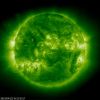
The Sun.jpgThe Sun86 visiteCaption NASA originale:"The ultraviolet light emitted by eleven times ionized iron at temperatures over 2 million degrees Farenheit was used to record the above picture of the Sun on September 22, 2001, the date of that year's autumnal equinox. The image was made by the EIT camera onboard the SOHO spacecraft, a space observatory which can continuously observe the Sun. Eleven times ionized iron is atomic iron with eleven of its electrons stripped away. Here the electrons are stripped by the frantic collisions with other atoms and electrons which occur at the extreme temperatures in the Solar Corona. Since electrons are negatively charged, the resulting ionized iron atom is highly positively charged. Astronomer's "shorthand" for eleven times ionized iron is written "Fe XII", the chemical symbol for iron followed by a Roman numeral 12 (Fe I is neutral iron)".Set 25, 2004
|
|

Sun - Coronal holes.jpgCoronal "Holes"66 visiteCaption NASA originale:"The ominous, dark shapes haunting the left side of the Sun are coronal holes - low density regions extending above the surface where the solar magnetic field opens freely into interplanetary space. Studied extensively from space since the 1960s in ultraviolet and x-ray light, coronal holes are known to be the source of the high-speed solar wind, atoms and electrons which flow outward along the open magnetic field lines. During periods of low activity, coronal holes typically cover regions just above the Sun's poles. These coronal holes, however, have just moved into view near the Sun's equator, and particles escaping them have already caused notable aurora here on Earth. Coronal holes like this one may last for a few solar rotations before the magnetic fields shift and change configurations. Shown in false-color, this picture of the Sun on March 9, 2003, was made in extreme ultraviolet light by the EIT instrument on board the space-based SOHO observatory".Set 23, 2004
|
|

Sun surface in 3D.jpgThe "bubbling" surface of the Sun in 3D119 visiteCaption NASA originale" How smooth is the Sun? The new Swedish 1-m Solar Telescope, deployed in the Canary Islands in 2002, allows imaging of objects less than 100-Km across on the Sun's surface. When pointed toward the Sun's edge, surface objects now begin to block each other, indicating true three-dimensional information. Close inspection of the image reveals much vertical information, including spectacular light-bridges rising nearly 500 Km above the floor of sunspots near the top of the image. Also visible in the above false-color image are hundreds of bubbling granules, each about 1000 Km across, and small bright regions known as "faculae".Set 23, 2004
|
|

At the edge of the Sun.jpgAt the edge of the Sun79 visiteCaption NASA originale: "Dramatic prominences can sometimes be seen looming just beyond the edge of the Sun. A Solar Prominence is a cloud of solar gas held just above the surface by the Sun's magnetic field. The Earth would easily fit below the prominence on the left. A quiescent prominence typically lasts about a month and may erupt in a Coronal Mass Ejection (CME) expelling hot gas into the Solar System. Although very hot, prominences typically appear dark when viewed against the Sun, since they are slightly cooler than the surface. The above image - in false color - was taken on June 1st, 2003, from Stuttgart, Germany, with a simple amateur telescope and camera".Set 18, 2004
|
|
| 144 immagini su 12 pagina(e) |
 |
|
|
|
|
|
|
|
10 | |
|








