| |

| Ultimi arrivi - Mercury |

ZZ-Mercury-Craters-Eitoku_Crater-PIA16361-PCF-LXTT.jpgEitoku Crater (Absolute Natural Colors; credits for the additional process. and color.: Dr Paolo C. Fienga/Lunar Explorer Italia/Italian Planetary Foundation)81 visiteThe main and really impressive Impact Crater visible in this NASA - MESSENGER Spacecraft image, Eitoku (which has a diameter of approx. 100 Km - such as about 62 miles) , displays several (almost) Central Peaks that appear especially prominent due to the high Solar Incidence Angle (meaning that the Sun was setting onto the imaged Local Horizon at the time that this picture was taken - and therefore the shadows of each and every Mercurian relief resulted way more visible - i.e.: longer - and suggestive) as well as to the fact that this frame has not been Map Projected. Note that Central (and/or almost Central, like in this case) Peaks are a relatively common Feature in Mercury's larger Impact Craters. Note, also, that the smaller Impact Craters visible on the Floor and Rim (which, on its side, appears quite degraded) of Eitoku Crater indicate/suggest that we are actually looking at an old Impact Feature.
Date acquired: July, 3rd, 2012
Image Mission Elapsed Time (MET): 249790754
Image ID: 2129670
Instrument: Narrow Angle Camera (NAC) of the Mercury Dual Imaging System (MDIS)
Center Latitude: 21,77° South
Center Longitude: 202,6° East
Resolution: 120 meters/pixel
Solar Incidence Angle: 83,4° (meaning that the Sun, at the time that the picture was taken, was about 6,6° above the imaged Local Mercurian Horizon)
Emission Angle: 59,9°
Sun-Mercury-Messenger (or "Phase") Angle: 134,5°
This picture (which is an Original NASA - MESSENGER Spacecraft color frame published on the NASA - Planetary Photojournal with the ID n. PIA 16361) has been additionally processed and then colorized in Absolute Natural Colors (such as the colors that a human eye would actually perceive if someone were onboard the NASA - MESSENGER Spacecraft and then looked down, towards the Surface of Mercury), by using an original technique created - and, in time, dramatically improved - by the Lunar Explorer Italia Team. Different colors, as well as different shades of the same color, mean, among other things, the existence of different Elements (Minerals) present on the Surface of Mercury, each having a different Albedo (---> Reflectivity) and Chemical Composition.MareKromiumOtt 24, 2012
|
|

ZZ-Mercury-Craters-Rustaveli_Crater-PIA16359-PCF-LXTT-IPF.jpgRustaveli Crater (Absolute Natural Colors; credits for the additional process. and color.: Dr Paolo C. Fienga/Lunar Explorer Italia/Italian Planetary Foundation)100 visiteThis Absolute Natural Color Image-Mosaic shows the Rustaveli Crater, a newly named Impact Basin located in the Northern Hemisphere of Mercury. The Basin has a smooth, filled Floor with little weathering and a Peak-ring Structure. Shota Rustaveli was a Georgian poet who lived from 1172-1216. He is well known for writing the Georgian National Epic Poem, "The Knight in the Panther's Skin". He is also the namesake of the coveted Shota Rustaveli State Prize, the highest honor a Georgian artist or writer can achieve.
Date acquired: July 18, 2011
Image Mission Elapsed Time (MET): 219478808, 219478804, 219478800
Image ID: 519956, 519955, 519954
Instrument: Wide Angle Camera (WAC) of the Mercury Dual Imaging System (MDIS)
WAC filters: 9, 7, 6 (996, 748, 433 nanometers) in red, green, and blue
Center Latitude: 52,40° North
Center Longitude: 81,79° East
Resolution: 187 meters/pixel
Scale: the diameter of Rustaveli basin is roughly 180 Km (such as approx. 112 miles).
Solar Incidence Angle: 59,8° (meaning that the Sun was about 30,2° above the imaged Local Horizon at the time that the picturs were taken)
Emission Angle: 30,6°
Sun-Mercury-MESSENGER (or "Phase") Angle: 90,4°MareKromiumOtt 15, 2012
|
|

ZZ-Mercury-Craters-Soseki-PIA16356-PCF-LXTT-IPF.jpgFeatures of Soseki Crater (Absolute Natural Colors; credits for the additional process. and color.: Dr Paolo C. Fienga/Lunar Explorer Italia/Italian Planetary Foundation)89 visiteThis Image-Mosaic shows part of the Mercurian Crater Soseki, in the North/West. A deep Scarp cuts through several Impact Craters visible on the right side of the image, though it does not stand out in this high-Sun view. The bright band crossing from upper right to lower left, is a Ray coming from the Crater Hokusai, which is located far away, to the North/East. Hokusai's Rays overprint older Impact Craters and cover a large portion of the whole Planet.
This image was acquired as a High-Resolution Targeted Color Observation. Targeted Color Observations are images of a small area on Mercury's Surface at resolutions higher than the 1-kilometer per pixel "Color Base Map". During MESSENGER's one-year Primary Mission, hundreds of Targeted Color Observations were obtained. During MESSENGER's extended mission, HR Targeted Color Observations are more rare, as the Color Base Map is covering Mercury's Northern Hemisphere with the highest-resolution color images that are possible.
Date acquired: April 09, 2011
Image Mission Elapsed Time (MET): 210807763, 210807759, 210807755
Image ID: 108194, 108193, 108192
Instrument: Wide Angle Camera (WAC) of the Mercury Dual Imaging System (MDIS)
WAC filters: 9, 7, 6 (996, 748, 433 nanometers) in red, green, and blue
Center Latitude: 36,39° North
Center Longitude: 323,5° East
Resolution: 302 meters/pixel
Scale: the Unnamed Impact Crater with the bright Floor (visible in the upper left corner of the frame) is about 32 Km in diameter (such as approx. 20 miles)
Solar Incidence Angle: 37,5° (meaning that the Sun was about 52,5° above the imaged Local Horizon at the time that the pictures were taken)
Emission Angle: 11,2°
Sun-Mercury-MESSENGER (or "Phase") Angle: 48,7°MareKromiumOtt 15, 2012
|
|
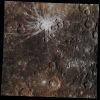
ZZ-Mercury-Craters-Mena_and_Cezanne_Crater-PIA16341-PCF-LXTT-IPF.jpgMena and Cezanne Crater (Absolute Natural Colors; credits for the additional process. and color.: Dr Paolo C. Fienga/Lunar Explorer Italia/Italian Planetary Foundation)87 visiteIn this Image-Mosaic, the Bright Rays of Mena Crater and the distinctive color difference of Cezanne Crater (with the surrounding area) are well highlighted. These two distinctive Impact Features provide beautiful contrast to this Absolute Natural Color image, giving the viewer more insight into reflectance variations (---> Albedoes) on Mercury's Surface. Also note the extremely old, degraded and larger, infilled Unnamed Crater visible on the center right of the frame, which is crossed by at least three major Crater Chains.
Date acquired: June 04, 2012
Image Mission Elapsed Time (MET): 247336883, 247336875, 247336879
Image ID: 1955368, 1955366, 1955367
Instrument: Wide Angle Camera (WAC) of the Mercury Dual Imaging System (MDIS)
WAC filters: 9, 7, 6 (996, 748, 433 nanometers) in red, green, and blue
Center Latitude: 3,78° South
Center Longitude: 235,8° East
Resolution: 552 meters/pixel
Scale: Cezanne Crater, such as the Crater in the bottom center, is about 67 km (approx. 41 miles) in diameter.
Solar Incidence Angle: 55,6° (meaning that the Sun was about 34,4° above the imaged Local Horizon at the time the pictures were taken)
Emission Angle: 0,0° (meaning that the MESSENGER Spacecraft, at the time that the pictures were taken, was absolutely perpendicular to the Mercurian Surface visible in the center of the frame)
Sun-Mercury-MESSENGER (or "Phase") Angle: 55,6°MareKromiumOtt 15, 2012
|
|

ZZ-Mercury-Terninator_Line-PIA16360-PCF-LXTT-IPF.jpgMercurian Terminator (Absolute Natural Colors; credits for the additional process. and color.: Dr Paolo C. Fienga/Lunar Explorer Italia/Italian Planetary Foundation)104 visiteThis striking image shows the progression of Daylight across the Surface of Mercury and the line separating the night from the day is called "Terminator". Scientists have studied interesting phenomena occurring near the Terminator of the Moon for years. Such occurrences involve the interaction between Lunar Dust and Charged Solar Particles (---> the Ions making the Solar Wind). Because Mercury's Regolith is exposed to almost ten times as many Charged Particles as the Moon, it is an excellent place to study the effects of Solar Radiation on Surface Materials. In this unprojected image, North is to the right.
This image was acquired as part of MDIS's campaign to monitor the South Polar Region of Mercury. By imaging the Polar Regions approximately every 4 (four) MESSENGER orbits as illumination conditions change, the Surface Features that were in the shadows on earlier orbits, can be discerned and any permanently shadowed areas can also be identified after repeated imaging over One Solar Day. During MESSENGER's one-year primary mission, MDIS's WAC was used to monitor the South Polar Regions for the first Mercury Solar Day (which corresponds to 176 Earth Days), and MDIS's NAC made repeated images of the South Polar Regions during the second Mercury Solar Day.
Date acquired: August 01, 2011
Image Mission Elapsed Time (MET): 220726567
Image ID: 579208
Instrument: Wide Angle Camera (WAC) of the Mercury Dual Imaging System (MDIS)
WAC filter: 7 (748 nanometers)
Center Latitude: 84.97° South Lat.
Center Longitude: 75,81° East Long.
Resolution: 1500 meters/pixel
Scale: the large crater at the bottom center is approx. 155 km (such as about 96 miles) in diameter.
Solar Incidence Angle: 84,9° (meaning that the Sun, at the picture was taken, was about 5,1° above the Imaged Local Horizon)
Emission Angle: 23,8°
Sun-Mercury-MESSENGER (or "Phase") Angle: 97,0°MareKromiumOtt 14, 2012
|
|

ZZ-Mercury-Craters-Unnamed_Craters-PIA15857-PCF-LXTT-IPF.jpgCraters on the Mercurian Terminator (Absolute Natural Colors; credits for the additional process. and color.: Dr Paolo C. Fienga/Lunar Explorer Italia/Italian Planetary Foundation)128 visiteThis is a beautiful and dramatic image of the Surface of Planet Mercury that was taken by the NASA - MESSENGER Spacecraft just when the Sun was a mere 10 degrees above the Local (imaged here) Horizon. The frame shows us four (4) Simple Unnamed Impact Craters which are all located on top of the Rim of a larger (approx. 3 Km-diameter) Simple Unnamed Crater (look from about 12 to a little after 1 o' clock of the disc drawn by the larger Crater) which, on its side, is positioned on the Outer Rim of an even larger (such as approx. 35 Km-diameter) Unnamed Complex Impact Crater which has been already caught and flooded by the shadows of the Mercurian Night.
As a matter of fact, the Rims of the four small Impact Craters show almost no signs of Erosion, or Collapse, and this circumstance marks them (always relatively speaking) as "young" Surface Features. However, while almost the entire Surface of Mercury is covered by Chains of small Craters (mostly formed by the action of repeated "waves" of Ejecta Boulders), these four small Craters DO NOT form nor constitute what is technically defined as a "Chain of Craters".
This image was acquired as a High-Resolution Targeted Observation. Targeted Observations are images of a small area on Mercury's Surface at resolutions much higher than the usual 200-meters per pixel Morphology Base Map. It is not possible to cover all of Mercury's Surface at such an High Resolution, but typically several areas of remarkable scientific interest are imaged in this mode each week.
Date acquired: May, 2nd, 2012
Image Mission Elapsed Time (MET): 217183900
Image ID: 1750578
Instrument: Narrrow Angle Camera (NAC) of the Mercury Dual Imaging System (MDIS)
WAC filter: 7 (748 nanometers)
Center Latitude: 79,27° North
Center Longitude: 232,13° East
Resolution: 15 meters/pixel
Solar Incidence Angle: 79,8° (meaning that the Sun, at the time that the picture was taken, was about 10,2° above the Local Mercurian Horizon)
Emission Angle: 11,9°
Sun-Mercury-Messenger (or "Phase") Angle: 67,9°
This frame (which is an Original NASA - MESSENGER Spacecraft image published on the NASA - Planetary Photojournal with the ID n. PIA 15857) has been additionally processed and then colorized in Absolute Natural Colors (such as the colors that a human eye would actually perceive if someone were onboard the NASA - MESSENGER Spacecraft and then looked down, towards the Surface of the Planet Mercury), by using an original technique created - and, in time, dramatically improved - by the Lunar Explorer Italia Team. Different colors, as well as different shades of the same color, mean, among other things, the existence of different Elements (Minerals) present on the Surface of Mercury, each having a different Albedo (---> Reflectivity) and Chemical Composition.MareKromiumOtt 12, 2012
|
|

ZZ-Mercury-Natural_Satellite-Caduceus-PIA15542.jpgNOT ALONE!238 visiteCaption NASA:"This discovery image provides the first evidence that Mercury has a small natural satellite or moon. Visible as a small bright spot in an image taken yesterday by the Mercury Dual Imaging System (MDIS) Wide Angle Camera (WAC), the moon is approximately 70 meters (230 feet) in diameter and orbits Mercury at a mean distance of 14.300 Km (such as 8890 miles). A proposal to name the moon "Caduceus", after the staff carried by the Roman god Mercury, has been submitted by the MESSENGER team to the International Astronomical Union, the body responsible for assigning names to celestial objects.
This discovery presents an unprecedented opportunity for a return of samples from the Mercury System, as Project Scientist Nat MacRulf explains. "We have yet to identify a sample from Mercury in any of the meteorite collections we have here on Earth. Such a sample would give us critical insight into the chemical composition of Mercury and the timing of crustal formation on that body, leading to a better understanding of how the planet formed and evolved. If we could obtain a sample of Caduceus, it would enhance the scientific return of the MESSENGER mission beyond our wildest dreams!"
Work on designing a scenario for sample return is already underway. MESSENGER Project Manager Burt Panini held an emergency meeting with the MESSENGER mission operations and navigation teams yesterday evening to determine if the spacecraft could be targeted toward the diminutive moon. After an intensive discussion, a unanimous decision was taken to abandon the orbit-correction maneuvers that had been planned for later this month to place the spacecraft in an eight-hour orbit. Instead, the new plan is to use the remaining propellant to crash MESSENGER into Caduceus. "Our detailed analysis tells us that if we act now, and with the right trajectory, MESSENGER will impart just enough momentum to the moon to break it free of Mercury's Gravity well and set it on an Earth-crossing trajectory suitable for recovery as a Mercury meteorite", said Panini.
This action will form the basis of a new request to NASA by the MESSENGER team for an extended extended mission, tentatively called "MESSENGER Infinitesimally Nudging Caduceus", or MIN-C for short. Once MIN-C is approved by NASA, the Spacecraft will be targeted for a collision trajectory. If Caduceus is successfully released from the pull of Mercury and placed on a course to reach Earth, we can expect the moon to arrive at Earth by 2014. "The risk to the public is reassuringly small", offers MESSENGER mission design lead Adam McJames. "We have designed a trajectory that will bring the moon to Earth at a remote location on the Wilkes Land ice sheet in Antarctica. This trajectory will avoid all population centers and will put the moon's impact site within reach for retrieval by the scientific staff at the U.S.-operated McMurdo Station".
If successful, MESSENGER's extended extended MIN-C mission will mark the first instance of the documented arrival to Earth of material from the Mercury system. Moreover, it will serve as the basis for a new Discovery-class mission proposal currently in development by the Applied Psychics Laboratory for a Mercury lander mission for in situ X-ray analysis of surface composition. That mission is to be named the Hermean On-surface Analysis with X-rays.
Date acquired: March 31, 2012
Image Mission Elapsed Time (MET): 131766564
Image ID: 6418
Instrument: Wide Angle Camera (WAC) of the Mercury Dual Imaging System (MDIS)
Center Latitude: 38,15° North
Center Longitude: 66,18° East
Resolution: 410 meters/pixel (0,25 miles/pixel) in the lower left corner of the image
Scale: the large crater in the center of the image (Copland) is about 210 Km (such as approx. 130 miles) in diameter.
Spacecraft Altitude: 16.200 Km (10.070 miles)
Incidence Angle: 69,1°
Emission Angle: 80,8°
Phase Angle: 138,2°MareKromiumApr 08, 2012
|
|

ZZ-Mercury-Rupes-PIA15219-PCF-LXTT.jpgCliffs on the Rim of Eminescu Crater (Enhanced and Sharpened Natural Colors; credits for the additional process. and color.: Dr Paolo C. Fienga - Lunexit Team)150 visiteThis oblique view shows a portion of the Rim of the crater Eminescu. The angle of this image provides a great perspective for viewing the spectacular Cliffs that formed as material slumped from the Crater Rim into the Crater Interior, as well as small ponds of impact melt perched on the Rim.
This image was acquired as a high-resolution targeted observation. Targeted observations are images of a small area on Mercury's Surface at resolutions much higher than the 250-meter/pixel (820 feet/pixel) morphology base map or the 1-Km/pixel (0,6 miles/pixel) color base map. It is not possible to cover all of Mercury's Surface at this high resolution during MESSENGER's one-year mission, but several areas of high scientific interest are generally imaged in this mode each week.
Date acquired: December, 05th, 2011
Image Mission Elapsed Time (MET): 231611014
Image ID: 1099316
Instrument: Narrow Angle Camera (NAC) of the Mercury Dual Imaging System (MDIS)
Center Latitude: 9,8° North
Center Longitude: 115,5° East
Resolution: 34 meters/pixel
Scale: the scene is approximately 35 km (about 22 miles)
Solar Incidence Angle: 65,1° (meaning that the Sun was about 24,9° above the Local Horizon when the picture was taken)
Emission Angle: 60,1°
Sun-Mercury-MESSENGER (or "Phase") Angle: 125,3°MareKromiumDic 31, 2011
|
|

ZZ-Mercury-Craters-Unnamed_Crater_with_bright_Rays-PIA15204-PCF-LXTT.jpgBright Rayed Crater (Enhanced Natural Colors; credits for the additional process. and color.: Dr Paolo C. Fienga - Lunar Explorer Italia)140 visiteThe Ejecta of this (relatively, of course) "fresh" approx. 20-Km Impact Crater swept the Surface, leaving beautiful bright Rays. Crater Rays fade with time as smaller impacts mix them into the surrounding Soil while Particles from the Solar Wind change the Surface's Chemistry. Given a little time (perhaps a million years or so), this Unnamed Crater will look like the other similar-sized Craters in the frame.
Date acquired: November, 17th, 2011
Image Mission Elapsed Time (MET): 230018573
Image ID: 1023529
Instrument: Narrow Angle Camera (NAC) of the Mercury Dual Imaging System (MDIS)
Center Latitude: 51,0° South
Center Longitude: 175,1° East
Resolution: 221 meters/pixel
Scale: the Rayed Crater is approximately 20 Km (about 12 miles) in diameter
Solar Incidence Angle: 53,1° (meaning that the Sun is about 36,9° above the Local Horizon)
Emission Angle: 37,8°
Sun-Mercury-MESSENGER (or "Phase") Angle: 78,6°MareKromiumDic 30, 2011
|
|

ZZ-Mercury-Pond-PIA15203-PCF-LXTT.jpgMercurian "Pond" (Absolute Natural Colors; credits for the additional process. and color.: Dr Paolo C. Fienga - Lunexit Team)237 visiteThis image shows a small Pond of impact melt that was ejected from a Crater just out of view. The melt ponded in this low, forming a smooth surface similar to the Melt Ponds south of Kuiper Crater. North is toward the upper right corner.
This image was acquired as a High-Resolution targeted observation. Targeted observations are images of a small area on Mercury's Surface at resolutions much higher than the 250-meter/pixel (820 feet/pixel) morphology base map or the 1-Km/pixel (0,6 miles/pixel) color base map. It is not possible to cover all of Mercury's Surface at this high resolution during MESSENGER's one-year mission, but several areas of high scientific interest are generally imaged in this mode each week.
Date acquired: November 06, 2011
Image Mission Elapsed Time (MET): 229105038
Image ID: 980525
Instrument: Narrow Angle Camera (NAC) of the Mercury Dual Imaging System (MDIS)
Center Latitude: 63,9° North
Center Longitude: 256,5° East
Resolution: 16 meters/pixel
Scale: the smooth region is approximately 3 Km (about 1,9 miles) across
Solar Incidence Angle: 69,5° (meaning that the Sun is about 20,5° above the Local Horizon)
Emission Angle: 15,6°
Sun-Mercury-MESSENGER (such as "Phase") Angle: 85,2°MareKromiumDic 19, 2011
|
|

ZZ-Mercury-Crater_Chain-PIA15156-PCF-LXTT.jpgSecondary Crater Chains (Absolute Natural Colors; credits for the additional process. and color.: Dr Paolo C. Fienga - Lunexit Team)212 visiteThis image, taken with the Narrow Angle Camera (NAC), shows a pair of Secondary Crater Chains. These features are formed when Ejecta from a Primary iImpact is thrown outward from the growing crater cavity. As chunks of Ejecta fall back to the Surface, they can form Chains of Secondary Craters that often overlap.
This image was acquired as part of MDIS's High-Resolution Surface Morphology Base Map. The surface morphology base map will cover more than 90% of Mercury's Surface with an average resolution of approx. 250 meters/pixel (0,16 miles/pixel or 820 feet/pixel).
Images acquired for the Surface Morphology Base Map typically have off-vertical Sun angles (such as High Solar Incidence Angles, meaning low Sun over the Local Horizon ) and visible shadows so as to reveal clearly the topographic form of geologic features.
Date acquired: October 28, 2011
Image Mission Elapsed Time (MET): 228324766
Image ID: 943677
Instrument: Narrow Angle Camera (NAC) of the Mercury Dual Imaging System (MDIS)
Center Latitude: 2,94° North
Center Longitude: 160,5° East
Resolution: 193 meters/pixel
Scale: this frame is about 100 Km (approx. 62 miles) across
Solar Incidence Angle: 87,3° (meaning that the Sun is about 2,7° above the Local Horizon)
Emission Angle: 17,3°
Sun-Mercury-MESSENGER (or "Phase") Angle: 104,7°MareKromiumDic 19, 2011
|
|

ZZ-Mercury-Craters-Unnamed_Crater_with_Hollows-PIA15069-PCF-LXTT.jpgUnnamed Crater with "Hollows" in Caloris Basin (Absolute Natural Colors; credits for the additional process. and color.: Dr Paolo C. Fienga - Lunexit Team)236 visiteThis stunning, and as of yet Unnamed, Crater lies within the Caloris Basin. Its fFoor provides another example of the beautiful "Hollows" found on Mercury and has an etched appearance similar to that found in the Crater Tyagaraja. This image was acquired as a high-resolution targeted observation. Targeted observations are images of a small area on Mercury's Surface at resolutions much higher than the 250-meter/pixel (820 feet/pixel) morphology base map or the 1-kilometer/pixel (0,6 miles/pixel) color base map. It is not possible to cover all of Mercury's Surface at this high resolution during MESSENGER's one-year mission, but several areas of high scientific interest are generally imaged in this mode each week.
Date acquired: October, 28th, 2011
Image Mission Elapsed Time (MET): 228326267
Image ID: 943690
Instrument: Narrow Angle Camera (NAC) of the Mercury Dual Imaging System (MDIS)
Center Latitude: 38,44° North
Center Longitude: 175,6° East
Resolution: 42 meters/pixel
Scale: this Unnamed Crater is approximately 38 Km (about 24 miles) across
Solar Incidence Angle: 76,1° (meaning that the Sun, at the time the picture was taken, was about 13,9° above the Local Horizon)
Emission Angle: 40,0°
Sun-Mercury-MESSENGER (or "Phase") Angle: 116,1°MareKromiumNov 22, 2011
|
|
| 248 immagini su 21 pagina(e) |
|
|
|
|
|
7 | |
|
|
|
|
|
|





