| |

| Ultimi arrivi - Mercury |

ZZ-Mercury-Craters-Damer_Crater-PIA17812-PCF-LXTT-IPF.jpgThe Walls of Damer (Absolute Natural Colors; credits for the additional process. and color. Dr Paolo C. Fienga/Lunar Explorer Italia/Italian Planetary Foundation)71 visiteThe (relatively) steep Walls of the Impact Crater named Damer are well highlighted in today's APOD. Named after the English sculptor, Anne Seymour Damer (née Conway, she was born in Sevenoaks - UK - on November, 8, 1749 and died in London on May, 28, 1828) earlier this year by the International Astronomical Union (or "IAU", for short), this approx. 60-Km diameter (such as about 37,26 miles) Impact Crater is distinguished by a massive and complex Central Peak that is almost completely covered with Hollows.
Date acquired: November, 13th, 2013
Images Mission Elapsed Time (MET): 26687033
Images ID: 5191249
Instrument: Narrow Angle Camera (NAC) of the Mercury Dual Imaging System (MDIS)
Center Latitude: 36,25° North
Center Longitude: 243,40° East
Solar Incidence Angle: 68,3° (meaning that the Sun, at the time that the picture was taken, was about 21,7° above the imaged Local Mercurian Horizon)
Emission Angle: 3,0°
Sun-Mercury-Messenger (or "Phase") Angle: 65,3°
This frame (which is an Original NASA - MESSENGER Spacecraft's b/w and NON Map-Projected image-mosaic published on the NASA - Planetary Photojournal with the ID n. PIA 17812) has been additionally processed, contrast enhanced, magnified to aid the visibility of the details, Gamma corrected and then colorized in Absolute Natural Colors (such as the colors that a human eye would actually perceive if someone were onboard the NASA - MESSENGER Spacecraft and then looked down, towards the Western Edge of the Mercurian Impact Crater "Damer"), by using an original technique created - and, in time, dramatically improved - by the Lunar Explorer Italia Team. Different colors, as well as different shades of the same color, mean, among other things, the existence of different Elements (Minerals) present on the Surface of Mercury, each having a different Albedo (---> Reflectivity) and Chemical Composition.MareKromiumDic 26, 2013
|
|

ZZ-Mercury-Craters-Unnamed_Craters-CB-PIA17692-PCF-LXTT-IPF-1.jpgOn the Edge of Caloris Basin (EDM - Possible Absolute Natural Colors; credits for the additional process. and color. Dr Paolo C. Fienga/Lunar Explorer Italia/Italian Planetary Foundation)82 visiteThis picture, which is an Extra Detail Magnification (or "EDM" for short) of a crop taken from an image-mosaic made of 3 (three) frames obtained by the NASA - MESSENGER Spacecraft on October, 24, 2013, features, in particular, two Unnamed Impact Craters (being the larger one, visible at the top of the image, approximately 54 Km - such as about 33,53 miles - in diameter) that are located in the proximities of the Eastern Edge of the Giant Caloris Basin. These two large Unnamed Impact Craters have excavated (at the time of their formation, and according to NASA's Scientists) "Low Reflectance Material", and they both show extrenmly bright Hollows (which, in fact, caused an oversaturation of the picture in the areas where thay are present) within their relatively flat Floors.
The Orange/Reddish Deposits visible in the North/Eastern Quadrant (---> upper right corner) of the scene, exhibit a so-called "Spectral Signature" that is similar to the one usually left by Pyroclastic Deposits, and this circumstance suggests that this Region (just like way many others on Mercury) might have, once, been the Site of Explosive Volcanism.
Date acquired: October, 24th, 2013
Images Mission Elapsed Time (MET): 24470528, 24960452, 24470516
Images ID: 5033545, 5068359, 5033542
Instrument: Wide Angle Camera (WAC) of the Mercury Dual Imaging System (MDIS)
Center Latitude: 23,72° North
Center Longitude: 179,10° East
Solar Incidence Angle: 24,8° (meaning that the Sun, at the time that the picture was taken, was about 65,2° above the imaged Local Mercurian Horizon)
Emission Angle: 8,4°
Sun-Mercury-Messenger (or "Phase") Angle: 33,2°
This frame (which is an an Extra Detail Magnification (or "EDM" for short) of a crop taken from an Original NASA - MESSENGER Spacecraft's False Colors and Map-Projected image-mosaic published on the NASA - Planetary Photojournal with the ID n. PIA 17692) has been additionally processed, contrast enhanced, magnified to aid the visibility of the smaller details, Gamma corrected and then re-colorized in Absolute Natural Colors (such as the colors that a human eye would actually perceive if someone were onboard the NASA - MESSENGER Spacecraft and then looked down, towards the Surface of Mercury), by using an original technique created - and, in time, dramatically improved - by the Lunar Explorer Italia Team. Different colors, as well as different shades of the same color, mean, among other things, the existence of different Elements (Minerals) present on the Surface of Mercury, each having a different Albedo (---> Reflectivity) and Chemical Composition.MareKromiumNov 25, 2013
|
|

ZZ-Mercury-Craters-Unnamed_Craters-CB-PIA17692-PCF-LXTT-IPF-0.jpgOn the Edge of Caloris Basin (CTX Frame - Possible Absolute Natural Colors; credits for the additional process. and color. Dr Paolo C. Fienga/Lunar Explorer Italia/Italian Planetary Foundation)100 visiteThis picture, which is an image-mosaic made of 3 (three) frames taken by the NASA - MESSENGER Spacecraft on October, 24, 2013, features several Unnamed Impact Craters (being the larger one, visible near the top of the image, approximately 54 Km - such as about 33,53 miles - in diameter) that are all located in the proximities of the Eastern Edge of the Giant Caloris Basin. The two larger Unnamed Impact Craters seen here have excavated (obviously, at the time of their formation, and according to NASA's Scientists) "Low Reflectance Material", and they both show extrenmly bright Hollows (which, in fact, caused an oversaturation of the picture in the areas where thay are present) within their relatively flat Floors.
The Orange/Reddish Deposits visible in the North/Eastern Quadrant (---> center and upper right corner) of the scene, exhibit a so-called "Spectral Signature" that is similar to the one usually left by Pyroclastic Deposits, and this circumstance suggests that this Region (just like way many others on Mercury) might have, once, been the Site of Explosive Volcanism.
Date acquired: October, 24th, 2013
Images Mission Elapsed Time (MET): 24470528, 24960452, 24470516
Images ID: 5033545, 5068359, 5033542
Instrument: Wide Angle Camera (WAC) of the Mercury Dual Imaging System (MDIS)
Center Latitude: 23,72° North
Center Longitude: 179,10° East
Solar Incidence Angle: 24,8° (meaning that the Sun, at the time that the picture was taken, was about 65,2° above the imaged Local Mercurian Horizon)
Emission Angle: 8,4°
Sun-Mercury-Messenger (or "Phase") Angle: 33,2°
This frame (which is an Original NASA - MESSENGER Spacecraft's False Colors and Map-Projected image-mosaic published on the NASA - Planetary Photojournal with the ID n. PIA 17692) has been additionally processed, contrast enhanced, magnified to aid the visibility of the details, Gamma corrected and then re-colorized in Absolute Natural Colors (such as the colors that a human eye would actually perceive if someone were onboard the NASA - MESSENGER Spacecraft and then looked down, towards the Surface of Mercury), by using an original technique created - and, in time, dramatically improved - by the Lunar Explorer Italia Team. Different colors, as well as different shades of the same color, mean, among other things, the existence of different Elements (Minerals) present on the Surface of Mercury, each having a different Albedo (---> Reflectivity) and Chemical Composition.MareKromiumNov 25, 2013
|
|

ZZ-Mercury-Craters-Neruda_Crater-PIA17515-PCF-LXTT-IPF-1.jpgNeruda Crater (EDM - Absolute Natural Colors; credits for the additional process. and color.: Dr Paolo C. Fienga/Lunar Explorer Italia/Italian Planetary Foundation)80 visiteThis frame is an Extra Detail Magnification (or "EDM", for short) featuring the Central Peaks' System of the Mercurian Impact Crater named "Neruda", after the Chilean poet Pablo Neruda (born on July, 12, 1904 in Parral - Chile - and died on September, 23, 1973 in the Chilean State's Capital, Santiago). As you can see, this Impact Crater (whose diameter is approx. 112 Km - such as about 69,55 miles) exhibits several Central Peaks punctuated by a few more recent, small Craters, resulting in a rugged Surface mostly made of ups and downs (and now think how difficult it would be if one hypothetical Astronaut decided - or just needed - to traverse the whole Crater's highly irregular Floor...). Similarly, the Crater's namesake Pablo Neruda experienced a number of ups and downs in his life, from success as a poet, through poverty, war and ultimately alleged poisoning.
Date acquired: July, 24th, 2012
Image Mission Elapsed Time (MET): 251577944
Image ID: 2256593
Instrument: Narrow Angle Camera (NAC) of the Mercury Dual Imaging System (MDIS)
Center Latitude: 52,20° South
Center Longitude: 125,30° East
Solar Incidence Angle: 80,4° (meaning that the Sun, at the time that the picture was taken, was about 9,6° above the imaged Local Mercurian Horizon)
Emission Angle: 2,4°
Sun-Mercury-Messenger (or "Phase") Angle: 78,0°
This picture (which is a crop taken from an Original NASA - MESSENGER Spacecraft's b/w and Map-Projected image published on the NASA - Planetary Photojournal with the ID n. PIA 17515) has been additionally processed, contrast enhanced, magnified to aid the visibility of the details and then colorized in Absolute Natural Colors (such as the colors that a human eye would actually perceive if someone were onboard the NASA - MESSENGER Spacecraft and then looked down, towards the Surface of Mercury), by using an original technique created - and, in time, dramatically improved - by the Lunar Explorer Italia Team. Different colors, as well as different shades of the same color, mean, among other things, the existence of different Elements (Minerals) present on the Surface of Mercury, each having a different Albedo (---> Reflectivity) and Chemical Composition.MareKromiumOtt 20, 2013
|
|

ZZ-Mercury-Craters-Neruda_Crater-PIA17515-PCF-LXTT-IPF-0.jpgNeruda Crater (CTX Frame - Absolute Natural Colors; credits for the additional process. and color.: Dr Paolo C. Fienga/Lunar Explorer Italia/Italian Planetary Foundation)75 visiteThis frame features the Mercurian Impact Crater named "Neruda", after the Chilean poet Pablo Neruda (born on July, 12, 1904 in Parral - Chile - and died on September, 23, 1973 in the Chilean State's Capital, Santiago). As you can see, this Impact Crater (whose diameter is approx. 112 Km - such as about 69,55 miles) exhibits several Central Peaks punctuated by a few more recent, small Craters, resulting in a rugged Surface mostly made of ups and downs (and now think how difficult it would be if one hypothetical Astronaut decided - or just needed - to traverse the whole Crater's highly irregular Floor...). Similarly, the Crater's namesake Pablo Neruda experienced a number of ups and downs in his life, from success as a poet, through poverty, war and ultimately alleged poisoning.
Date acquired: July, 24th, 2012
Image Mission Elapsed Time (MET): 251577944
Image ID: 2256593
Instrument: Narrow Angle Camera (NAC) of the Mercury Dual Imaging System (MDIS)
Center Latitude: 52,20° South
Center Longitude: 125,30° East
Solar Incidence Angle: 80,4° (meaning that the Sun, at the time that the picture was taken, was about 9,6° above the imaged Local Mercurian Horizon)
Emission Angle: 2,4°
Sun-Mercury-Messenger (or "Phase") Angle: 78,0°
This picture (which is an Original NASA - MESSENGER Spacecraft's b/w and Map-Projected image published on the NASA - Planetary Photojournal with the ID n. PIA 17515) has been additionally processed, contrast enhanced, magnified and then colorized in Absolute Natural Colors (such as the colors that a human eye would actually perceive if someone were onboard the NASA - MESSENGER Spacecraft and then looked down, towards the Surface of Mercury), by using an original technique created - and, in time, dramatically improved - by the Lunar Explorer Italia Team. Different colors, as well as different shades of the same color, mean, among other things, the existence of different Elements (Minerals) present on the Surface of Mercury, each having a different Albedo (---> Reflectivity) and Chemical Composition.MareKromiumOtt 20, 2013
|
|

ZZ-Mercury-Craters-Unnamed_Crater-PIA17290-PCF-LXTT-IPF-0.jpgUnnamed and (relatively) Fresh Impact Crater (CTX Frame - Absolute Natural Colors; credits for the additional process. and color.: Dr Paolo C. Fienga/Lunar Explorer Italia/Italian Planetary Foundation)92 visiteThis Absolute Natural Color Image-Mosaic shows us a bright (and, of course, relatively speaking, "fresh") Impact Crater - approx. 33 Km (such as about 20,49 miles) in diameter - exhibiting possible evidence of a Pyroclastic Deposit on it's Eastern Side (---> Dx of the Crater for the Observer), as well as a series of Secondary Impact Craters which have unearthed some - still unknown - kind of Sub-Surface Material, barely visible (and lightly gray-colored) in the North-Eastern corner of the picture (---> upper right quadrant).
Date acquired: November, 6th, 2011
Images Mission Elapsed Time (MET): 229105596, 229105592, 229105588
Images ID: 980566, 980565, 980564
Instrument: Wide Angle Camera (WAC) of the Mercury Dual Imaging System (MDIS)
Center Latitude: 25,42° North
Center Longitude: 266,80° East
Solar Incidence Angle: 52,3° (meaning that the Sun, at the time that the picture was taken, was about 37,7° above the imaged Local Mercurian Horizon)
Emission Angle: 16,8°
Sun-Mercury-Messenger (or "Phase") Angle: 69,1°
This picture (which is an Original NASA - MESSENGER Spacecraft's false colors Map-Projected image-mosaic published on the NASA - Planetary Photojournal with the ID n. PIA 17290) has been additionally processed, contrast enhanced, magnified and then re-colorized in Absolute Natural Colors (such as the colors that a human eye would actually perceive if someone were onboard the NASA - MESSENGER Spacecraft and then looked down, towards the Surface of Mercury), by using an original technique created - and, in time, dramatically improved - by the Lunar Explorer Italia Team. Different colors, as well as different shades of the same color, mean, among other things, the existence of different Elements (Minerals) present on the Surface of Mercury, each having a different Albedo (---> Reflectivity) and Chemical Composition.MareKromiumLug 14, 2013
|
|
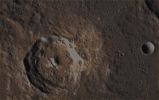
ZZ-Mercury-Craters-Unnamed_Crater-PIA17290-PCF-LXTT-IPF-1.jpgUnnamed and (relatively) Fresh Impact Crater (EDM - Absolute Natural Colors; credits for the additional process. and color.: Dr Paolo C. Fienga/Lunar Explorer Italia/Italian Planetary Foundation)87 visiteThis Absolute Natural Color Image-Mosaic shows us a bright (and, of course, relatively speaking, "fresh") Complex Mercurian Impact Crater - approx. 33 Km (such as about 20,49 miles) in diameter - that exhibits Terraced and Multi-Layered Inner Walls and Slopes - with some Collapse Feature (Mass-Wasting?) here and there -, an also quite Complex Central Peaks' System and, last but not least, the (more than just) possible evidence of a large Pyroclastic Deposit located on it's Eastern Side (---> Dx of the Crater for the Observer), and mostly concentrated in the Region going from about 1 to 4 o'clock of its Outer Surroundings.
Date acquired: November, 6th, 2011
Images Mission Elapsed Time (MET): 229105596, 229105592, 229105588
Images ID: 980566, 980565, 980564
Instrument: Wide Angle Camera (WAC) of the Mercury Dual Imaging System (MDIS)
Center Latitude: 25,42° North
Center Longitude: 266,80° East
Solar Incidence Angle: 52,3° (meaning that the Sun, at the time that the picture was taken, was about 37,7° above the imaged Local Mercurian Horizon)
Emission Angle: 16,8°
Sun-Mercury-Messenger (or "Phase") Angle: 69,1°
This picture (which is a crop from an Original NASA - MESSENGER Spacecraft's false colors Map-Projected image-mosaic published on the NASA - Planetary Photojournal with the ID n. PIA 17290) has been additionally processed, contrast enhanced, magnified and then re-colorized in Absolute Natural Colors (such as the colors that a human eye would actually perceive if someone were onboard the NASA - MESSENGER Spacecraft and then looked down, towards the Surface of Mercury), by using an original technique created - and, in time, dramatically improved - by the Lunar Explorer Italia Team. Different colors, as well as different shades of the same color, mean, among other things, the existence of different Elements (Minerals) present on the Surface of Mercury, each having a different Albedo (---> Reflectivity) and Chemical Composition.MareKromiumLug 14, 2013
|
|

ZZ-Mercury-Terminator-PIA17229-PCF-LXTT-IPF.jpgSouthern Terminator (Absolute Natural Colors; credits for the additional process. and color.: Dr Paolo C. Fienga/Lunar Explorer Italia/Italian Planetary Foundation)118 visiteThis image-mosaic was created by combining two frames that were taken only 96 seconds apart from each other. It is obvious that the NASA - MESSENGER Spacecraft has to be farther away from the Planet Mercury (and, precisely, it must be in the Southern portion of its orbit) to acquire views like these. Mercury's heavily Cratered Surface is very well and really dramatically highlighted here - particularly in the Regions near the Terminator (such as the Boundary Line existing between the Sunlit Dayside and the Dark Nightside of the Planet) -, thus reflecting its, in a way, "violent" history; an history which saw this always mysterious and fascinating Celestial Body being impacted by thousands and thousands of objects (i.e.: Meteors, Comets and, probably, even a few small Asteroids), through the ages.
Date acquired: May 7th, 2013
Images Mission Elapsed Time (MET): 10234404, 10234500
Images ID: 4021801, 4021802
Instrument: Wide Angle Camera (WAC) of the Mercury Dual Imaging System (MDIS)
Center Latitude: 60,00° South
Center Longitude: 260,00° East
This picture (which is an Original NASA - MESSENGER Spacecraft's b/w Map-Projected frame published on the NASA - Planetary Photojournal with the ID n. PIA 17229) has been additionally processed, contrast enhanced, magnified and then colorized in Absolute Natural Colors (such as the colors that a human eye would actually perceive if someone were onboard the NASA - MESSENGER Spacecraft and then looked down, towards the Surface of Mercury), by using an original technique created - and, in time, dramatically improved - by the Lunar Explorer Italia Team. Different colors, as well as different shades of the same color, mean, among other things, the existence of different Elements (Minerals) present on the Surface of Mercury, each having a different Albedo (---> Reflectivity) and Chemical Composition.MareKromiumGiu 16, 2013
|
|

ZZ-Mercury-Craters-Tolstoj_Basin-PIA16663-PCF-LXTT-IPF.jpgTolstoj Basin and Surroundings (Absolute Natural Colors; credits for the additional process. and color.: Dr Paolo C. Fienga/Lunar Explorer Italia/Italian Planetary Foundation)72 visiteThis image of the Limb of the Planet Mercury shows, among other fascinating Surface Features, the location of the Impact Basin Tolstoj (approximately 350 Km - such as about 217,35 miles - in diameter). The interior of Tolstoj is filled with smooth Plains while the exterior is largely made of the so-called Low Reflectivity Material (or LRO, for short). Just to give to our Readers an idea of the real dimensions and proportions of what is visible on this part of Mercury, you have to consider that today's frame is approx. 2770 Km (such as about 1720,17 miles) across.
Date acquired: February 12th, 2013
Image Mission Elapsed Time (MET): 212797716
Image ID: 202274
Instrument: Wide Angle Camera (WAC) of the Mercury Dual Imaging System (MDIS)
Center Latitude: 8,04° South
Center Longitude: 200,07° East
Solar Incidence Angle: 60,1° (meaning that the Sun, at the time that the picture was taken, was about 29,9° above the imaged Local Mercurian Horizon)
Emission Angle: 48,1°
Sun-Mercury-Messenger (or "Phase") Angle: 96,8°
This picture (which is an Original NASA - MESSENGER Spacecraft's b/w Map-Projected frame published on the NASA - Planetary Photojournal with the ID n. PIA 16663) has been additionally processed, contrast enhanced, magnified and then colorized in Absolute Natural Colors (such as the colors that a human eye would actually perceive if someone were onboard the NASA - MESSENGER Spacecraft and then looked down, towards the Surface of Mercury), by using an original technique created - and, in time, dramatically improved - by the Lunar Explorer Italia Team. Different colors, as well as different shades of the same color, mean, among other things, the existence of different Elements (Minerals) present on the Surface of Mercury, each having a different Albedo (---> Reflectivity) and Chemical Composition.MareKromiumGiu 16, 2013
|
|

ZZ-Mercury-Craters-Tyagaraja_Crater-PIA17051-PCF-LXTT-IPF-2.jpgTyagaraja Crater (EDM - Absolute Natural Colors; credits for the additional process. and color.: Dr Paolo C. Fienga/Lunar Explorer Italia/Italian Planetary Foundation)89 visiteThis colorful picture of Tyagaraja Crater (which is about 97 Km - such as approx. 60,23 miles - in diameter) and its surroundings shows us many different types of Material that exist on the Surface of Mercury. For instance, the very bright, white areas visible on the Floor of the Crater (in particular to the North/East, at about 3 o'clock) are the very "famous" (and common, on Mercury) Hollows; as a matter of fact, they are so much brighter than the surrounding Areas that they appear slightly over-saturated in this particular image.
The yellow/red/orangish spots located near the center of the Crater are, most likely, Volcanic Materials which surround a Pyroclastic Vent. Last, but not least, the very Dark Material (almost black) that is visible all around Tyagaraja Crater (and, particularly, towards the South/Western Regions surrounding Tyagaraja - such as the areas located in the lower left (Sx) side of the frame) is Low Reflectance Material (LRM).
Just out of curiosity, if you look carefully at the outline of Tyagaraja Crater, you may notice that its shape is quite unusual for a Primary Impact Crater: in fact, its shape it is not a "circle", but rather an (almost regular, on its Western side) "hexagon". Also, the Inner Slopes of the Crater show clear evidence of multiple Layers (and such a circumstance, at least for the time being, is really hard, for Planetary Scientists, to fully understand and explain).
Date acquired: April 25th, 2013
Images Mission Elapsed Time (MET): 9232956, 9232948, 9232944
Images ID: 3950118, 3950116, 3950115
Instrument: Wide Angle Camera (WAC) of the Mercury Dual Imaging System (MDIS)
Center Latitude: 3,94° North
Center Longitude: 211,20° East
Resolution: 22 meters/pixel
Solar Incidence Angle: 13,4° (meaning that the Sun, at the time that the picture was taken, was about 76,6° above the imaged Local Mercurian Horizon)
Emission Angle: 18,0°
Sun-Mercury-Messenger (or "Phase") Angle: 31,5°
This picture (which is an Original NASA - MESSENGER Spacecraft Map Projected false color image-mosaic published on the NASA - Planetary Photojournal with the ID n. PIA 17051) has been additionally processed, cropped, contrast enhanced, magnified and then re-colorized in Absolute Natural Colors (such as the colors that a human eye would actually perceive if someone were onboard the NASA - MESSENGER Spacecraft and then looked down, towards the Surface of Mercury), by using an original technique created - and, in time, dramatically improved - by the Lunar Explorer Italia Team. Different colors, as well as different shades of the same color, mean, among other things, the existence of different Elements (Minerals) present on the Surface of Mercury, each having a different Albedo (---> Reflectivity) and Chemical Composition.MareKromiumMag 26, 2013
|
|

ZZ-Mercury-Craters-Tyagaraja_Crater-PIA17051-PCF-LXTT-IPF-1.jpgTyagaraja Crater (CTX Frame - Absolute Natural Colors; credits for the additional process. and color.: Dr Paolo C. Fienga/Lunar Explorer Italia/Italian Planetary Foundation)104 visiteThis colorful picture of Tyagaraja Crater (which is about 97 Km - such as approx. 60,23 miles - in diameter) and its surroundings shows us many different types of Material that exist on the Surface of Mercury. For instance, the very bright, white areas visible on the Floor of the Crater (in particular to the North/East, at about 3 o'clock) are the very "famous" (and common, on Mercury) Hollows; as a matter of fact, they are so much brighter than the surrounding Areas that they appear slightly over-saturated in this particular image. The yellow/red/orangish spots located near the center of the Crater are, most likely, Volcanic Materials which surround a Pyroclastic Vent. Last, but not least, the very Dark Material (almost black) that is visible all around Tyagaraja Crater (and, particularly, towards the South/Western Regions surrounding Tyagaraja - such as the areas located in the lower left (Sx) side of the frame) is Low Reflectance Material (LRM). Just out of curiosity, if you look carefully at the outline of Tyagaraja Crater, you may notice that its shape is quite unusual for a Primary Impact Crater: in fact, its shape it is not a "circle", but rather an (almost regular, on its Western side) "hexagon".
Date acquired: April 25th, 2013
Images Mission Elapsed Time (MET): 9232956, 9232948, 9232944
Images ID: 3950118, 3950116, 3950115
Instrument: Wide Angle Camera (WAC) of the Mercury Dual Imaging System (MDIS)
Center Latitude: 3,94° North
Center Longitude: 211,20° East
Resolution: 22 meters/pixel
Solar Incidence Angle: 13,4° (meaning that the Sun, at the time that the picture was taken, was about 76,6° above the imaged Local Mercurian Horizon)
Emission Angle: 18,0°
Sun-Mercury-Messenger (or "Phase") Angle: 31,5°
This picture (which is an Original NASA - MESSENGER Spacecraft Map Projected false color image-mosaic published on the NASA - Planetary Photojournal with the ID n. PIA 17051) has been additionally processed, contrast enhanced and then re-colorized in Absolute Natural Colors (such as the colors that a human eye would actually perceive if someone were onboard the NASA - MESSENGER Spacecraft and then looked down, towards the Surface of Mercury), by using an original technique created - and, in time, dramatically improved - by the Lunar Explorer Italia Team. Different colors, as well as different shades of the same color, mean, among other things, the existence of different Elements (Minerals) present on the Surface of Mercury, each having a different Albedo (---> Reflectivity) and Chemical Composition.MareKromiumMag 26, 2013
|
|

ZZ-Mercury-Craters-Balanchine_Crater-PIA17057-PCF-LXTT-IPF-2.jpgBalanchine Crater (EDM - Absolute Natural Colors; credts for the additional process. and color.: Dr Paolo C. Fienga/Lunar Explorer Italia/Italian Planetary Foundation)83 visiteThe Impact Crater visible at the center of this scene (such as the one whose Floor is largely covered by extremely bright - and therefore, here, slightly over-exposed - Hollows) has been named "Balanchine", after the choreographer George Balanchine (Leningrad, 1904/New York City - NY - 1983). Now, if you carefully take a look at the Ejecta Blanket which emanates from Balanchine Crater, you may ask yourself what could have caused such an Asymmetric Pattern. Obviously, no one can give an absolutely definitive answer to this kind of question, as you should know, but a reasonable possibility is that the irregularly shaped Ejecta Pattern of Balanchine Crater formed (perhaps just in part) on top of a similarly sized, and pre-existing, Impact Crater.
In this scenario, the older Impact Crater could have unearthed the Lower Reflectance dark-gray Deposit (which, by the way, appear blue in the Original NASA false color image-mosaic) from beneath the Surface, while, some time (perhaps a few millions of years) afterwards, a certain portion of them was (unevenly) redistributed all over the Mercurian Surface by the impact that formed Balanchine.
Date acquired: June 29th, 2011
Images Mission Elapsed Time (MET): 217863931, 217863927, 217863923
Images ID: 441964, 441963, 441962
Instrument: Wide Angle Camera (WAC) of the Mercury Dual Imaging System (MDIS)
Center Latitude: 39,05° North
Center Longitude: 175,80° East
Resolution: 282 meters/pixel
Solar Incidence Angle: 39,6° (meaning that the Sun, at the time that the picture was taken, was about 50,4° above the imaged Local Mercurian Horizon)
Emission Angle: 6,3°
Sun-Mercury-Messenger (or "Phase") Angle: 40,9°
This picture (which is a crop taken from an Original NASA - MESSENGER Spacecraft Map Projected false color image-mosaic published on the NASA - Planetary Photojournal with the ID n. PIA 17057) has been additionally processed, contrast enhanced, magnified and then re-colorized in Absolute Natural Colors (such as the colors that a human eye would actually perceive if someone were onboard the NASA - MESSENGER Spacecraft and then looked down, towards the Surface of Mercury), by using an original technique created - and, in time, dramatically improved - by the Lunar Explorer Italia Team. Different colors, as well as different shades of the same color, mean, among other things, the existence of different Elements (Minerals) present on the Surface of Mercury, each having a different Albedo (---> Reflectivity) and Chemical Composition.MareKromiumMag 26, 2013
|
|
| 248 immagini su 21 pagina(e) |
|
3 | |
|
|
|
|
|
|
|
|
|
|





