| |

| Ultimi arrivi - Mercury |

ZZ-Mercury-Craters-Sveinsdottir_Crater-PIA11078.jpgSveinsdóttir Crater in 3D74 visiteThis graphic shows a portion of the fault scarp Beagle Rupes cutting through the highly elliptical crater Sveinsdóttir in a three-dimensional (3D) representation.
By combining information from multiple images of the same portion of Mercury's surface taken under different viewing angles, the topography of the surface was determined. A high-resolution image was then overlaid on the topography map, resulting in this 3D image.
In total, over 80 MESSENGER images were used to create this 3D view of Mercury's surface.
As the MESSENGER mission continues, many more images will be acquired, and these additional images will provide views of Mercury's surface from a variety of illumination conditions and viewing geometries. These myriad views, anchored by topographic profiles to be acquired by MESSENGER's laser altimeter, will enable large portions of the surface of Mercury to be studied in 3D.
Date Acquired: January 14, 2008
Image Mission Elapsed Time (MET) : NAC image from 108830230 resampled on a topographic map made from more than 80 NAC and WAC images.
Instrument: Narrow Angle Camera (NAC) and Wide Angle Camera (WAC) of the Mercury Dual Imaging System (MDIS)
Scale: Sveinsdóttir Crater is about 120 by 220 Km (approx. 75 by 140 miles). MareKromiumSet 16, 2008
|
|

ZS-Mercury-PIA11077.jpgFaults in Caloris Basin64 visiteAs the youngest large impact basin known on Mercury, the Caloris Basin has landforms that are better preserved than in older basins, which have been more modified by impact cratering.
This figure, recently published in Science magazine, shows a map of many linear features within Caloris Basin that formed when the near-surface rocks were subjected to large horizontal forces. The Caloris Basin contains hundreds of extensional troughs, mapped as black lines, where the surface has been pulled apart and faulted.
Pantheon Fossae (located inside the white box of the top map and shown in detail in the bottom image) has over 200 such troughs in a radiating pattern, but near the outer edges of the basin interior troughs are seen in patterns broadly concentric to Caloris Basin. The Caloris Basin interior also has been deformed by many wrinkle ridges, mapped as red lines, formed when the surface was compressed or shortened horizontally. Relationships between the extensional troughs and contractional wrinkle ridges provide information about the evolution of the Caloris basin and Mercury's interior.
Date Acquired: January 14, 2008
Instrument: Narrow Angle Camera (NAC) of the Mercury Dual Imaging System (MDIS)
Scale: Caloris Basin is about 1550 Km (approx. 960 miles) in diameter. The crater Apollodorus near the center of Pantheon Fossae is about 41 Km (approx. 25 miles) in diameter. MareKromiumSet 16, 2008
|
|

Mercury-PIA11013.jpgMapping a "Volcano"68 visiteMESSENGER Science Team members are busy studying in detail the newly discovered volcanoes on Mercury (see also PIA10942). This figure, recently published in Science magazine, shows a NAC mosaic of the largest volcano currently identified on Mercury and a geologic sketch map of the major features in the surrounding area.
The “irregularly-shaped depressions” are believed to correspond to volcanic vents, and the “margin of the dome-like feature” marks the outer limits of lava flows from the vents that are thought to have covered up the underlying surface of “hummocky plains”.
The unlabeled double line outlines bright material associated with the volcano, believed to be pyroclastic deposits ejected during volcanic eruptions at the vents. A “highly-embayed impact crater” also appears to have had lava flow up to its rim, while a slightly more distant impact crater is “relatively fresh” and unchanged by any lava.
The volcano is located just inside the rim of the Caloris Impact Basin (see also PIA10383), labeled as “Caloris Basin Rim Units” on this map. Maps such as this are aiding scientists as they work to understand the history of volcanism on Mercury.
Date Acquired: January, 14th, 2008
Image Mission Elapsed Time (MET): Mosaic of 108826812 and 108826877
Instrument: Narrow Angle Camera (NAC) of the Mercury Dual Imaging System (MDIS)
Spacecraft Altitude: about 10.500 Km (approx. 6500 miles)MareKromiumSet 01, 2008
|
|

ZQ-Mercury-PIA10942.jpgShield-Volcano on Mercury65 visiteAs reported in the July 4, 2008 issue of Science magazine, volcanoes have been discovered on Mercury’s Surface from images acquired during MESSENGER’s first Mercury flyby. This image shows the largest feature identified as a volcano in the upper center of the scene. The volcano has a central kidney-shaped depression, which is the vent, and a broad smooth dome surrounding the vent. The volcano is located just inside the rim of the Caloris Impact Basin. The rim of the Basin is marked with hills and mountains, as visible in this image. The role of volcanism in Mercury’s history had been previously debated, but MESSENGER’s discovery of the first identified volcanoes on Mercury’s surface shows that volcanism was active in the distant past on the innermost Planet.
Date Acquired: January 14, 2008
Image Mission Elapsed Time (MET:108826877
Instrument: Narrow Angle Camera (NAC) of the Mercury Dual Imaging System (MDIS)
Resolution: 270 meters/pixel (0,17 miles/pixel)
Scale: This image is about 270 Km across (approx. 170 miles)
Spacecraft Altitude: approx. 10.500 Km (about 6500 miles)MareKromiumAgo 24, 2008
|
|

ZQ-Mercury-PIA10984.jpgCraters "Deformed" and "Shortened" on Mercury65 visiteNumerous examples of craters that have been deformed and shortened by younger faults have been identified on images returned from MESSENGER’s first flyby of Mercury. In three cases shown here (arrows), portions of the floor and rim of a crater were buried when a large block of crust was thrust over the crater during the formation of a prominent fault scarp or cliff. By comparing the estimated size and shape of the original, undeformed crater with the crater’s current geometry, scientists can infer the amount of movement between the two crustal blocks on either side of the fault. This figure was recently published in Science magazine.
For each of the three examples of deformed and shortened craters shown here, movement on the faults buried at least a kilometer of the original crater. A: 17-Km (11-mile) diameter crater (arrows) shortened by Beagle Rupes. B: 5-Km (3-mile) diameter crater deformed near the rim of an older, larger crater, shown enlarged in the box on the lower left. C: 11-Km (7-mile) diameter crater (arrows) shortened by a North/West-South/East-trending fault scarp.MareKromiumAgo 24, 2008
|
|

ZZ-Mercury-Rupes-PIA11012.jpgMercurian Rupes74 visiteGiant scarps (cliffs), called rupes (see PIA10609), are believed to have formed when Mercury’s interior cooled and the entire Planet shrank slightly as a result. This figure, recently published in Science magazine, shows one of these scarps (white arrows) that is about 270 Km (approx. 170 miles) long.
This portion of Mercury’s surface was seen during the Mariner 10 flybys, but this scarp, despite its large size, was not visible in the Mariner 10 photos because the Sun was nearly overhead at the time and, consequently, the scarp did not cast a discernable shadow.
In contrast, MESSENGER acquired a mosaic of this area (see PIA10605) before the spacecraft’s closest approach to the Planet, when this portion of the Surface was near the Terminator, the line between the sunlit dayside and the dark night side of the Planet. Such lighting produced long shadows, enabling this rupes to be recognized for the first time.
Date Acquired: January 14, 2008
Image Mission Elapsed Time (MET): Mosaic of images from 108821370, 108821375, 108821397 and 108821402
Instrument: A: Narrow Angle Camera (NAC) of the Mercury Dual Imaging System (MDIS)MareKromiumAgo 24, 2008
|
|

ZQ-Mercury-PIA11025.jpgWrinkle-Ridge Rings on Mercury and Mars63 visitePlanetary scientists commonly compare and contrast the geologic features found on different planetary bodies, to learn about the similar processes that operated throughout the Solar System and to understand how each planet is different and unique. This figure, recently published in Science magazine, shows wrinkle-ridge rings on both Mercury (upper image) and Mars (lower image) that look quite similar. Wrinkle ridges arrayed in such a ring are interpreted to trace the rim of an impact crater that was nearly or completely flooded by lavas prior to ridge formation. Wrinkle ridges are created by forces that compress the crust horizontally.
A buried crater rim can concentrate the near-surface forces and cause the wrinkle ridges to form a ring. The presence of wrinkle-ridge rings is thus good evidence that volcanism helped to shape the surfaces of both Mars and Mercury.
Date Acquired: January 14, 2008
Image Mission Elapsed Time (MET): A: 108826972
Instrument: A: Narrow Angle Camera (NAC) of the Mercury Dual Imaging System (MDIS)
Mars Image: B: Mars Express High-Resolution Stereo Camera nadir image h2660_0001
MareKromiumAgo 24, 2008
|
|

ZZ-Mercury-Terminator-PIA10937-0.jpgNorthern Latitudes and a possible Orbital Anomaly (natural colors; credits: Lunexit)75 visiteAbout 91 minutes after MESSENGER’s closest pass by the Planet, MDIS acquired this image of Mercury’s Northern Surface, which is one in a set of 48 that form a mosaic of the departing Planet. In this image, the left portion of the Surface fades into darkness at the Terminator, the line between the sunlit dayside of the Planet and the dark night side.
The left-side portions of the surface that are just coming out of the darkness are being hit with the first rays of morning sunlight. Some of the surface to the right of this scene can be viewed in this previously released image looking toward Mercury’s North Pole (PIA10193).
Date Acquired: January 14, 2008
Image Mission Elapsed Time (MET): 108830334
Instrument: Narrow Angle Camera (NAC) of the Mercury Dual Imaging System (MDIS)
Resolution: 0,8 Km/pixel (0,5 miles/pixel) Scale: The width of this image is about 800 Km (approx. 500 miles)
Spacecraft Altitude: about 30.700 Km (approx. 19.100 miles)MareKromiumAgo 24, 2008
|
|

ZZ-Mercury-Limb-PIA10936.jpgDürer Basin (natural colors; credits: Lunexit)62 visiteMESSENGER snapped this image of Mercury’s horizon about 56 minutes before the Spacecraft’s closest pass by the Planet. The distinctive peak-ring basin Dürer (named from Mariner 10 photos for the German artist Albrecht Dürer) is visible.
The smaller crater Mickiewicz (named for the Polish poet Adam Mickiewicz) can also be seen, with a smaller central peak-ring structure in the middle of its crater floor.
Craters form ring structures during the impact process that creates the crater, and the number and characteristics of the rings depend on the crater’s size. Raditladi, imaged for the first time by MESSENGER and recently named, also shows a pronounced peak-ring structure.
Date Acquired: January 14, 2008
Image Mission Elapsed Time (MET): 108821505
Instrument: Narrow Angle Camera (NAC) of the Mercury Dual Imaging System (MDIS)
Scale: Dürer crater is about 190 Km (approx. 120 miles) in diameter
Spacecraft Altitude: about 18.300 Km (approx. 11.400 miles)MareKromiumAgo 24, 2008
|
|

ZZ-Mercury-Craters-Kertész_Crater-PIA10933.jpgKertész Crater (Saturated Natural Colors; credits for the additional process. and color.: Dr Paolo C. Fienga/Lunar Explorer Italia/Italian Planetary Foundation)61 visiteLocated in the Western Edge of Mercury's giant Caloris Basin, Kertész Crater (recently named for André Kertész, a Hungarian-born American photographer) has some unusual, bright material located on its floor. Sander crater, located in the North-Western Edge of Caloris Basin, also shows bright material on its floor.
The MESSENGER Science Team is investigating the nature and composition of these bright materials and making comparisons between these two craters both located at the edges of Caloris Basin.
Just North-East of Kertész, a small crater has very bright rays and ejecta in this image, indicating that the crater is young.
Date Acquired: January 14, 2008
Image Mission Elapsed Time (MET): 108826812
Instrument: Narrow Angle Camera (NAC) of the Mercury Dual Imaging System (MDIS)
Resolution: 260 meters/pixel (0,16 miles/pixel
Scale: Kertész Crater is about 34 Km (approx. 21 miles) in diameter
Spacecraft Altitude: about 10.200 Km (approx. 6.340 miles)MareKromiumAgo 24, 2008
|
|

ZZ-Mercury-Limb-PIA10359.jpgCaloris Basin (natural colors; credits: Lunexit)61 visiteThis natural-color image of Mercury shows the great Caloris Impact Basin (see also PIA10383), visible in this image as a large, circular feature in the center of the picture. The contrast between the colors of the Caloris Basin Floor and those of the surrounding plains indicate that the composition of Mercury's surface is variable. Many additional geological features with intriguing color signatures can be identified in this image. For example, the bright spots just inside the rim of Caloris Basin are thought to mark the location of Volcanic Features, such as the volcano shown in this previously released Narrow Angle Camera (NAC) image PIA10942.
MESSENGER Science Team members are studying these regional color variations in detail, to determine the different mineral compositions of Mercury's surface and to understand the geologic processes that have acted on it. (...)
Date Acquired: January 14, 2008
Image Mission Elapsed Times (MET): 108827278-108827328
Instrument: Wide Angle Camera (WAC) of the Mercury Dual Imaging System (MDIS)
Resolution: about 2,3 Km (approx. 1,4 miles/pixel)
Scale: Caloris Basin is about 1550 Km in diameter (approx. 960 miles)
Spacecraft Altitude: approx. 13.000 Km (about 8000 miles)MareKromiumAgo 24, 2008
|
|
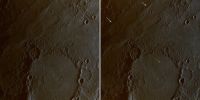
ZZ-Mercury-Global_View_of_the_Surface-PIA10601.jpgNew Lands on Mercury (Extremely Enhanced Natural Colors; credits for the additional process. and color.: Dr Paolo C. Fienga - Lunexit Team)68 visiteOn January 14, 2008, MESSENGER became the First Spacecraft in over three decades to visit Mercury, snapping images of a large portion of Mercury's Surface previously unseen by spacecraft. As the Spacecraft proceeds on its journey, the science team continues to study the 1213 images returned from the mission's historic first flyby. The probe's trajectory will bring it to a second Mercury flyby on October 6, 2008.
MESSENGER's Narrow Angle Camera (NAC) of the Mercury Dual Imaging System (MDIS) captured this image during the flyby of January 2008. The Sun is illuminating this Region at a low angle, accentuating the modest ridges and other low topography on these nearly flat plains. Low ridges trend from the top-center of the image to the left edge (white arrows). The ghostly remains of craters are visible, filled to their rims by what may have been volcanic lavas (red arrows). The faint remnant of an inner ring within the large crater in the bottom half of this picture can be seen (blue arrow); the area interior to this ring was also flooded, possibly by lava, nearly to the point of disappearance. Clusters of secondary craters on the floor of the large crater and elsewhere (yellow arrows) formed when clumps of material were ejected from large impacts beyond the view of this image, which is about 350 Km (approx. 220 miles) across.
Image Mission Elapsed Time (MET): 108826972MareKromiumAgo 24, 2008
|
|
| 248 immagini su 21 pagina(e) |
|
|
|
|
|
15 | |
|
|
|
|
|
|





