| |

| Ultimi arrivi - Mercury |

ZU-PIA12038.jpgIn search of the "Vulcanoids"63 visiteIn mid-February 2009, before and after MESSENGER's latest Perihelion (such as the closest approach to the Sun), an imaging campaign was conducted to search for "Vulcanoids": small rocky bodies that have been postulated to exist in orbits between Mercury and the Sun. Those images are still waiting to be transmitted to Earth.
The image here is from the first set of 240 MDIS images taken to look for vulcanoids, acquired in June 2008. It is a 10" exposure taken through the WAC's clear filter. Jupiter is bright and visible in the image. The camera field of view is nearly large enough to capture the entire width of Sagittarius, a constellation of the Zodiac visible low and to the South in Summer from temperate latitudes in the Northern Hemisphere. The Greek letters identify some of the brighter stars in Sagittarius.
During the Vulcanoid search campaign, 4-5 images of the same scene are taken back to back. This procedure allows Cosmic Ray strikes on the camera's detector to be identified and enables fainter objects to be detected. One such Cosmic Ray strike is labeled on this image. In this single image, the Cosmic Ray strike appears similar to the stars, but in the 4 images taken immediately after this one, the Cosmic Ray strike is gone whereas the stars remain. Images are also taken hours and days apart, so the motion of objects in the sky can be determined. If a Vulcanoid were imaged, its motion through the sky would appear very different from motions of the background stars and known Solar System objects.
No Vulcanoids have been found yet, but the latest set of acquired images will expand the volume of the search region examined so far.
Date Acquired: June 4, 2008
Image Mission Elapsed Time (MET): 121050477
Instrument: Wide Angle Camera (NAC) of the Mercury Dual Imaging System (MDIS)
WAC Filter: 2 (clear filter)
Field of View: The WAC has a 10,5° field of viewMareKromiumGiu 23, 2009
|
|

ZZ-Mercury-Craters-Raditladi_Impact_Basin-PIA12042_fig1.jpgRaditladi Basin62 visiteRaditladi Basin, imaged during MESSENGER's first Mercury flyby and named in April 2008 (PIA10611), is intriguing for several reasons. Shown extending across the top of this high-resolution NAC image, Raditladi Basin is relatively young, with only a few small impact craters on its floor and with well-preserved walls and peak-ring structure.
Visible on the floor of Raditladi are concentric troughs (blue arrows), formed by extension (pulling apart) of the surface. However, extensional troughs on Mercury are quite rare, having been seen to date only in two other locations on the Planet: as part of Pantheon Fossae and other troughs in Caloris Basin and on the floor of Rembrandt, the large basin discovered during MESSENGER's second Mercury flyby (see PIA11769).
Understanding how these troughs formed in the young Raditladi Basin could provide an important indicator of processes that acted relatively recently in Mercury’s geologic history.
Raditladi Basin was the topic of one of 25 presentations made by MESSENGER team members at the 40th Lunar and Planetary Science Conference held last week (April 2009).
Date Acquired: January 14, 2008
Image Mission Elapsed Time (MET): 108826792
Instrument: Narrow Angle Camera (NAC) of the Mercury Dual Imaging System (MDIS)
Resolution: 250 meters/pixel (0,16 miles/pixel)
Scale: Raditladi basin has a diameter of approx. 257 Km (about 160 miles)
Spacecraft Altitude: approx. 10.000 Km (about 6200 miles)MareKromiumGiu 23, 2009
|
|

ZU-PIA12051.jpgGlobal Map of Mercury76 visiteMESSENGER's two flybys of Mercury in 2008 have greatly increased the portion of the Planet's Surface that has been imaged by spacecraft, from approximately 45% coverage obtained by Mariner 10 to about 90% coverage following the second flyby.
This significant increase in imaging coverage is enabling global studies of Mercury's Surface for the first time. MESSENGER team members recently published an article in the 1st of May issue of the "Science" Magazine that utilizes this new global view to examine the evolution of Mercury's crust. This recent work was also featured in a NASA media teleconference, and the top image shown here was presented during that teleconference.
Both images are orthographic map projections of Mercury created with WAC enhanced-color images. The orthographic projection produces a view that has the perspective that one would see from deep space. The WAC enhanced color uses a statistical analysis of images from all 11 WAC filters to highlight subtle differences in the crustal rocks on Mercury's Surface. For other examples and discussion of enhanced color images, see previous releases of the departure view from Mercury flyby 2, Rudaki Plains, Thakur Crater and Caloris Basin.
The top view uses images from Mercury flyby 1, with the thin crescent of Mercury imaged during approach forming the right portion of the globe and the fuller departure view showing Caloris Basin forming the left side and majority of the view.
The black strip between the approach and departure images is a portion of Mercury's Surface not viewed by MESSENGER during the flybys. Similarly, the approach and departure images obtained during Mercury flyby 2 yielded the bottom view.
The top and bottom projections are centered on 180° and 0° Longitude, respectively.
Date Acquired: January 14, 2008, and October 6, 2008
Instrument: Wide Angle Camera (WAC) of the Mercury Dual Imaging System (MDIS)
Scale: Mercury’s diameter is about 4880 Km (approx. 3030 miles)MareKromiumGiu 23, 2009
|
|

ZZ-Mercury-Craters-Munch_Crater_et_al_-PIA12034.jpgMunch, Sander and Poe Crater (Natural Colors; credits: Lunar Explorer Italia)69 visitenessun commentoMareKromiumGiu 23, 2009
|
|

ZZ-Mercury-Craters-Munch_Crater_et_al_-PIA12034_fig1.jpgMunch, Sander and Poe Crater64 visiteSander, Munch and Poe are a trio of impact craters within the Caloris Impact Basin (see PIA10359).
Munch and Poe were recently named (see PIA11762), while Sander received its name in the first set of feature names (see PIA10611) after MESSENGER’s first Mercury flyby. Munch is named for Edvard Munch (1863-1944), the Norwegian artist and painter of "The Scream".
The crater Poe takes its name from Edgar Allan Poe, the 19th century American writer and poet.
Sander is named for the German photographer August Sander (1876-1964).
Sander Crater exhibits very bright material within its Rim, while Munch and Poe each are surrounded by dark material. The presence of both bright and dark materials suggest that there is a diversity of rock types on and below Mercury's Surface, with different mineralogical compositions from those of the volcanic plains that comprise the majority of the floor of Caloris Basin.
The 3 Craters are located in the far northern part of the Caloris Basin. The basin Rim (see PIA10942), indicated by yellow arrows, can be seen in the upper left and extending across the top of this image, and many fractures within Caloris Basin (see PIA10606) are visible in the lower portion of this image.
Date Acquired: January 14, 2008
Image Mission Elapsed Time (MET): 108828587
Instrument: Narrow Angle Camera (NAC) of the Mercury Dual Imaging System (MDIS)
Resolution: 520 meters/pixel (0,32 miles/pixel)
Scale: This image is about 550 Km (approx. 340 miles) across
Spacecraft Altitude: about 20.400 Km (approx. 12.400 miles)MareKromiumGiu 23, 2009
|
|

ZZ-Mercury-Scarp-PIA12054.jpgLong and High Scarp (Natural Colors; credits: Lunar Explorer Italia)62 visiteThe Scarp cutting through this Unnamed Crater was imaged as MESSENGER approached the Planet during the mission's second Mercury flyby. The full NAC image acquired by MDIS is shown in a previous release (see PIA11772) while the image shown here is a reprojected view. Compare the two images to see the differences.
By using very precise knowledge about the time that the image was taken and the location of the Spacecraft at that time, the original image can be mapped onto a globe of Mercury. Once mapped onto a Mercury globe, that globe can be viewed in many different ways, including reprojections that create flat maps of Mercury's Surface, as seen in the Global Map of Mercury (see PIA11403). The reprojected image shown here is from a simple cylindrical map projection. Map projections are needed to measure accurately the extent of features on the surface. For example, from this reprojection it was determined that this Scarp is about 1 Km (0,6 miles) high and over 160 Km (about 100 miles) in length. MESSENGER Science Team members recently published an image similar to this reprojection in Science magazine.
Date Acquired: October 6, 2008
Image Mission Elapsed Time (MET): 131766501
Instrument: Narrow Angle Camera (NAC) of the Mercury Dual Imaging System (MDIS)
Resolution: 420 meters/pixel (0,26 miles)
Scale: This crater is about 200 Km (about 124 miles) in diameter
Spacecraft Altitude: 16.300 Km (about 10.100 miles)MareKromiumGiu 23, 2009
|
|

ZZ-Mercury-Craters-Praxiteles_Crater-PIA12052.jpgPraxiteles Crater (enhanced Natural Colors; credits: Lunar Explorer Italia)68 visiteMESSENGER's high-resolution images obtained during the mission's second Mercury flyby have revealed a number of irregularly shaped depressions on the floor of Praxiteles Crater. These depressions are intriguing indications of possible past volcanic activity within this Crater. View the previously released NAC image of Praxiteles for additional discussion.
The image shown here is similar to one recently published in the 1st of May issue of the "Science" magazine. This image was created by first mosaicking together the highest-resolution NAC images available of Praxiteles (one of which is shown in the previous web release), to produce complete coverage of the Crater. Independently, an enhanced-color image of Praxiteles was created by using images from all 11 WAC narrow-band color filters. (Visit last week's web release for more examples of enhanced-color images see PIA12051).
The WAC images provide important color information, but the WAC resolution is considerably less than that of the mosaicked NAC images. Thus, by overlaying a slightly transparent version of the WAC enhanced-color image on the high-resolution NAC mosaic, the high-resolution color view of Praxiteles crater shown here was produced. This overlay-color view helps associate the color features with the morphologic surface features. The fact that the irregularly shaped depressions on the floor of Praxiteles are associated with bright orange and yellow color features provides evidence that the depressions may be related to past volcanic activity in this area of Mercury.
Date Acquired: October 6, 2008
Instrument: Wide Angle Camera (WAC) and Narrow Angle Camera (NAC) of the Mercury Dual Imaging System (MDIS)
Resolution: 210 meters/pixel (0,13 miles/pixel)
Scale: Praxiteles Crater has a diameter of about 182 Km (approx. 113 miles) MareKromiumGiu 23, 2009
|
|

ZZ-Mercury-Limb-PIA12047.jpgMercurian Limb with Rembrandt Basin (Natural Colors; credits: Lunar Explorer Italia)62 visiteThis mosaic was assembled using NAC images acquired as the MESSENGER spacecraft approached the Planet during the mission's second Mercury flyby. The Rembrandt Impact Basin is seen at the center of the mosaic, as night was falling across the Basin's Eastern Edge. An image similar to this one appears on the cover of the 1st of May issue of the "Science" magazine, which contains four articles on the latest results from that flyby. Click here to view more materials presented during a NASA media teleconference about these latest findings.
Date Acquired: October 6, 2008
Instrument: Narrow Angle Camera (NAC) of the Mercury Dual Imaging System (MDIS)
Scale: Rembrandt Basin is approx. 715 Km (about 444 miles) in diameterMareKromiumGiu 23, 2009
|
|

ZZ-Mercury-Limb-PIA12046.jpgMercurian Limb and Navoi Crater (Natural Colors; credits: Lunar Explorer Italia)61 visiteAt the center of this NAC image is the crater Navoi, named in November 2008 for the Uzbek poet Alisher Navoi (1441/1501 - see also PIA11762).
Located in the far north of Mercury’s Northern Hemisphere, Navoi can be seen clearly as a bright orange feature near the top of a previously released enhanced-color Wide Angle Camera (WAC) image of the Caloris Basin (part of which is shown in this release) (see PIA10359). As seen in that color WAC image, Navoi contains uncommon reddish material that indicates a different rock composition from its surroundings. In the high-resolution NAC image shown here, Navoi also appears to have an irregularly shaped depression in its center. Such depressions have been seen elsewhere on Mercury, including within Praxiteles Crater (see PIA12040), and may indicate past volcanic activity.
Date Acquired: January 14, 2008
Image Mission Elapsed Time (MET): 108828804
Instrument: Narrow Angle Camera (NAC) of the Mercury Dual Imaging System (MDIS)
Resolution: 550 meters/pixel (0,34 miles)
Scale: Navoi is about 66 Km (approx. 41 miles) in diameter
Spacecraft Altitude: approx. 21.700 Km (about 13.500 miles)MareKromiumGiu 23, 2009
|
|

ZZ-Mercury-Terminator-PIA12045.jpgMercurian Terminator (Natural Colors; credits: Lunar Explorer Italia)73 visiteThis high-resolution NAC image shows a view of Mercury's Dawn Terminator, the division between the sunlit dayside and dark nightside of the planet, as seen as the MESSENGER Spacecraft departed the Planet during the mission's second Mercury flyby.
This frame is just one of 195 images that make up the second NAC mosaic obtained following closest approach (see PIA11767). A mosaic is a series of images that form a larger picture, in this case a high-resolution view of a portion of Mercury's Northern Hemisphere. This image is also just one of the 1287 total images acquired during Mercury flyby 2.
Last week, all of the images (as well as data from MESSENGER's other instruments) collected during Mercury flyby 2 were made publicly available on NASA's Planetary Data System (PDS) website, giving scientists around the world access to this exciting new dataset.
Date Acquired: January 14, 2008
Image Mission Elapsed Time (MET): 108829034
Instrument: Narrow Angle Camera (NAC) of the Mercury Dual Imaging System (MDIS)
Resolution: 590 meters/pixel (0,37 miles)
Scale: Moody is approx. 80 Km (about 50 miles) in diameter
Spacecraft Altitude: about 23.100 Km (approx. 14.300 miles)MareKromiumGiu 23, 2009
|
|

ZZ-Mercury-Global_View_of_the_Surface-PIA11795_fig1.jpgVarious Mercurian Surface Features (natural colors; credits: Lunar Explorer Italia)73 visiteThis NAC image displays a number of interesting geologic features characteristic of Mercury’s Surface.
The Crater indicated by the yellow arrow has unusual bright material on its floor, likely due to rocks of a different chemical composition. Bright material also has been seen in the craters Sander and Kertész.
The pink arrows point to a pair of larger and older craters that have been flooded with now solidified volcanic lava, similar to flooding seen at the impact basin Raphael. In the lower right-hand corner of the image is a large peak-ring Basin, about 210 Km (approx. 130 miles) in diameter, which also appears to have been flooded with lava. There is also a small Scarp (or "Cliff") within that Basin that cuts through a smaller crater at the edge of the Basin's inner ring, at the point indicated by the blue arrow.
Scarps on Mercury are often seen intersecting Impact Craters, such as this dramatic, previously released image from the mission's second Mercury flyby (see, for example, PIA11358).
The green arrows on the left side of the image indicate a series of Secondary Crater Chains. Chains of small craters such as these are formed when ejecta are expelled from a Primary Crater after the initial impact. Secondaries are widespread across Mercury's Surface, as was also discussed in the caption to this previously released image (see PIA10178).
Unraveling Mercury's Geologic History requires investigating the complex and overlapping relationships of Volcanic Plains, Impacts and Scarps seen on the Planet's Surface.
Date Acquired: October 6, 2008
Image Mission Elapsed Time (MET): 131774026
Instrument: Narrow Angle Camera (NAC) of the Mercury Dual Imaging System (MDIS)
Resolution: 540 meters/pixel (0,33 miles/pixel)
Scale: This image is about 550 Km (approx. 340 miles) across
Spacecraft Altitude: about 21.000 Km (approx. 13.000 miles)MareKromiumFeb 11, 2009
|
|
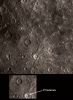
ZZ-Mercury-Craters-Enwonwu_Crater-PIA11784-1.jpgEnwonwu: a young Mercurian Crater (Natural Colors; credits: Lunar Explorer Italia)73 visiteThe feature indicated by the white arrow in this NAC image is the newly named crater Enwonwu (see also PIA11762). It is named in honor of Benedict (Ben) Chukwukadibia Enwonwu, the 20th Century modernist Nigerian sculptor and painter.
Enwonwu Crater displays a Central Peak and a set of bright rays emanating from the Crater Rim. The rays cross the surrounding surface and neighboring craters, indicating that Enwonwu Crater was formed comparatively recently in Mercury’s history. The brightness of the rays also suggests relative youth, as over time rays darken and disappear on Mercury's Surface.
These relationships provide useful indicators for determining the relative ages of features and the sequence of events that have shaped the Surface of Mercury.
Date Acquired: January 14, 2008
Image Mission Elapsed Time (MET): 108829024
Instrument: Narrow Angle Camera (NAC) of the Mercury Dual Imaging System (MDIS)
Resolution: 590 meters/pixel (0,37 miles/pixel)
Scale: Enwonwu Crater is about 38 Km (approx. 24 miles) in diameter
Spacecraft Altitude: about 23.000 Km (approx. 14.300 miles)MareKromiumFeb 11, 2009
|
|
| 248 immagini su 21 pagina(e) |
|
|
|
|
|
13 | |
|
|
|
|
|
|





