| |

| Ultimi arrivi - Mercury |

ZZ-Mercury-Rupes-PIA13748-0.jpgBeagle Rupes and Impact Craters Sveinsdottir, Izquierdo and Kunisada (Context Frame)103 visiteWhen MESSENGER first flew by Mercury on January, 14th, 2008, MDIS acquired images of a large portion of Mercury's Surface that had never previously been seen by Spacecraft. This mosaic of NAC images shows some of the Geologic Features discovered during that first fly-by that have been subsequently named: the curving cliff face of Beagle Rupes, the elongated crater Sveinsdottir and the craters Izquierdo and Kunisada flooded with Lava.
This year, the MESSENGER spacecraft is positioned once again to visit the Solar System's Innermost Planet. However, this time, the Spacecraft won't just pass by. On March 18, 2011, a 15-minute maneuver will place MESSENGER in orbit around Mercury, making it the first Spacecraft ever to do so. The MESSENGER Mission will then begin an extensive year-long science campaign to unravel Mercury's mysteries.
Date Acquired: January, 14th, 2008
Instrument: Narrow Angle Camera (NAC) of the Mercury Dual Imaging System (MDIS)
Scale: Izquierdo Crater is approx. 170 Km (105,57 miles) in diameterMareKromiumGen 23, 2011
|
|

ZZ-Mercury-Volcanic_Regions-Plains-PIA13676.jpgSmooth Plains and Impact Craters96 visiteThis scene, a mosaic of images acquired as MESSENGER approached Mercury for its third fly-by of the Planet, shows a large expanse of Smooth Volcanic Plains near the center of the image.
Most Smooth Plains are believed to have formed by Lavas that flooded Mercury's Surface. In this view, Craters are visible that have been nearly filled with Lava, leaving only traces of their Circular Rims.
Curving Scarps (or "Cliffs") and "Wrinkle Ridges" can also be seen running mostly from top to bottom of the frame. The density of Impact Craters on the Smooth Plains is less than on the heavily Cratered Terrain visible in the upper right and lower right corners of this image.
The presence of fewer Impact Craters per unit area means that the Volcanic Smooth Plains are younger than the Cratered Terrain.
During orbital observations beginning in 2011, MESSENGER will gather high-resolution and color imaging data to map the global extent of Mercury's Volcanic Smooth Plains, gaining clues to the composition of the Plains and unraveling the History of Volcanism on the Solar System's Innermost Planet. The named craters Picasso, Firdousi and Steichen are visible in this scene.
Date Acquired: September, 29th, 2009
Instrument: Narrow Angle Camera (NAC) of the Mercury Dual Imaging System (MDIS)
Scale: The bottom edge of this image is approximately 1450 Km (900,45 miles) acrossMareKromiumGen 23, 2011
|
|

ZW-Mercury-PIA13508-PCF-LXTT.jpgHokusai Crater (Absolute Natural Colors; credits for the additional process. and color.: Dr Paolo C. Fienga - Lunexit Team)122 visiteThis mosaic of NAC images shows the Impact Crater Hokusai, located on Mercury at a latitude of approx. 58° North. The Crater has an impressive System of Rays, which extend as much as a thousand kilometers (more than 600 miles) across the Planet and are the longest that have yet been identified on Mercury.
Such Rays are formed when an impact excavates material from beneath the Surface and throws that material outward from the Crater. These bright Rays, consisting of both Ejecta and Secondary Craters (that form when the ejected material re-impacts the Surface), slowly begin to fade as they are exposed to the harsh Space Environment. Mercury and other airless Planetary Bodies are being constantly bombarded with Micrometeoroids and Energetic Ions, both concurring to produce an effect known as "Space Weathering".
Craters with Bright Rays are thought to be relatively young because the Rays are still visible, indicating that they have had less exposure to such weathering processes than craters that lack rays.
Although the extent of some of Hokusai's Rays have been determined, images acquired during MESSENGER's three Mercury fly-bys have not yet shown all of them.
During MESSENGER's orbital observations, which will begin in March 2011, MDIS will acquire high-resolution color images of Mercury's entire Surface.
This Global Color Map will allow the better understand the extent of the extensive Systems of Rays emanating from Hokusai and other young Craters, to be mapped for the first time.
Date Acquired: October, 6th, 2008
Instrument: Narrow Angle Camera (NAC) of the Mercury Dual Imaging System (MDIS)
Scale: The diameter of Mercury is of about 4880 Km (3030,48 miles) and Hokusai Crater has a diameter of approx. 95 Km (58,995 miles)MareKromiumGen 23, 2011
|
|

ZZ-Mercury-Caloris_Basin-PIA13675-PCF-LXTT-3.jpgCaloris Basin (Absolute Natural Colors; credits for the additional process. and color.: Dr Paolo C. Fienga - Lunexit Team)147 visiteThis view is a mosaic of multiple MDIS images and shows the Caloris Basin in its entirety. The Caloris Basin was discovered in 1974 from Mariner 10 images, but when Mariner 10 flew-by Mercury, only the Eastern half of the Basin was in daylight. During MESSENGER's first Mercury flyby, the Spacecraft was able to acquire High-Resolution images of the entire Basin, revealing the full extent of this Great Basin for the first time.
Geologists use the term "Basin" to refer to an impact crater that is larger than about 300 Km (186,3 miles) in diameter and often displays multiple Concentric Rings. Caloris has one Main Topographic Ring (1550-Km diameter). Patterns of concentric structures both inside and outside the Main Ring have been mapped and interpreted as evidence for additional Rings.
Caloris is one of the largest Impact Basins in the Solar System, and MESSENGER's orbital observations will provide much more data for this impressive geologic feature, including high-resolution color and low-Sun images for discerning morphology. This mosaic was obtained when the Sun was high overhead. Such lighting conditions emphasize brightness differences among the Surface Materials, with little shadowing to provide a sense of the texture and topography.
The interior of the Basin has been filled with lighter-hued Plains, which in turn have been modified by Impact Craters. These Craters range from small bright dots to larger Craters with bright Rays. Some of the larger Craters exhibit dark Rims. The dark Rims suggest that dark material underlies the Interior Plains in some places and was exposed through the formation of those Impact Craters.
Date Acquired: January, 14th, 2008
Instrument: Narrow Angle Camera (NAC) of the Mercury Dual Imaging System (MDIS)
Scale: Caloris Basin is roughly 1550 Km in diameter (about 962,55 miles)MareKromiumGen 23, 2011
|
|

ZZ-Mercury-Craters-Dearin_Crater-PIA13488.jpgDark Spot at "Derain Crater" (Enhanced Absolute Natural Colors; credits for the additional process. and color.: Dr Paolo C. Fienga - Lunexit Team)124 visiteIn the center of this image is Derain, an impact crater first viewed during MESSENGER's 2nd Mercury flyby and named in 2009.
Derain has material within it and in its surroundings that is much darker than the neighboring terrain. In fact, the material associated with Derain appears to have the lowest reflectance yet identified on Mercury's Surface.
The Dark Deposits may be material with a mineralogical composition different from the majority of Mercury's visible Surface, but more data are needed before any further insight into the composition can be gained.
Observations to be acquired during MESSENGER's orbital mission phase will help to identify the uncommonly Dark Material at Derain Crater and similar occurrences elsewhere on the Planet.
Also visible in this image (upper right side), is the rayed Crater "Berkel", which has Dark Material as well in its center and in a ring immediately surrounding it. In contrast, two neighboring craters of Berkel have bright rays but lack Dark Halos. Why do some craters contain Dark Materials while others do not? MESSENGER's orbital data will be used to investigate that question and to improve our understanding of the nature and structure of Mercury's Crust.
Date Acquired: October 6, 2008
Instrument: Narrow Angle Camera (NAC) of the Mercury Dual Imaging System (MDIS)
Scale: Derain Crater is approx. 190 Km in diameter (such as about 118 miles)MareKromiumNov 10, 2010
|
|

ZZ-Mercury-Craters-Copland_Crater-PIA13068.jpgCopland on Mercury (Natural Colors; credits for the additional process. and color.: Dr Paolo C. Fienga - Lunexit Team)133 visiteVisible in the center of this image is the Crater Copland, recently named in honor of the American composer and pianist Aaron Copland.
Aaron Copland and this Crater are both unquestionably worthy candidates for named features on Mercury, but how this specific crater came to be known as Copland has an interesting back-story.
Amateur astronomer Ronald Dantowitz and his colleagues Scott Teare and Marek Kozubal used the Mt. Wilson 60-inch telescope in 1998 to observe a very bright feature on this portion of Mercury's surface, and they assumed that the bright feature was an impact crater.
Mr. Dantowitz expressed his wish that the crater be named "Copland" once better images of the area were obtained from spacecraft. Surprisingly, MESSENGER images from Mercury flyby 3 revealed that the small bright feature, seen at the left edge of this image, is not an impact crater but more closely resembles a Volcanic Vent.
No convention for naming Volcanic Vents on Mercury has yet been adopted, because none were identified prior to MESSENGER's first Mercury flyby. However, even if a convention for naming volcanic features on Mercury is adopted in the future, the naming rules will likely differ from those for impact craters, and thus "Copland" would probably not be an acceptable name for the bright volcanic feature.
A MESSENGER team member corresponded with Mr. Dantowitz and suggested that the name Copland be proposed instead for a large crater nearby.
He agreed, and the International Astronomical Union (IAU) approved the name Copland on March 3, 2010. Copland crater is flooded with volcanic smooth plains material that could be related to the activity that formed the bright vent.
Date Acquired: September 29, 2009
Instrument: Narrow Angle Camera (WAC) of the Mercury Dual Imaging System (MDIS)
Scale: Copland crater has a diameter of about 208 Km (approx. 129 miles)
Projection: This image is a portion of the NAC approach mosaic from Mercury flyby 3. It is shown in a simple cylindrical map projection with a resolution of roughly 500 meters/pixel (approx. 0,31 miles/pixel).MareKromiumGiu 03, 2010
|
|

ZW-Mercury-PIA12842-1.jpgThe Eastern Limb of Mercury (possible Natural Colors; add. process. and color.: Dr Paolo C. Fienga - Lunexit Team)154 visiteDate Acquired: January, 14th, 2008
Instrument: Wide Angle Camera (WAC) of the Mercury Dual Imaging System (MDIS)
Resolution: 2,8 Km/pixel (such as about 1,7 miles/pixel) at the Equator
Scale: Caloris Basin (which is the round, light-brown colored Surface Feature visible on the top right of Mercury) is about 1550 Km (approx. 960 miles) in diameter
Spacecraft Altitude: about 13.000 Km (approx. 8000 miles)MareKromiumMar 18, 2010
|
|

ZZ-Mercury-Craters-Benoit_Crater-PIA12428.jpgBenoit Crater and Lange Basin (False Colors; credits: Dr Paolo C. Fienga - Lunexit Team)75 visiteThis NAC image, acquired during MESSENGER's 1st Mercury Fly-By, shows the Crater Benoit and the Lange Basin.
Benoit Craer has been so named in honor of Rigaud Benoit, a twentieth century Haitian painter (1911-1987), while the Lange Basin is in honor of the American photographer Dorothea Lange (1895-1965).
These particular Craters were proposed for names on the basis of some interesting features of each. Benoit is a small approx. 35-Km-diameter (about 22-mile-diameter) Crater, but its floor is quite unusual, with two mounds that have been suggested to be evidence of intrusive volcanic activity on Mercury.
The larger neighboring Lange Basin appears to have been flooded by lava, with only faint traces remaining of a now buried Inner Ring.
Date Acquired: January 14, 2008
Image Mission Elapsed Time (MET): 108828463
Instrument: Narrow Angle Camera (NAC) of the Mercury Dual Imaging System (MDIS)
Resolution: 500 meters/pixel (0,31 miles)
Scale: Lange Basin is approx. 180 Km (about 112 miles) in diameter
Spacecraft Altitude: about 19.700 Km (approx. 12.200 miles)MareKromiumGen 30, 2010
|
|

ZW-Mercury-PIA12397.jpgMercury76 visiteToday (December, 15th, 2009), the first High-Resolution Global Map of Mercury was made publicly available. Members of the MESSENGER team and experts from the U. S. Geological Survey (USGS) used images from MESSENGER's three Mercury flybys and from the Mariner 10 Mission in 1974-75 to create a Global Mosaic that covers 97,7% of Mercury's Surface at a resolution of 500 meters/pixel (0,31 miles/pixel).
The above image shows the full global Mercury mosaic but at a greatly reduced scale of only 5% of the HR version. The full HR mosaic by can be seen at the USGS Map-a-Planet website.
Date Mercury Fly-By 1: January 14, 2008
Date of Mercury Fly-By 2: October 6, 2008
Date of Mercury Fly-By 3: September 29, 2009
Instrument: Narrow Angle Camera (NAC) of the Mercury Dual Imaging System (MDIS)
Scale: Mercury's diameter is approx. 4880 Km (such as about 3030 miles)MareKromiumDic 27, 2009
|
|

ZZ-Mercury-Craters-Rembrandt_Crater-PIA12395.jpgLow Sun over Rembrandt Crater (possible Natural Colors; credits: Dr Paolo C. Fienga - Lunexit Team)63 visiteThis NAC image acquired during MESSENGER's third Fly-By of Mercury shows a view of the interior of Rembrandt Basin that emphasizes landforms. Rembrandt was discovered during the Mission's second Fly-By, in October 2008. Its large size (approx. 715 Km, or about 444 miles, in diameter), its relatively young age (as implied by the low number of superposed impact craters), and the radiating extensional and contractional fractures on its Floor, have made it a topic of special interest to the MESSENGER Science Team.
Earlier this year, an article devoted to the first study of the geology of Rembrandt was published in the Science magazine. During Mercury's Fly-By 3, Rembrandt was closer to the Terminator - such as the line between the sunlit dayside and dark nightside of the Planet - and the different viewing geometries between Fly-Bys 2 and 3 enabled a three-dimensional view of this unusual basin. The grazing angle of the light from the setting Sun in this particular NAC image accentuates the topography of the features on the Rembrandt's Floor, including the set of unusual Radiating Fractures.
Date Acquired: September 29, 2009
Image Mission Elapsed Time (MET): 162744327
Instrument: Narrow Angle Camera (NAC) of the Mercury Dual Imaging System (MDIS)
Resolution: 390 meters/pixel (0,24 miles/pixel)
Scale: The prominent crater at center left is about 44 Km (approx. 27 miles) in diameter
Spacecraft Altitude (distance from target): approx. 15.100 Km (about 9400 miles)
MareKromiumDic 27, 2009
|
|
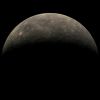
ZW-Mercury-PIA12365.jpgRising Mercury (Natural Colors; credits: NASA and Lunexit)74 visiteAs MESSENGER approached Mercury for the mission's 3rd and final flyby of the Solar System's innermost planet, the WAC acquired images through all 11 of its narrow-band color filters. The 1000, 700, and 430 nanometer filters were combined in red, green, and blue to create this color image, the last close-up color view that will be acquired until MESSENGER goes into orbit around Mercury in March of 2011. Only 6% of Mercury's Surface in this image had not been viewed previously by spacecraft, and most of the measurements made by MESSENGER's other instruments during this flyby were made prior to closest approach. The observations from MESSENGER's third flyby of Mercury nonetheless revealed fresh surprises. Check out the NASA Science Update Telecon held today for details about some of these new surprises.
Date Acquired: September 29, 2009
Instrument: Wide Angle Camera (WAC) of the Mercury Dual Imaging System (MDIS)
WAC Filter: 9, 1, 6 (1000, 700, and 430 nanometers)
Resolution: 5 Km/pixel (about 3 miles/pixel)
Scale: Mercury's diameter is approx. 4880 Km (about 3030 miles) MareKromiumNov 17, 2009
|
|

ZZ-Mercury-Craters-Unnamed_Double-Ring_Crater-PIA12368.jpgUnnamed Double-Ring Basin (Natural Colors; credits: Lunexit)72 visiteThis spectacular approx. 290-Km-diameter Double-Ring Basin seen in detail for the first time during MESSENGER's 3rd flyby of Mercury bears a striking resemblance to Raditladi Basin, observed during the 1st flyby.
This still-unnamed basin is remarkably well preserved and appears to have formed relatively recently, compared with most basins on Mercury. The low numbers of superposed impact craters and marked differences in color across the basin (seen in this enhanced color image released earlier this week) suggest that the smooth area within the innermost ring may be the site of some of the most recent volcanism on Mercury.
Date Acquired: September 29, 2009
Instrument: Narrow Angle Camera (NAC) of the Mercury Dual Imaging System (MDIS)
Scale: This double-ring basin is approx. 290 Km (about 180 miles) in diameterMareKromiumNov 17, 2009
|
|
| 248 immagini su 21 pagina(e) |
|
|
|
|
|
11 | |
|
|
|
|
|
|





