| Ultimi arrivi - Artistic Views of the Solar System |

Mars Odyssey.jpgMars Odyssey95 visiteDa "NASA - Picture of the Day" del 25.10.2001:"After an interplanetary journey lasting 200 days, the Mars Odyssey spacecraft has entered orbit around the Red Planet on October, 25, 2001. This success is welcome as in the past Mars has often seemed a difficult planet to visit. Beginning with the first Soviet attempts in 1960, around 30 missions have tried while only 10 or so have gone without serious mishap (...) Cautiously dipping into the Martian atmosphere, the spacecraft will gradually adjust its present wide and elliptical 20-hour orbit to a circular 2-hour orbit only 400 Km above the planet's surface. Then, its instruments and cameras will focus on exploring the climate and geologic history of Mars, including the search for water and evidence of life-sustaining environments. In the artist's conception above, the spacecraft with wing-like solar panels is imagined firing its rocket engine for Mars orbit insertion over terrain seen in natural and false-color".Ott 30, 2004
|
|

ZZ-Pluto & Charon.jpgPluto & Charon119 visitenessun commentoOtt 21, 2004
|
|
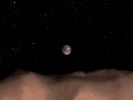
Toutatis.jpgEarth from the asteroid "Toutatis"109 visiteOn September 29, 2004, the Earth came within 1 million miles of the asteroid Toutatis - the closest predicted approach of our fair planet to a sizable asteroid or comet in this century. Coming within 1 million miles (or about 4 times the Earth-Moon distance), Earth would appear to be nearly the size of the full moon in the asteroid's sky, as suggested in this illustration. In Earth's sky, Toutatis appeared only as a faint object rapidly moving against a background of stars. Also known as Earth-Crossing Asteroid (ECA) 4179, Toutatis is in an eccentric 4 year orbit which moves it from the asteroid belt between Mars and Jupiter to just inside Earth's orbit. When the Earth passed near it in 1992 Toutatis was imaged by radar and seen to be 2 irregularly shaped lumps, perhaps joined by a narrow neck. This bizarre object is about 3 Km wide, 5,5 Km long and is tumbling through space. Studies of Toutatis and other ECA's help reveal connections between the Solar System's meteorites main-belt asteroids and comets.Ott 01, 2004
|
|

Mars Express-PIA04802_modest.jpgMars Express111 visitenessun commentoSet 16, 2004
|
|

Jupiter.jpgJupiter's Kingdom171 visiteForse non è Giove il pianeta a cui l'Artista (Lynette Cook) stava pensando mentre l'opera veniva realizzata, ma a noi è venuto in mente il Re degli Dei e quindi...Set 13, 2004
|
|

Landing on Mars.jpgLanding on Mars156 visiteA livello di curiosità Vi suggeriamo, se volete vedere una ricostruzione davvero molto credibile di un futuro "landing on Mars" (a base di paracadute prima ed airbags poi), la sequenza della discesa della capsula di emergenza con 5 astronauti a bordo che viene presentata nel discreto Sci-Fi Movie "Red Planet".Set 10, 2004
|
|

En route to Titan.jpgHuygens Probe: en route to Titan126 visiteThe Huygens Probe, after deploying from the Cassini Orbiter, en route into the murky atmosphere of Saturn's largest moon, Titan.Set 04, 2004
|
|

Landing on Titan (3).jpgSaturn, through the fog of Titan129 visiteTitan's surface may hold lakes of liquid ethane and methane, sprinkled over a thin veneer of frozen methane and ammonia. Most of the brownish-orange color comes from more heavily processed hydrocarbons present in Titan's atmosphere and on its surface. Artistic license has been used to exaggerate the size of the orbiter, the sharpness of the icy features, the tilt of Saturn's rings, and the visibility of the planet through Titan's atmosphere. Set 04, 2004
|
|

Landing on Titan (2).jpgLanding on Titan (2)119 visiteThe Huygens probe descends through Titan's murky, brownish-orange atmosphere of nitrogen and carbon-based molecules, beaming its findings to the distant Cassini orbiter. The probe is equipped with a variety of scientific sensors to measure the physical properties of the moon's atmosphere; it also carries an imaging device to return pictures of Titan's possibly hydrocarbon-lake-dotted surface. Set 04, 2004
|
|
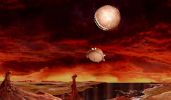
Landing on Titan.jpgLanding on Titan119 visiteBecause it's in a deep freeze state, Titan's atmosphere is thought to contain chemicals similar to those found on Earth's early days. Data from the Huygens probe combined with Cassini's measurements may offer clues about how life began on Earth. Set 04, 2004
|
|

Titan - artwork.jpgHuygens on Titan105 visiteThin methane clouds dot the horizon and a narrow methane spring or "methanefall" flows from the cliff at left and drifts mostly into vapor. Smooth ice features rise out of the methane/ethane lake, and crater walls can be seen far in the distance.Set 04, 2004
|
|

Venus fly-by.jpgCassini-Huygens during the Venus fly-by82 visitenessun commentoAgo 31, 2004
|
|
| 91 immagini su 8 pagina(e) |
 |
|
|
|
6 | |
|








