| Ultimi arrivi - Artistic Views of the Solar System |

Quaoar.jpgQuaoar134 visitenessun commentoNov 03, 2005
|
|

Voyagers-Heliosphere4b.jpgThe Voyagers at the "Final Frontier"90 visiteOriginal caption:"In the summer of 1989, NASA's Voyager 2 became the first spacecraft to observe the planet Neptune, its final planetary target. Passing about 4.950 Km (about 3.000 miles) above Neptune's North Pole, Voyager 2 made its closest approach to any planet since leaving Earth 12 years before. Five hours later, Voyager 2 passed about 40.000 Km (about 25.000 miles) from Neptune's largest moon, Triton, the last solid body the spacecraft had an opportunity to study". Ott 25, 2005
|
|

Voyagers-Heliosphere3b.jpgThe "Voyagers" at the Final Frontier108 visiteVoyager 1 and 2 are still going strong and are returning valuable science data. Each Voyagers' Cosmic Ray Detector, Magnetometer, Plasma Wave Detector and Low-Energy Charged Particle Detector all still operational. In addition, the Ultraviolet Spectrometer on Voyager 1 and the Plasma Science instrument on Voyager 2 continue to return data. Both spacecraft are expected to continue to operate and send back valuable data until at least the year 2020.
The mission currently employs the equivalent of about 10 full-time people at JPL, significantly less than the approximately 300 during the height of its famed "Grand Tour" of the planets through 1989. Only two veterans of the Voyager launches still work on the flight team. Some of the summer interns the team has employed were not even born when the spacecraft were launched. The project scientist, Dr. Ed Stone of the California Institute of Technology has been with the mission since inception and two original principal investigators - Dr. Stamatios Krimigis of the Applied Physics Laboratory and Dr. Norman Ness of the University of Delaware - remain.
During the journey, the Voyagers flew by Jupiter, Saturn, Uranus and Neptune and returned nearly 80 thousand images and more than 5 trillion bits of data. After traveling through space for more than 27 years, Voyager 1 is now more than 14 billion kilometers (94 AU) from the Sun, heading in a northerly direction toward interstellar space. Voyager 2, closer at about 11 billion kilometers (75 AU), is headed on a southerly path toward interstellar space. Voyager 1 is now the furthest human-made object from the Sun, having surpassed Pioneer 10 on February 17, 1998.
Since the beginning of the Interstellar Mission in 1990, the two spacecraft have returned well more than 65 billion bits of data, though at lower data rates than during the Grand Tour. The data continue to reveal new characteristics of the effects of the sun in the distant solar wind. As an example, a Coronal Mass Ejection (CME) shock wave from the October 2003 solar storms was detected at Voyager 2 in mid-April 2004. Some of the most powerful flares in recorded history hurled billion-ton clouds of gas, called coronal mass ejections (CMEs), into the solar system. By the time the resulting shocks reached Voyager 2, about 6 months later, they had combined into Merged Interaction Regions and had slowed considerably. Traveling at 600 km/sec, it had slowed considerably from the 1500-2000 km/sec detected last Fall as the storms left the Sun. Voyager 2 measured the speed of the shock, its composition, temperature and magnetism. When combined with measurements from SOHO, Mars Odyssey, Ulysses, Cassini and other spacecraft, the Voyager data show how far-ranging CMEs evolve and dissipate.
For the past two years or so, Voyager 1 has detected phenomena unlike any encountered before in all its years of exploration. These observations and what they may infer about the approach to the termination shock have been the subject of on-going scientific debates. While some of the scientist believed that the passage past the termination shock had already begun, some of the phenomena observed were not what would have been expected. So the debate continues while even more data are being returned and analyzed. However, it is certain that the spacecraft are in a new regime of space. The observed plasma wave oscillations and increased energetic particle activity may only be the long-awaited precursor to the termination shock. If we have indeed encountered the termination shock, Voyager 1 would be the first spacecraft to enter the solar system's final frontier, a vast expanse where wind from the Sun blows hot against thin gas between the stars: interstellar space.
Ott 25, 2005
|
|

Earth From Mars.jpgMy "Day", your "Night"117 visiteThough Earthlings will be able to get a good look at Mars during close approach, NASA's 2 Rovers on Mars will not be able to see Earth. That's because at the moment, Earth is on the daytime side of Mars. As shown in the top half of this artist's rendering, when it's nighttime on Earth, it's daytime on Mars. After Earth passes Mars, the Rovers will be able to see the sunlit side of Earth again just before dawn. The bottom half of this illustration shows what the Rovers would see if they looked toward Earth.Ott 21, 2005
|
|

MarsAtmosphere.jpgHow Mars lost its atmosphere...120 visitenessun commentoOtt 10, 2005
|
|

Flash-PIA02108.jpgFlash!!!114 visiteThis image shows a flash produced in a laboratory by a high-velocity bead slamming into dust. Though the flash itself can't be resolved, its brilliant effects can be seen in this three-second time exposure. Scientists say that the collision between Deep Impact's Impactor and comet Tempel 1 may produce a similar flash.
This flash occurred when a quarter-inch sphere smashed into powdered dust at a speed of 6,4 Km-per-second (about 4 miles-per-second).
Even though the actual flash lasted less than 50 millionths of a second, the camera recorded the hot debris in the impact crater (center) and the streaking ejecta.
This experiment was performed at NASA's Ames Research Center, Moffett Field, Ca.Set 29, 2005
|
|

Gusev Crater.jpgGusev Crater: an artistic interpretation147 visite"...The landing site and the Columbia Hills are within Gusev Crater, a bowl about 150 Km (about 95 miles) in diameter. It was selected for the Spirit mission because the shape of the terrain suggests the crater once held a lake. Volcanic deposits appear to have covered any sign of ancient lakebed geology out on the plain, but scientists say the hills expose older layers that have been lifted and tipped by a meteorite impact or other event...".
"Spirit has climbed to the hilltop and looked over the other side, but NASA did not do this just to say we can do it. The Mars rovers are addressing fundamental questions about Martian history and planetary environments," said NASA's Mars Exploration Program Director Doug McCuistion.
The crest of "Husband Hill" offers Spirit's views of possible routes into a basin to the south with apparently layered outcrops. Shortly after Spirit landed, it observed a cluster of seven hills about 3 kilometers (2 miles) east of its landing site. NASA proposed naming the range "Columbia Hills" in tribute to the last crew of Space Shuttle Columbia. The tallest of the hills commemorates Rick Husband, Columbia's commander.
Set 04, 2005
|
|
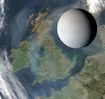
Enceladus-PIA07724.jpgEnceladus, Great Britain and Northern France145 visiteSaturn's moon Enceladus is only 505 Km (approx. 314 miles) across, small enough to fit within the length of the United Kingdom, as illustrated here. The intriguing icy moon also could fit comfortably within Arizona or Colorado. Ago 30, 2005
|
|

mars-dust-devil-large-bg.jpgMartian Dust Devil131 visiteAh, Martian Summer! Finally, the days are long, just like on dear old Earth. And daytime highs rocket all the way up to a balmy 20°C (68°F) from the Summer nighttime low of -90°C (-130°F), meaning you and your fellow astronauts can warm up your machinery earlier to get a good start on mining operations.
But those warm daytime temperatures also bring alive the Martian devils. Dust devils, that is.
You were caught in one just yesterday - and a devilishly terrifying experience it was! This was no little Arizona desert whirlwind, only a few tens of meters high and a few meters across and past you in seconds.
No, what hit you yesterday was a monster column towering kilometers high and hundreds of meters wide, 10 times larger than any tornado on Earth. Red-brown sand and dust whipping around faster than 30 meters per second (70 miles per hour) dropped visibility to zero, scouring your faceplate, driving dust into every fold and wrinkle of your spacesuit.
For 15 minutes you huddled and endured the buffeting. The scariest part was the incessant crackling and flashing of miniature lightning bolts nipping at you and your rover, and the loud static on your radio that prevented you from calling for help.
Could this really happen?
Lug 28, 2005
|
|

Mars.jpgEarth and Mars, soon closer than ever!112 visiteThe Red Planet is about to be spectacular again. In October and November 2005, Earth is catching up with Mars in an encounter that will culminate in a new close approach between the 2 planets.
The next time Mars may come this close is in AD 2287. Due to the way Jupiter's gravity tugs on Mars and perturbs its orbit, astronomers can only be certain that Mars has not come this close to Earth in the last 5000 years, but it may be as long as 60.000 years before it happens again. The encounter will culminate on October 30th.
By late October, Mars will be a bright star-like object in the sky and therefore very easy to spot.
Nota: le informazioni pubblicate in precedenza erano riferite al "contatto ravvicinato" Terra/Marte dell'AD 2003. Lug 07, 2005
|
|

Spirit2-19-DDM-04-Rover-A113R1.jpgI like to "roll" on Mars!!!86 visiteUn'interpretazione "artistica" (ma fortemente legata alla realtà fattuale) del Rover Spirit mentre cammina (anzi: rolls...) sulla superficie di Gusaev Crater - Marte.
E' un disegno, naturalmente, ma estremamente bello e suggestivo il quale ci ricorda, come d'altronde noi abbiamo già fatto tantissime volte, che la Scienza non è solo calcolo e razionalità: la Scienza, in quanto tale, è Arte!...Giu 06, 2005
|
|

000-0-Mars.jpgMeteor strike on Mars132 visiteMars may have lost much of its atmosphere during asteroid impacts early in its history.
The Beagle 2 lander will look for signatures of life on Mars, whether long-dead or still-living, by measuring the ratio of two different types of carbon in the rocks. Biological processes on Earth favour the lighter isotope of carbon, carbon-12, over the heavier carbon-13. Hence, a high carbon-12 to carbon-13 ratio is taken as evidence of life and has been found in rocks up to 4 billion years old, even where geological processing has occurred. The hope is that the same occurred on Mars.Apr 19, 2005
|
|
| 91 immagini su 8 pagina(e) |
 |
|
4 | |
|
|
|








