| Ultimi arrivi - Artistic Views of the Solar System |
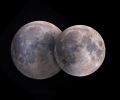
The_Moon-Super_and_Micro_Moon_Mukherjee_3000.jpgSuper and Micro Moon (Credits: Soumyadeep Mukherjee)123 visiteWhat is so micro about tonight's blue micromoon? Just after sunset, a full moon will appear slightly smaller and dimmer than usual. The reason is that the Moon's fully illuminated phase occurs within a short time of apogee - when the Moon is farthest from the Earth in its elliptical orbit. In fact, tonight's micromoon will be the farthest, smallest, and dimmest Moon this year. But tonight's micromoon is notable for yet another reason: it is also a blue moon, meaning that it is the second full moon in the same month (moon-th). Pictured here, a supermoon -- when the full moon appears near its largest -- is compared to a micromoon as photographed from Kolkata, India in May and December of 2021. Although the next micromoon occurs next month, and the next blue moon at the end of 2028, the next blue micromoon will not occur until 2053.MareKromiumGiu 08, 2026
|
|
Voyagers-InterstellarSpace9-jpg.jpgVoyager 1 is still alive!165 visitenessun commentoMareKromiumFeb 04, 2024
|
|

Voyagers-InterstellarSpace8d.jpgThe Infinite and Beyond173 visitenessun commentoMareKromiumFeb 04, 2024
|
|

Bardarbunga.jpgBardarbunga278 visiteMother Earth when is pissed...
And, please, do not confuse this funny-named Icelandic Volcano with the Italian "Bunga-Bunga" dance (or party)...MareKromiumAgo 15, 2023
|
|

Deep_Impact.pngDeep Impact153 visite"...così, anche per mezzo delle Equazioni di Riemann-Hake, alla fine si arrivò ad una dimostrazione matematica della Necessità (Teorica) dell'Area Spaziale di Deformazione Logica precognizzata da Twistermann. Quest'Area divenne nota, in seguito, come "Mondo Distorto", sebbene non fosse né distorto, né un vero e proprio mondo. E, suprema ironia, l'importantissimo Terzo Postulato di Twistermann (secondo il quale l'Area Spaziale di Deformazione Logica doveva essere considerata come quella regione dell'Universo agente come "contrappeso" di caos verso la Struttura Primaria e coerente della Realtà) venne ritenuto superfluo in sede di dimostrazione..."
Dalla voce "Mondo Distorto" - Enciclopedia Galattica del Sapere Universale, 483ma Edizione.MareKromiumAgo 29, 2021
|
|

Voyagers-Heliosphere7d.pngInterstellar Space for the "Voyagers"!217 visiteAffascinante. Notizia vecchiotta (quasi di due anni), ma sempre interessante da leggere ed osservare.MareKromiumGiu 26, 2020
|
|

Volcanoes-Olympus_and_Clouds.jpgOlympus, in a Sea of Clouds (Painting by Gordon Legg, based on Viking Orbiter mosaic P17444. From NASA SP-444, 1980) 137 visiteThis painting, based on a mosaic of black-and-white Viking Orbiter images of Olympus Mons, shows the volcano's flanks and complex caldera protruding above thin clouds of water ice. MareKromiumNov 07, 2011
|
|

Martian_Residual_Lake-2779-22384.jpgResidual Lake on Mars80 visitenessun commentoMareKromiumGiu 19, 2009
|
|

Unknown_Centaur.JPGUnknown Centaur81 visitenessun commentoMareKromiumFeb 21, 2009
|
|

Titan-PIA11001.jpgEthane Lake on Titan113 visiteNASA scientists have concluded that at least one of the large lakes observed on Saturn's moon Titan contains liquid hydrocarbons, and have positively identified the presence of ethane. This makes Titan the only body in our solar system beyond Earth known to have liquid on its surface.
Scientists made the discovery using data from an instrument aboard the Cassini spacecraft. The instrument identified chemically different materials based on the way they absorb and reflect infrared light. Before Cassini, scientists thought Titan would have global oceans of methane, ethane and other light hydrocarbons. More than 40 close flybys of Titan by Cassini show no such global oceans exist, but hundreds of dark, lake-like features are present. Until now, it was not known whether these features were liquid or simply dark, solid material.
"This is the first observation that really pins down that Titan has a surface lake filled with liquid," said Bob Brown of the University of Arizona, Tucson. Brown is the team leader of Cassini's visual and mapping instrument. The results will be published in the July 31 issue of the journal Nature.
Ethane and several other simple hydrocarbons have been identified in Titan's atmosphere, which consists of 95 percent nitrogen, with methane making up the other fiver percent. Ethane and other hydrocarbons are products from atmospheric chemistry caused by the breakdown of methane by sunlight.
Some of the hydrocarbons react further and form fine aerosol particles. All of these things in Titan's atmosphere make detecting and identifying materials on the surface difficult, because these particles form a ubiquitous hydrocarbon haze that hinders the view. Liquid ethane was identified using a technique that removed the interference from the atmospheric hydrocarbons.
The visual and mapping instrument observed a lake, Ontario Lacus, in Titan's south polar region during a close Cassini flyby in December 2007. The lake is roughly 20,000 square kilometers (7,800 square miles) in area, slightly larger than North America's Lake Ontario.
"Detection of liquid ethane confirms a long-held idea that lakes and seas filled with methane and ethane exist on Titan," said Larry Soderblom, a Cassini interdisciplinary scientist with the U.S. Geological Survey in Flagstaff, Ariz. "The fact we could detect the ethane spectral signatures of the lake even when it was so dimly illuminated, and at a slanted viewing path through Titan's atmosphere, raises expectations for exciting future lake discoveries by our instrument."
The ethane is in a liquid solution with methane, other hydrocarbons and nitrogen. At Titan's surface temperatures, approximately 300 degrees Fahrenheit below zero, these substances can exist as both liquid and gas. Titan shows overwhelming evidence of evaporation, rain, and fluid-carved channels draining into what, in this case, is a liquid hydrocarbon lake.
Earth has a hydrological cycle based on water and Titan has a cycle based on methane. Scientists ruled out the presence of water ice, ammonia, ammonia hydrate and carbon dioxide in Ontario Lacus. The observations also suggest the lake is evaporating. It is ringed by a dark beach, where the black lake merges with the bright shoreline. Cassini also observed a shelf and beach being exposed as the lake evaporates. "During the next few years, the vast array of lakes and seas on Titan's north pole mapped with Cassini's radar instrument will emerge from polar darkness into sunlight, giving the infrared instrument rich opportunities to watch for seasonal changes of Titan's lakes," Soderblom said.
More information is available at: http://www.nasa.gov/cassini, http://saturn.jpl.nasa.gov and http://wwwvims.lpl.arizona.edu .
MareKromiumAgo 06, 2008
|
|

Venus-Lightning.jpgVenusian Lightnings72 visiteCaption ESA:"This artist’s concept of Venus, dated 2006, suggests the presence of lightning in the atmosphere". MareKromiumFeb 26, 2008
|
|

The_Rings-PIA10082.jpgMittens72 visiteCaption NASA:"This is an artist concept of the view from Cassini during the star occultation that detected "Mittens," the small object to the right of the star. As Cassini watched the star pass behind Saturn's F-Ring (foreground), the star blinked out when Mittens blocked it, indicating it may be a solid moonlet".MareKromiumDic 13, 2007
|
|
| 91 immagini su 8 pagina(e) |
1 |
 |
|
|
|
|
|








