| Ultimi arrivi - Pluto and Charon: The "Double Planet" |

ZYZ-Pluto_s System.2jpg.jpgThe "colors" and a Schematic of Pluto's System71 visiteThe new HST/ACS observations made on March 2nd reveal that all three of Pluto's satellites are neutrally colored, unlike reddish Pluto itself. Pluto's reddish color is believed to be due to reddening agents created by the effects of sunlight acting on its Nitrogen and Methane surface ices. Charon's surface is known to consist primarily of water ice; the similar color of P1 and P2 may indicate they too have water ice surfaces.
The color similarity of Pluto's two small satellites to one another and to Charon is consistent with their all having been born as a result of a single giant impact, as previously indicated by their orbits and Charon's large mass.Mar 11, 2006
|
|

ZY-Pluto_s System.jpgThe "colors" of Pluto's System62 visiteThe latest NASA HST images of Pluto's two newly discovered satellites reveal that the new moons have the same color as Charon.
All three of Pluto's satellites reflect the Sun's light equally across the visible spectrum and have essentially the same color as Earth's moon. Pluto, in contrast, has a reddish hue.
The common color of the moons further reinforces the idea that all three moons were born from a single titanic collision between Pluto and another similarly sized Kuiper Belt object billions of years ago.
The color exposures were made on March 2nd in both red (F606W) and blue (F435W) filters using Hubble's Advanced Camera for Surveys. The Pluto team hopes to make further observations in more color filters to more precisely characterize the moons.Mar 11, 2006
|
|

ZX-Pluto_s System.jpgPluto's System61 visiteThis pair of NASA HST images shows the motion of Pluto's satellites between February 15th and March 2nd, 2006.
Both images were taken through a red filter (F606W) using the High Resolution Channel (HRC) of the Advanced Camera for Surveys (ACS). During this 15-day period, Pluto's newly-discovered satellite S/2005 P 2 (P2 for short) moved counterclockwise from the noon position to the 5 o'clock position, while the other newly-discovered satellite S/2005 P 1 (P1 for short) moved counterclockwise from the 1 o'clock position to the 7 o'clock position. During that same period, Pluto's much larger and closer moon, Charon, started near the 2 o'clock position, made more than two complete counterclockwise revolutions around Pluto and ended up near the 10 o' clock position. The motions of P1 and P2 confirm that these satellites are orbiting Pluto in the same plane as Charon's orbit, as expected if all the 3 moons were created during a single - and gigantic - impact event.Mar 11, 2006
|
|

ZV-Pluto System-HST~0.jpgHubble Space Telescope confirms NEW MOONS of Pluto!56 visiteAnxiously awaited follow-up observations with NASA's HST have confirmed the presence of two new moons around the distant planet Pluto. The moons were first discovered by Hubble in May 2005, but the science team probed even deeper into the Pluto System last week to look for additional satellites and to characterize the orbits of the moons.
Though the team had little doubt the moons are real, they were happy to see the moons show up very close to the locations predicted from the earlier Hubble observations. The initial discovery is being reported today in this week's edition of magazine "Nature".Feb 25, 2006
|
|

ZZ-New Horizon.jpgLet's go to Pluto!!!72 visiteDestination: Pluto. The New Horizons spacecraft roared off its launch pad at Cape Canaveral in Florida, USA, last week toward adventures in the distant Solar System. The craft is one of the fastest spaceships ever launched by humans, having passed the Moon only 9 hours (!) after launch and is on track to buzz Jupiter in early 2007.
Even traveling over 75.000 Km per hour, the New Horizons craft will not arrive at Pluto until 2015.
Pluto is the only remaining planet that has never been visited by a spacecraft or photographed up close. After Pluto, the robot spaceship will visit one or more Kuiper Belt Objects orbiting the Sun even further out than Pluto.
In the picture, the New Horizons craft launches into space atop a powerful Atlas V rocket.Gen 24, 2006
|
|

ZU-2005-19-b-large_web.jpgPluto's System: the best images so far (2)54 visiteSemplifichiamo: la nostra speculazione dice che i due nuovi corpi (che chiameremo P1 e P2) NON orbitano attorno a Plutone in un rapporto riconducibile al modello classico "Satellite:Parent Planet", bensì costituiscono un Sistema Binario Indipendente il quale si trova in - semplice - equilibrio gravitazionale rispetto ad un altro Sistema Indipendente.
Le prove di una simile (azzardata, ma affascinante) costruzione, le potremmo trovare solo studiando in maniera ultra-dettagliata i movimenti di P1 e P2 rispetto a Plutone e Caronte. Movimenti che, se la nostra speculazione fosse corretta, configurerebbero percorsi orbitali - dal nostro punto di vista - "completamente anomali" e riassumibili in questo schema logico:
Plutone è Parent Planet di Caronte e SOLO di Caronte il quale gli orbita attorno assecondando un'orbita circolare; P1 e P2, invece, si muovono armonicamente l'uno rispetto all'altro e, nel farlo, "orbitano" (in senso ampio) attorno al Sistema Plutone-Caronte (che diventa "Parent System").Nov 03, 2005
|
|

ZT-2005-19-c-large_web.jpgPluto's System: the best images so far (1)54 visiteEd ora, per concludere, una nostra modesta speculazione: come avete letto e notato, gli Scienziati che stanno studiando le immagini HST, cercano (come ovvio) di ricondurre i possibili movimenti orbitali dei 2 nuovi oggetti individuati nelle immediate prossimità del Sistema Plutone-Caronte agli schemi orbitali tradizionali classici i quali prevedono, in buona sostanza, l'esistenza di un corpo centrale maggiore (il 'Parent-Planet') ed "n" corpi secondari minori ('moons' o 'satellites') che gli orbitano intorno.
Ebbene, in assenza di dati decisivi e definitivi (per ora), potremmo considerare anche un'altra ipotesi, e cioè che i due nuovi oggetti sìano essi stessi un Sistema Binario (in questo caso "puro", e cioè senza "Parent Planet") il quale si muove attorno al Sistema Plutone-Caronte.Nov 03, 2005
|
|

ZS-Pluto System 00.jpgPluto's System: the movements of the bodies in three days54 visiteThese HST images, taken by the Advanced Camera for Surveys, reveal Pluto, its large moon Charon, and the planet's two new candidate satellites. Between May 15 and May 18, 2005, Charon, and the putative moons, provisionally designated P1 and P2, all appear to rotate counterclockwise around Pluto. P1 and P2 move less than Charon because they are farther from Pluto and therefore would be orbiting at slower speeds. P1 and P2 are thousands of times less bright than Pluto and Charon. The enhanced-color images of Pluto (the brightest object) and Charon (to the right of Pluto) were constructed by combining short exposure images taken in filters near 475 nnmts (blue) and 555 nnmts (green-yellow). The image of the new moons were made from longer exposures taken in a single filter centered near 606 nnmts (yellow) and therefore no color information is available for them.
Nov 03, 2005
|
|

ZR-Pluto System 04.jpgPluto's System: second scheme of the possible orbits54 visiteAlthough a full orbital solution for the satellites cannot be determined from only two HST measurements, it turns that their paths closely follow that expected for objects orbiting the Pluto System's barycenter in a perfect circle in the same plane as Charon's orbit. In this diagram, the barycenter is the dot in the center, Pluto's orbit is the smallest ellipse, Charon's orbit is the next ellipse (its position on May 15 and May 18 are indicated by the filled and open circles, respectively), an orbit that is consistent with P2's measured positions is next, followed by an orbit that is consistent with P1's measured positions. For both of the latter cases, the filled squares are positions on May 15 and open squares are positions on May 18.
Note: the so-called "projection effects" cause the circular orbits to look elliptical on the plane of the sky.Nov 03, 2005
|
|

ZQ-Pluto System 02.jpgPluto's System: the observations of June 200255 visiteA careful search of HST images taken with the ACS/HRC on June 14th, 2002, reveals two objects that are consistent with the expected locations of the newly-discovered satellites. One image (top) was taken in yellow light (555 nm) and the other (bottom) was taken in blue light (475 nm). The ellipse shows the orbital path of the new satellites derived from the May 2005 HST observations. The satellites should lie somewhere along this ellipse and, indeed, there are two objects along the predicted path, thus confirming the 2005 observations.Nov 03, 2005
|
|

ZP-Pluto System 01.jpgPluto's System: first scheme of the possible orbits54 visiteHubble reveals two previously undetected satellites likely orbiting Pluto in the same plane as Pluto's moon, Charon. The two objects are estimated to have diameters between 30/40 and 100/125 miles (such as from about 48/64 and 160/200 Km) and both orbit roughly 27.000 miles (about 43.000 Km) from Pluto.Nov 03, 2005
|
|
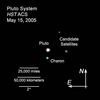
ZO-Pluto System.jpgPluto's System: Facts, Data, Men and early Picture55 visiteFast Facts — Recent Technical information (Oct. 2005)
Object Name: Pluto
Object Description: Planet
Distance: Although its orbit is highly eccentric, Pluto's average distance from the Sun is 39,44 Astronomical Units (A.U.) or roughly 3,6 BMs (such as about 5,9 BKM).
Dimensions: Pluto has a diameter of roughly 1.475 miles (about 2.280 Km) at the equator.
About the Data Description: these HST data are from proposal 10427: H.A. Weaver (JHU/APL), M.W. Buie (Lowell Obs.), S.A. Stern, J.R. Spencer, E. Young, and L.A. Young (SwRI); and proposal 9391: M.W. Buie and W.M. Grundy (Lowell Obs.), E. Young, L.A. Young, and S.A. Stern (SwRI). M. Mutchler (STScI) and A.J. Steffl (SwRI) are also on the science team.
Instrument: ACS/WFC ACS/HRC
Exposure Date(s): May 15/18, 2005 various dates in 2002 and 2003
Filters: F606W (V) F475W (B) and F555W (V)Nov 03, 2005
|
|
| 76 immagini su 7 pagina(e) |
 |
|
|
5 | |
|





