| Ultimi arrivi - Pluto and Charon: The "Double Planet" |

ZZ-ZZ-Nhcp20071201_0488.jpgWhere's New Horizons? December 2007 (1) - Current Position54 visiteThis image shows New Horizons' current position. The green segment of the line shows where New Horizons has traveled since launch; the red indicates the Spacecraft's path toward Jupiter, Pluto and beyond. Positions of stars with magnitude 12 or brighter are shown from this perspective, which is above the Sun and "North" of Earth's orbit.
What Is an AU? The graphics on these pages note New Horizons' distance from Earth, Jupiter and Pluto in AU, or Astronomical Units. One AU is the average distance between the Sun and Earth, about 93 MMs or 149,6 MKM.
Heliocentric Velocity.
The current position graphic also notes the Spacecraft's Heliocentric Velocity (HV), such as its speed with respect to the Sun - in kilometers per second.
One kilometer per second is equivalent to 0,62 miles per second, or 2237 miles per hour.MareKromiumDic 21, 2007
|
|

ZZ-ZZ-Nhov20071201_0488.jpgWhere's New Horizons? December 2007 (2) - Full Trajectory: Overhead View54 visiteThis image shows New Horizons' current position along its full planned trajectory. The green segment of the line shows where New Horizons has traveled since launch; the red indicates the spacecraft's future path.
Positions of stars with magnitude 12 or brighter are shown from this perspective, which is above the Sun and "North" of Earth's orbit.MareKromiumDic 21, 2007
|
|

ZZ-ZZ-Nhsv20071201_0488.jpgWhere's New Horizons? December 2007 (3) - Full Trajectory - Side View54 visiteThis image shows New Horizons' current position along its full planned trajectory. The green segment of the line shows where New Horizons has traveled since launch; the red indicates the Spacecraft's future path.
Positions of stars with magnitude 12 or brighter are shown from this perspective, which is slightly above the Orbital Plane of the Planets. MareKromiumDic 21, 2007
|
|

ZZ-Pluto-PIA09234.gifPluto! From New Horizons (GIF-Movie)55 visiteCaption NASA:"The Long Range Reconnaissance Imager (LORRI) on New Horizons acquired images of the Pluto field 3 days apart in late September 2006, in order to see Pluto's motion against a dense background of stars. LORRI took 3 frames at 1-second exposures on both Sept. 21 and Sept. 24.
Because it moved along its predicted path, Pluto was detected in all six images.
These images are displayed using false-color to represent different intensities: the lowest intensity level is black, different shades of red mark intermediate intensities, and the highest intensity is white. The images appear pixilated because they were obtained in a mode that compensates for the drift in spacecraft pointing over long exposure times. LORRI also made these observations before operators uploaded new flight-control software in October; the upgraded software package includes an optical navigation capability that will make LORRI approximately three times more sensitive still than for these Pluto observations".MareKromiumOtt 06, 2007
|
|

ZZ-New_Horizons-00.jpgOn the way to Pluto: the passing of the Moon (1)54 visiteCaption NASA:"The first body New Horizons passed after launch was our own Moon, just 8 hours and 35' after liftoff on Jan. 19, 2006. New Horizons reached the closest distance to the Moon before crossing lunar orbit".Feb 28, 2007
|
|

ZZ-New_Horizons-01.jpgOn the way to Pluto: the passing of Mars (2)54 visiteCaption NASA:"New Horizons' trailblazing journey to the Solar System's outermost frontier took it past the orbit of Mars at 6 a.m. EDT (1000 UTC) on April 7, 2006 - 78 days after the spacecraft launched.
At the time, because of Mars' position in its orbit, New Horizons was actually closer to Earth than to Mars - just 93,5 MKM (58,1 MMs) from home, compared to 299 MKM (186 MMs) from the Red Planet. Speeding away from the Sun at 21 Km (about 13 miles) per second, the spacecraft crossed Mars' path some 243 MKM (about 151 MMs) from the Sun - close to the farthest point in Mars' elliptical 687-day orbit".Feb 28, 2007
|
|

ZZ-New_Horizons-02.jpgOn the way to Pluto: through the Jupiter System (3)55 visiteCaption NASA:"This image shows New Horizons' path through the Jupiter System; the inset shows the location of Jupiter's four largest moons, Io, Ganymede, Europa and Callisto.
New Horizons will turn its science instruments toward the moons as well as the giant planet".Feb 28, 2007
|
|

ZZ-New_Horizons-03.jpgOn the way to Pluto: beyond Jupiter (4)54 visiteCaption NASA:"This image shows New Horizons' Current Position (end of February, 2007). The green segment of the line shows where New Horizons has traveled since launch; the red indicates the spacecraft's path toward Jupiter, Pluto and beyond. Positions of stars with magnitude 12 or brighter are shown from this perspective, which is above the Sun and "north" of Earth's orbit.
AU -> The graphics on these pages note New Horizons' distance from Earth, Jupiter and Pluto in AU, or Astronomical Units. One AU is the average distance between the Sun and Earth, about 93 MMs or 149,6 MKM.
HV -> The Current Position graphic also notes the spacecraft's Heliocentric Velocity - HV, such as its speed with respect to the Sun - in kilometers per second.
One kilometer per second is equivalent to 0,62 miles per second, or 2237 miles per hour".Feb 28, 2007
|
|

ZYZ-R-Pluto.jpgPluto54 visitenessun commentoOtt 14, 2006
|
|
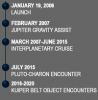
ZZ-ZZ-ZZ-ZZ-ZZ-ZZ-ZZ-ZZ-ZZ-ZZ-Timeline.jpgThe "Timeline" to Pluto...and beyond81 visiteLa schedula temporale (o "Timeline") che illustra il prossimo futuro della Sonda New Horizons, dal giorno della partenza, passando attraverso l'incontro con Giove (che le servirà da "Fionda Gravitazionale"), sino al passaggio ravvicinato con Plutone, nel Luglio 2015 e poi...L'immersione nella Fascia di Kuiper e l'incontro (probabile) con uno o due oggetti, tra il 2016 ed il 2020.
New Horizons, come tutte le Sonde destinate ad attraversare il Sistema Solare, sarà precisa e puntuale al suo appuntamento con la Storia: non ci sono dubbi.
Siatelo anche Voi!... Lug 13, 2006
|
|

ZW-Pluto & Companions.jpgNix and Hydra!55 visiteDa "NASA - Picture of the Day" del 24 Giugno 2006:"Discovered in mid-2005, Pluto's small moons were provisionally designated S/2005 P1 and S/2005 P2.
They have now been officially christened Nix and Hydra.
Compared to Pluto and its large moon Charon, at 2.360 and 1.210 Km in diameter respectively, Nix (inner moon) and Hydra (outer moon) are tiny, estimated to be only 40 to 160 Km across. Pluto and Charon are bright enough to create diffraction spikes in this HST image, but Nix and Hydra are some 5.000 times fainter than Pluto and appear only as small points of light. Still, their new names are appropriate for the distant Pluto System. In mythology, Nix was the goddess of Darkness and Night and the mother of Charon, while Hydra was a nine headed monster and is now orbiting the Solar System's 9th planet.
Of course Nix and Hydra also share initials with the pluto-bound spacecraft New Horizons".Giu 26, 2006
|
|

ZYZ-Q-PlutoLatestColors.jpgThe "true" colors of Pluto (another interpretation)58 visiteUno studio sui possibili colori autentici di Plutone, realizzato dal bravo e modesto Ricercatore Don Davis, di cui abbiamo già apprezzato svariati studi ed elaborazioni sui "Colori del Sistema Solare" (Marte e Venere, in maniera particolare, sono - secondo noi - i suoi lavori più belli e riusciti).
Caption originale:"Pluto seems to have intriguing surface details, with pronounced contrast between white and yellow brown Regions. These regional contrasts have been largely detected by measurements of light changes as Pluto was eclipsed by its large satellite Charon, in the late 1980's. The albedo of Pluto ranges from 0,49 to 0,66, while darker more neutral colored Charon averages about 0,37".Apr 09, 2006
|
|
| 76 immagini su 7 pagina(e) |
 |
|
4 | |
|
|





