| |

| Ultimi arrivi - Neptune and His Moons |

Neptune-crescent-PIA02204_modest.jpgNeptune's bright crescent66 visiteCaption NASA originale:"Neptune's bright crescent taken in six filters (from bottom to top: UV, violet, blue, clear, green, orange) on August, 31, 1989. The images were shuttered in temporal order: violet, blue, UV, clear, green, orange. These images how the bright core of D2, the South Polar feature, and the symmetric structure immediately surrounding the South Pole. The relatively high contrast of the features in these images indicates that they extend above most of the scattering haze and absorbing methane gas in Neptune's atmosphere. [Image processing by D.A. Alexander]"Mar 15, 2005
|
|
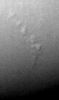
Neptune-shadows-PIA02220.jpg"Cloud shadows" on Neptune73 visiteCaption NASA originale:"This image of Neptune shows the discovery of shadows in Neptune's atmosphere, shadows cast onto a deep cloud band by small elevated clouds. They are the first cloud shadows ever seen by Voyager 2 on any planet. Estimates of the height of these discrete clouds above the underlying cloud bank can be obtained by careful analysis of this data".Mar 15, 2005
|
|

Neptune-bw-PIA02222.jpgNeptune and the "Great Dark Spot"101 visiteCaption NASA originale:"This photo was taken by Voyager 2's wide-angle camera. Light at methane wavelengths is mostly absorbed in the deeper atmosphere. The bright, white feature is a high-altitude cloud just south of the Great Dark Spot. Other, smaller clouds associated with the Great Dark Spot are white, and are also at high altitudes.
The Voyager Mission was conducted by JPL for NASA's Office of Space Science and Applications".Mar 15, 2005
|
|

Neq-Neptune-PIA00051.jpgNeptune in false colors64 visiteCaption NASA originale:"In this false color image of Neptune, objects that are deep in the atmosphere are blue, while those at higher altitudes are white. The image was taken by Voyager 2's wide-angle camera through an orange filter and two different methane filters. Light at methane wavelengths is mostly absorbed in the deeper atmosphere. The bright, white feature is a high altitude cloud just south of the Great Dark Spot. The hard, sharp inner boundary within the bright cloud is an artifact of computer processing on Earth. Other, smaller clouds associated with the Great Dark Spot are white or pink, and are also at high altitudes. Neptune's limb looks reddish because Voyager 2 is viewing it tangentially, and the sunlight is scattered back to space before it can be absorbed by the methane. A long, narrow band of high altitude clouds near the top of the image is located at 25° north latitude and faint hazes mark the equator and polar regions".Mar 15, 2005
|
|

Neq-Neptune-PIA00057.jpgThe "haze" of Neptune (false colors)74 visiteCaption NASA originale:"This false color photograph of Neptune was made from Voyager 2 images taken through 3 filters: blue, green and a filter that passes light at a wavelength that is absorbed by methane gas. Thus, regions that appear white or bright red are those that reflect sunlight before it passes through a large quantity of methane. The image reveals the presence of a ubiquitous haze that covers Neptune in a semitransparent layer. Near the center of the disk, sunlight passes through the haze and deeper into the atmosphere, where some wavelengths are absorbed by methane gas, causing the center of the image to appear less red. Near the edge of the Planet, the haze scatters sunlight at higher altitude, above most of the methane, causing the bright red edge around the planet. By measuring haze brightness at several wavelengths, scientists are able to estimate the thickness of the haze and its ability to scatter sunlight. The image is among the last full disk photos that Voyager 2 took before beginning its endless journey into interstellar space".Mar 15, 2005
|
|
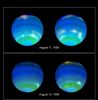
AA-Neptune-HST-PIA01542.jpgThe weather on Neptune - HST63 visite Caption NASA originale:"Using powerful ground and space-based telescopes, scientists have obtained a moving look at some of the wildest, weirdest weather in the Solar System. Combining simultaneous observations of Neptune made by HST and NASA's Infrared Telescope Facility on Mauna Kea, a team of scientists led by Lawrence A. Sromovsky (University of Wisconsin-Madison) has captured the most insightful images to date of a planet whose blustery weather - monster storms and equatorial winds of 900MPH! - bewilders scientists. Blending a series of HST images, Sromovsky's team constructed a time-lapse rotation movie of Neptune, permitting scientists to watch the ebb and flow of the distant planet's weather. And while the observations are helping scientists tease out clues to the planet's stormy weather, they also are deepening some of Neptune's mysteries. The weather on Neptune, is an enygma: the mechanism that drives its near-supersonic winds and giant storms has yet to be discerned! On Earth, weather is driven by energy from the sun as it heats the atmosphere and oceans. On Neptune, the sun is 900 times dimmer and scientists have yet to understand how Neptune's weather-generating machinery can be so efficient".Feb 10, 2005
|
|

AA-Neptune-HST-PIA01284.jpgNeptune in "Primary Colors" - HST72 visiteCaption NASA originale:"These 2 NASA HST images provide views of weather on opposite hemispheres of Neptune. Taken Aug. 13, 1996, with Hubble's Wide Field Planetary Camera 2, these composite images blend information from different wavelengths to bring out features of Neptune's blustery weather. The predominant blue color of the planet is a result of the absorption of red and infrared light by Neptune's methane atmosphere. Clouds elevated above most of the methane absorption appear white, while the very highest clouds tend to be yellow-red as seen in the bright feature at the top of the right-hand image. Neptune's powerful equatorial jet - where winds blow at nearly 900 mph! - is centered on the dark blue belt just south of Neptune's equator. Farther south, the green belt indicates a region where the atmosphere absorbs blue light".Feb 10, 2005
|
|

Neptune-PIA02209_modest.jpgNeptune from 176.000.000 Km - Voyager 281 visiteCaption NASA originale:"These pictures of Neptune were obtained by Voyager 2 on April 26,1989, at a distance of 176 MKM. At the center of the Neptune disc, each pixel covers a square 4° by 4° in latitude. (Each Voyager image contains 800 pixels, picture elements, per line and 800 lines.) Resolution here was 3256 Km per line pair. The violet, clear and orange filters of Voyager's narrow-angle camera were used to produce the color pictures. Image processing enhances contrast of the features. The picture on the right was taken five hours after that at left, during which time the planet rotated 100°. The dark spot visible in the left picture appeared in clear filter images obtained three months earlier. A much brighter, white spot, prominent in the earlier images, has now apparently faded. The white spot near the south pole in the right picture is new. It was visible only faintly in a picture taken 18 hours earlier at the same longitude. This evidence of dynamic activity was unexpected in Neptune's atmosphere because Neptune receives only one-tenth of one percent as much solar energy as does the Earth".Feb 01, 2005
|
|

Neptune-clouds-PIA00047_modest.jpgThe clouds of Neptune (b/w) - 162 visiteCaption NASA originale:"The bright cirrus-like clouds of Neptune change rapidly, often forming and dissipating over periods of several to tens of hours. In this sequence Voyager 2 observed cloud evolution in the region around the Great Dark Spot (GDS). The surprisingly rapid changes which occur separating each panel shows that in this region Neptune's weather is perhaps as dynamic and variable as that of the Earth. However, the scale is immense by our standards - the Earth and the GDS are of similar size... - and in Neptune's frigid atmosphere, where temperatures are as low as 55 degrees Kelvin (-360 F), the cirrus clouds are composed of frozen methane rather than Earth's crystals of water ice". Gen 17, 2005
|
|

Neptune-PIA01286_modest.jpgA new "dark spot" on Neptune, as seen by HST71 visiteCaption NASA originale:"NASA's HST has discovered a new Great Dark Spot, located in the Northern Hemisphere of Neptune. Because the planet's Northern Hemisphere is tilted away from Earth, the new feature appears near the limb of the planet.
The Spot is a near mirror-image to a similar Southern Hemisphere Dark Spot that was discovered in 1989 by the Voyager 2. In 1994, HST showed that the Southern Dark Spot had gone. Like its predecessor, the new Spot has high altitude clouds along its edge, caused by gasses that have been pushed to higher altitudes where they cool to form methane ice crystal clouds. The Dark Spot may be a zone of clear gas that is a window to a cloud deck lower in the atmosphere. Planetary scientists do not know how long this new feature might live. HST's HR images will allow astronomers to follow the spot's evolution and other unexpected changes in Neptune's dynamic atmosphere. This image was taken on 2.11-'94 with HST's Wide Field Planetary Camera 2, when Neptune was 4,5 BKMs from Earth".Gen 17, 2005
|
|

Neptune-clouds-PIA01982_modest.jpgThe clouds of Neptune (b/w) - 261 visiteAncora i "cirri" di Nettuno, ripresi dalla Sonda Voyager 2, mentre si spostano rapidamente nei pressi - e lungo i bordi, in particolare- della Grande Macchia Scura (o GDS, come dicono alla NASA).
E' curioso pensare che i mutamenti del clima, su Nettuno, possano in qualche modo essere simili ai mutamenti di clima che possiamo riscontrare nel cielo della nostra Terra.
Già, ma in fondo - a pensarci bene - le nuvole ed il vento devono essere fenomeni assolutamente universali.
Certo, le nuvole di Nettuno non sono costituite da cristalli d'acqua, bensì da cristalli di metano ghiacciato ed i venti di Nettuno superano i 2000 Km orari. Ma le nuvole restano nuvole ed il vento - per quanto forte possa essere - rimane vento. Forse queste considerazioni sono banali, ma noi siamo convinti che, di tanto in tanto, sia una cosa giusta quella di pensare a quanto diversi, eppure quanto simili, possano essere i fenomeni della Natura qui, sulla Terra, o su Marte, o su Nettuno od ovunque - probabilmente - nell'Universo.Gen 17, 2005
|
|

Triton-PIA00056_modest.jpgTriton's limb66 visiteCaption NASA originale:"Voyager 2 acquired this black and white image of Triton, Neptune's largest satellite, during the night of Aug. 24-25, 1989. Triton's limb cuts obliquely across the middle of the image. The field of view is about 1.000 Km (600 miles) across. Three irregular dark areas, surrounded by brighter material, dominate the image. Low-lying material with intermediate albedo occupies the central area, and fresh craters occur along the right margin. Sub-parallel alignment of linear patches of dark material shown in the lower and left part of the image suggests that the patches are structurally controlled".Gen 13, 2005
|
|
| 96 immagini su 8 pagina(e) |
|
|
|
5 | |
|
|
|
|





