| |

| Ultimi arrivi - Neptune and His Moons |
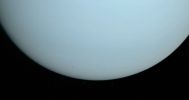
Z-Thalassa_and_Despina.jpgThalassa and Despina transiting (Credits: NASA/JPL - Voyager 2 Mission; Credits for the additional process.: "zelario12" - https://creativecommons.org/licenses/by-sa/2.0/deed.en)137 visitenessun commentoMareKromiumApr 26, 2026
|
|
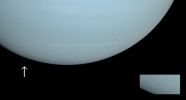
Z-Naiad.jpgNaiad transiting Neptune (Credits: NASA/JPL - Voyager 2 Mission; Credits for the additional process.: "zelario12" - https://creativecommons.org/licenses/by-sa/2.0/deed.en)111 visitenessun commentoMareKromiumApr 26, 2026
|
|
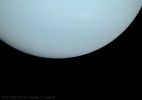
Z-Despina.jpgDespina transiting Neptune (Credits: NASA/JPL - Voyager 2 Mission; Credits for the additional process.: "zelario12" - https://creativecommons.org/licenses/by-sa/2.0/deed.en)131 visiteImmagine molto "datata", ma sempre molto bella ed ottimamente elaborata da tale "zelario12", al quale faccio i miei complimenti.MareKromiumApr 26, 2026
|
|

Neptune-V2.pngCrescent Neptune (August 1989)448 visite(ANSA) - ROMA, 18 AGOSTO 2022 - Compie 45 anni la sonda Voyager 2, la più longeva dell'era spaziale.
Lanciata il 20 agosto 1977, la sonda ha superato i confini del Sistema Solare nel 2018 ed è ancora attiva nello Spazio Interstellare, dal quale ha recentemente inviato dati mai visti (vedi Nota 1). Con la sua gemella Voyager 1, lanciata 15 giorni più tardi, la Voyager 2 è la protagonista di una missione da record. Gestite dal Jet Propulsion Laboratory (Jpl) della Nasa, le due sonde sono anche messaggeri molto speciali, che stanno portando nello spazio interstellare un biglietto da visita della Terra e dei suoi abitanti: un disco placcato in oro progettato per durare oltre un miliardo di anni, che contiene le immagini e suoni della vita sul nostro pianeta, diagrammi di leggi scientifiche fondamentali e saluti in molte lingue.
Entrambe le Sonde Voyager hanno attraversato il Sistema Solare rincorrendosi, con la Voyager 1 che ha raggiunto Giove e Saturno prima della sua compagna, mentre la Voyager 2 è stata la prima e finora l'unica sponda ad avvicinarsi a Urano, nel 1986, e poi a Nettuno, nel 1989, inviando a Terra le prime immagini ravvicinate di quei pianeti lontani, Nel 2013 la Voyager 1 era stata la prima a inoltrarsi nello spazio interstellare, seguita sei anni dopo dalla sua gemella. "Entrambe le sonde continuano a inviare all'umanità osservazioni da territori inesplorati", osserva la vice-responsabile scientifica del progetto, Linda Spilker, del Jpl. Le due Voyager "continuano a fare scoperte soprendenti", ha aggiunto la responsabile della missione Suzanne Dodd. "Non sappiamo per quanto tempo ancora la missione proseguirà, ma siamo sicuri che continuerà a regalarci molte sorprese scientifiche" (vedi Nota 2).
Nota 1: quali?
Nota 2: quali?
Come al solito: sensazionalismo di portata, condito dal nulla. Bellissima immagine comunque. L'aura più luminosa e bluastra che copre la porzione Sx del frame potrebbe essere un effetto del Sole. Ma non ho info al riguardo.MareKromiumAgo 20, 2022
|
|

Neptune-PIA21629.jpgNeptune from the Saturnian Sky (Natural Colors; credits: NASA/JPL-Caltech/Space Science Institute)127 visiteCaption NASA:"On August 25, 1989, NASA's Voyager 2 made its historic Fly-By of Neptune and its largest moon, Triton. The Cassini Spacecraft took this image to celebrate the anniversary of that event.
Neptune appears in this Natural Color composite as a pale blue disk (similar to Cassini's image of Uranus from 2014), just below and to the right of image center. Most of the faint specks in the image are background stars, although some are likely Cosmic Rays (charged particles that strike the camera detector).
By imaging Neptune, Cassini's Solar System family portrait-taking is complete. The Mission's Planetary Photojournal includes all of the major Planets except Mercury, which is too close to the Sun to be imaged, as well as dwarf planet Pluto.
This view was acquired by the Cassini narrow-angle camera on Aug. 10, 2017, at a distance of approximately 2,72 Billion Miles (such as approx. 4,38 BKM) from Neptune. Red, blue and green filter images were combined to create this Natural Color image".MareKromiumGen 20, 2020
|
|

Triton-PIA02246-PCF-LXTT-IPF.jpgStill in the Abyss (Absolute Natural Colors; credits for the additional process. and color.: Dr Paolo C. Fienga - Lunar Explorer Italia/Italian Planetary Foundation)97 visiteFeatures as small as approx. 100 Km (such as a little more than 62 miles) across can be seen in this Absolut Color Image of Neptune's moon Triton, photographed by the NASA - Voyager 2 Spacecraft on August 20, 1989, while it was still approx. 5,4 Million KiloMeters (such as about 3,35 Million Miles) from Neptune. Triton's overall light pinkish color may be due to the heavy irradiation (---> the action of the Cosmic Rays and other Charged Particles, including the ones forming the Solar Wind) of the Ice (and, maybe, other Elements which were already) existing on the Surface of this distant Celestial Body.
The dark areas near the top of the image seem to be part of a belt of dark markings observed near Triton's Equator at different Longitudes. However - and generally speaking -, the darker areas visible on Triton appear to be somewhat redder in color than the brighter ones. The central Longitude in the image is 123° East. The South Pole of Triton is at about 6 o'clock of the disk, approximately 1/6th (one sixth) of the way up from its lower limb.
This frame (which is the Original NASA - Voyager 2 color frame published on the NASA - Planetary Photojournal with the ID n. PIA 02246) has been additionally processed and then re-colorized, according to an educated guess carried out by Dr Paolo C. Fienga (LXTT-IPF), in Absolute Natural Colors (such as the colors that a human eye would actually perceive if someone were onboard the NASA - Voyager 2 Spacecraft and then looked outside, towards the Neptunian moon Triton), by using an original technique created - and, in time, dramatically improved - by the Lunar Explorer Italia Team. Different colors, as well as different shades of the same color, mean, among others, the existence of different Elements present on the Surface of Triton, each having a different Albedo (---> Reflectivity) and Chemical Composition.MareKromiumFeb 24, 2013
|
|

Triton-PIA00317-PCF-LXTT-IPF.jpgThe Southern Regions of Triton (Absolute Natural Colors; credits for the additional process. and color.: Dr Paolo C. Fienga/Lunar Explorer Italia/Italian Planetary Foundation)106 visiteThis wonderful and highly detailed global Absolute Natural Color image mosaic of Triton was obtained in the AD 1989 by the NASA - Voyager 2 Spacecraft during its Fly-By of the Neptunian System.
With a radius of approx. 1350 Km (such as a little more than 838 miles) and therefore some 22% smaller than Earth's Moon, Triton is by far the largest Natural Satellite of Neptune. Furthermore, Triton is one of the only 3 (three) objects in the Solar System known to have a Nitrogen-dominated Atmosphere (the others are our Home Planet Earth and the Saturnian giant moon, Titan). Triton has the coldest Surface known anywhere in the Solar System (38 K, or about - 391 degrees Fahrenheit, or - 235° Celsius): it is so cold that most of Triton's Nitrogen is condensed as Frost, making it the only Celestial Body in the whole Solar System that is known to have a Surface mainly composed of Nitrogen Ice.
The pinkish deposits constitute a vast South Polar Cap, that is believed to contain Methane Ice, which somehow reacted under Sunlight so to form pink or red Compounds. The Dark Streaks overlying these pink ices are believed to be an Icy and - perhaps - Carbonaceous Dust deposited from huge Geyser-like Plumes, some of which were found to be active during the Voyager 2 Fly-By. The light gray colored band visible in this image extends all the way around Triton, near the Equator and it may consist of relatively fresh Nitrogen Frost Deposits. The vaguely greenish areas of Triton (central and upper right side) include what is known as "The Cantaloupe Terrain", whose origin is still unknown, and a set of "Cryovolcanic" Landscapes apparently produced by Icy-cold Liquids (now totally frozen) that were erupted from Triton's interior.
This frame (which is the Original NASA - Voyager 2 color image mosaic published on the NASA - Planetary Photojournal with the ID n. PIA 00317) has been additionally processed and then re-colorized, according to an educated guess carried out by Dr Paolo C. Fienga (LXTT-IPF), in Absolute Natural Colors (such as the colors that a human eye would actually perceive if someone were onboard the NASA - Voyager 2 Spacecraft and then looked outside, towards the Neptunian moon Triton), by using an original technique created - and, in time, dramatically improved - by the Lunar Explorer Italia Team. Different colors, as well as different shades of the same color, mean, among others, the existence of different Elements present on the Surface of Triton, each having a different Albedo (---> Reflectivity) and Chemical Composition.MareKromiumFeb 24, 2013
|
|

Neptune-June2011-HST.jpgOne Neptunian Day...101 visiteCaption NASA:"Neptune rotates once on its axis in about 16 hours. So, spaced about 4 hours apart these 4 images of the Solar System's most distant Gas Giant cover one Neptune day. Recorded by the Hubble Space Telescope in late June 2011, they combine exposures made with visible and Near-InfraRed filters to show high-altitude Clouds composed of Methane ice crystals against the Planet's normally blue Cloud Tops.
Because Neptune's axis of rotation is tilted to its orbital plane by 29°, compared to Earth's 23,5°, Neptune experiences seasons analogous to Earth's.
As early Summer comes to Neptune's Southern Hemisphere and Winter to the North, Hubble observations have shown Cloud activity shifting to the Northern Hemisphere. In fact the progression of Neptune's seasons has come around once since its position was predicted by French mathematician Urbain Le Verrier and British mathematician John Couch Adams, and the Planet was subsequently discovered by German astronomer Johann Galle on September 23, 1846. With an orbital period of approximately 165 years, this week on July 12, 2011, Neptune has been once around the Sun since its discovery date".MareKromiumLug 14, 2011
|
|
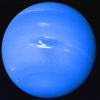
A-Neptune-PCF-LXTT.jpgBlue, Blue Neptune! (Natural Colors; credits for the additional process. and color.: Dr Paolo C. Fienga - Lunexit Team)112 visiteNeptune Data and Statistics
Discovered by Johann Gotfried Galle
Date of discovery = AD 1846
Mass (kg) = 1.024e+26
Mass (Earth = 1) = 1,7135e+01
Equatorial radius = 24.746 Km
Equatorial radius (Earth = 1) = 3,8799e+00
Mean density (gm/cm^3) = 1,64
Mean distance from the Sun = 4.504.300.000 Km
Mean distance from the Sun (Earth = 1) = 30,0611
Rotational period (hours) = 16,11
Orbital period (years) = 164,79
Mean orbital velocity = 5,45 Km per second
Tilt of axis = 29,56°
Orbital inclination = 1,774°
Equatorial surface gravity (m/sec^2) = 11,0
Equatorial escape velocity = 23,50 Km per second
Magnitude (Vo) = 7,84
Mean cloud temperature = from - 193°C to - 153°C
Atmospheric pressure (bars) = from 1 to 3
Atmospheric composition: Hydrogen 85%; Helium 13% and Methane 2% MareKromiumGiu 25, 2011
|
|

Neptune-V2.jpgBright Neptunian Clouds99 visiteCaption NASA:"This Voyager 2 HR Natural Color image, taken about two hours before closest approach, provides obvious evidence of vertical relief in Neptune's bright Cloud Streaks. These clouds were observed at a latitude of 29° North near Neptune's Eastern Terminator. The linear cloud forms are stretched approximately along lines of constant latitude and the Sun is toward the lower left.
The bright sides of the clouds which face the sun are brighter than the surrounding cloud deck because they are more directly exposed to the Sun.
Shadows can be seen on the side opposite the Sun. These shadows are less distinct at short wavelengths (violet filter) and more distince at long wavelengths (orange filter). This can be understood if the underlying cloud deck on which the shadow is cast is at a relatively great depth, in which case scattering by moleculres in the overlying Atmosphere will diffuse light into the shadow. Because molecules scatter blue light much more efficiently than red light, the shadows will be darkest at the longest (reddest) wavelengths, and will appear blue under white light illumination.
The resolution of this image is roughly 11 Km (about 6,8 miles) per pixel and the range is only 157.000 Km (approx. 98.000 miles). The width of the Clouds Streaks range from about 50 to about 200 Km (approx. 31 to 124 miles), and their shadow widths range from about 30 to about 50 Km (approx. 18 up to 31 miles). Cloud heights appear to be of the order of approx. 50 Km (about 31 miles).MareKromiumAgo 08, 2010
|
|

Triton-PIA02234~0.jpgTriton (possible Natural Colors; credits for the additional process. and color.: Dr Paolo C. Fienga - Lunexit Team)74 visitenessun commentoMareKromiumGiu 19, 2010
|
|

Triton-PIA12184.jpgVolcanic Plains on Triton (possible Natural Colors; credits: Lunexit)64 visiteCaption NASA:"This view of the Volcanic Plains of Neptune's moon Triton was produced using topographic maps derived from images acquired by NASA's Voyager Spacecraft during its August 1989 flyby, 20 years ago this week (August 2009).
Triton, Neptune's largest moon, was the last solid object visited by the Voyager 2 Spacecraft on its epic 10-year tour of the Outer Solar System.
This regional view shows a variety of Terrains on Triton, including the smooth Volcanic Plains in the foreground, formed by icy lavas. Parts of this Surface have been eroded, forming mounds and depressions with relief of tens to a few hundred meters (several hundred feet). The round pits and mounds across the center of the scene are probably volcanic explosion or collapse craters, the largest of which (at bottom center) is approx. 250 meters deep (820 feet) and approx. 15 Km (about 9 miles) across.
Many of these pits are aligned in chains similar to those seen in basaltic volcanic areas on Earth, such as Craters of the Moon National Monument in Idaho, except the lavas on Triton are water and other ices that erupted onto the Surface.
In the distance is one of two large walled smooth plains of unknown origin. These plains are roughly 200 Km (about 124 miles) across.
The Surface of Triton is very rugged, scarred by rising blobs of ice (Diapirs), Faults and Volcanic Pits and Lava Flows composed of water and other ices. The Surface is also extremely young and sparsely cratered. It may even be younger than the Surface of Europa, one of the first objects visited by the Voyager Spacecraft and could be geologically active today.
Although locally very rugged, Triton has no large mountains or deep basins and regional relief is low, a consequence of its high internal heat and the low strength of most ices. This scene is on the order of 500 Km (about 310 miles) across and is taken from a new flyover movie across the Equatorial Regions of Triton commemorating the Voyager 20-year anniversary of this flyby.
Vertical relief has been exaggerated by a factor of 25 to aid interpretation".MareKromiumSet 08, 2009
|
|
| 96 immagini su 8 pagina(e) |
1 |
|
|
|
|
|
|
|
|





