| Ultimi arrivi - Uranus and His Moons |

A - Uranus.jpgUranus from Voyager 2109 visiteUranus Data and Statistics
Discovered by William Herschel
Date of discovery = AD 1781
Mass (kg) = 8.686e+25
Mass (Earth = 1) = 1,4535e+01
Equatorial radius = 25.559 Km
Equatorial radius (Earth = 1) = 4,0074
Mean density (gm/cm^3) = 1,29
Mean distance from the Sun = 2.870.990.000 Km
Mean distance from the Sun (Earth = 1) = 19,1914
Rotational period (hours) = - 17,9
Orbital period (years) = 84,01
Mean orbital velocity = 6,81 Km per second
Tilt of axis = 97,86°
Orbital inclination = 0,774°
Equatorial surface gravity (m/sec^2) = 7,77
Equatorial escape velocity = 21,30 Km per second
Magnitude (Vo) = 5,52
Mean cloud temperature = - 193°C
Atmospheric pressure (bars) = 1,2
Atmospheric composition: Hydrogen 83%; Helium 15%; Methane 2% Dic 15, 2004
|
|

Uranus from Keck Obs..jpgUranus from Keck Observatory112 visiteCaption NASA originale:"These sharp views of tilted gas giant Uranus show dramatic details of the planet's atmosphere and ring system. The remarkable ground-based images were made using a near-infrared camera and the Keck Adaptive Optics system to reduce the blurring effects of Earth's atmosphere. Recorded in July 2004, the pictures show two sides of Uranus. In both, high, white cloud features are seen mostly in the northern (right) hemisphere, with medium level cloud bands in green and lower level clouds in blue. The artificial color scheme lends a deep reddish tint to the otherwise faint rings. Because of the severe tilt of its rotational axis, seasons on Uranus are extreme and last nearly 21 Earth years on the distant planet. Uranus is now slowly approaching its southern autumnal equinox - the beginning of fall in the southern hemisphere - in 2007".Nov 18, 2004
|
|

Miranda-V2-PIA00141_modest.jpgMiranda's limb from Voyager 2 - January 24, 1986114 visiteEd ecco ora Miranda, la Luna più interna di Urano. Essa ha una forma decisamente irregolare ed evidenzia molto chiaramente - come in questo frame - delle profonde "cicatrici" superficiali le quali rivelano, come dicono alla NASA, una "complessa storia geologica". EccoVi parte della caption originale NASA per questa foto:"...At least 3 terrain types of different age and geologic style are evident at this resolution of about 700 (2.300 feet) meters. Visible in this clear-filter, narrow-angle image are, from left: (1) an apparently ancient, cratered terrain consisting of rolling, subdued hills and degraded medium-sized craters (2) a grooved terrain with linear valleys and ridges developed at the expense of, or replacing, the first terrain type and (3) a complex terrain seen along the terminator, in which intersecting curvilinear ridges and troughs are abruptly truncated by the linear, grooved terrain. Voyager scientists believe this third terrain type is intermediate in age between the first two". Nov 02, 2004
|
|
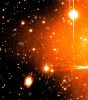
VE-Caliban.jpgCaliban95 visiteUna "Luna Minore" di Urano, Calibano, persa fra le stelle ed individuabile solo grazie alla "cerchiatura" bianca inserita in questa (comunque molto bella) immagine.Ott 20, 2004
|
|
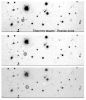
VM-Sycorax.jpgSycorax79 visitenessun commentoOtt 20, 2004
|
|

VL-Rosalind-V2.jpgRosalind - Voyager 290 visitenessun commentoOtt 20, 2004
|
|

VI-Puck-V2.jpgPuck - Voyager 299 visitenessun commentoOtt 20, 2004
|
|

VH-Juliet-V2.jpgJuliet - Voyager 292 visitenessun commentoOtt 20, 2004
|
|

VG-Desdemona-V2.jpgDesdemona - Voyager 293 visitenessun commentoOtt 20, 2004
|
|

VF-Cressida, Ophoelia, Portia.jpgCressida, Ophoelia and Portia - Voyager 296 visiteUn piccolissimo commento (forse abbastanza scontato): noi non sappiamo chi, fisicamente, abbia dato i nomi a queste Lune Minori di Urano ma, certamente, si trattava di un appassionato lettore di Sir William Shakespeare.
Non credete?!?...Ott 20, 2004
|
|

VD-Bianca-V2.jpgBianca - Voyager 288 visiteUn'immagine scarsamente significativa? Secondo noi no. Non è certamente un frame magnifico, ma non sempre per vedere (e per capire!) qualcosa di grande e di complesso dobbiamo fare affidamento sulla sola "bellezza". Urano, in questo frame, è vicino alla Sonda, è luminoso ed appare sovraesposto (sembra più il Sole che un pianeta...); gli Anelli di Urano si mostrano piuttosto bene ed evidenziano tanti dettagli. Bianca è solo un puntino, apparentemente insignificante, ma che, con la sua sola presenza, comunque contribuisce a mantenere in equilibrio una parte del Sistema degli Anelli di Urano (essa è, dunque, per Urano, una "Shepherd Moon", così come lo sono Mimas ed Hyperion - oltre ad altre Lune interne minori - per Saturno"). Interessante, vero?!?Ott 20, 2004
|
|

VC-Belinda-V2.jpgBelinda - Voyager 280 visiteEd ora una carrellata relativa ad alcune delle Lune "minori" di Urano. La maggior parte di esse è stata scoperta ex-post, cioè analizzando le immagini mandateci alcuni anni fa dai nostri Messaggeri inviati ai confini del Sistema Solare: le Sonde Voyager 1 e 2. Si tratta di mondi assai minuscoli, dalle forme irregolari, probabilmente non originari del Sistema di Urano, ma "catturati" dal Gigante Gassoso in epoche più o meno remote. Forse, queste Lune minori, sono delle "comete mancate" o forse sono frammenti, schegge di corpi celesti più grandi entrati in collisione quando il Sistema Solare era ancora - relativamente - "giovane". Qualunque sia la verità (che, probabilmente, non conosceremo mai), noi Vi offriamo le immagini che abbiamo raccolto in giro per la Rete e desideriamo ringraziare l'Ing. Calvin J. Hamilton, creatore e curatore del bellissimo Sito conosciuto come "Views of the Solar System".Ott 20, 2004
|
|
| 109 immagini su 10 pagina(e) |
 |
|
|
|
|
7 | |
|
|





