| Ultimi arrivi - Uranus and His Moons |

Miranda-vg2_2684617-B.jpgThe beautiful "Verona Rupes" from a different angle (detail mgnf)116 visiteUn detail mgnf dedicato ad un frame raro e stupendo che ci rammenta (ancora una volta) una delle Meraviglie del Sistema Solare: le Verona Rupes.Lug 31, 2006
|
|

Miranda-vg2_2684617-A.jpgThe beautiful "Verona Rupes" from a different angle (context image)100 visitenessun commentoLug 31, 2006
|
|

VAA-Uranus Rings.2jpg.jpgBeautiful Starfield, through Uranus' Rings79 visitenessun commentoApr 26, 2006
|
|

VAA-Uranus Rings-1.jpgUranus' Rings (3)78 visiteCiò che intendiamo dire (l'ipotesi di lavoro che Vi proponiamo) è questo: forse gli Anelli di Giove, Urano e di Nettuno hanno un'origine diversa (almeno in parte) rispetto a quelli di Saturno. Gli Scienziati che vanno per la maggiore, infatti, pensano che la differenza nella "tessitura" degli Anelli tipici dei Giganti Gassosi dipenda solo dalle dimensioni originali del corpo celeste (o dei corpi celesti) dal cui disintegrarsi essi vennero generati: più grande era questo/i corpo/i, maggiore era il quantitativo di materiale che si distribuiva lungo l'orbita, più grande e maestosa (scenicamente) risultava la trama finale degli Anelli. Noi opiniamo che, forse, questa costruzione spiega gli Anelli di Giove, Urano e Nettuno ma non è sufficiente - da sola! - per spiegare l'origine degli Anelli di Saturno i quali ci appaiono troppo grandi e troppo complessi per essere derivati soltanto da un evento come quello dianzi ipotizzato.
Ne riparleremo ancora. Apr 26, 2006
|
|
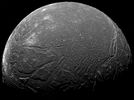
Ariel.jpgAriel (HR)88 visiteLa tormentata superficie di Ariel si rivela in tutto il suo (comunque grande) fascino.
Una serie di impressionanti fratture tettoniche (forse un raffreddamento troppo rapido?) caratterizza l'Est e l'Ovest di questo mondo lontano; svariati mega-canyons, lunghi e profondi, passano attraverso l'equatore di Ariel, frammentandosi e ramificandosi poi in centinaia di crepacci minori; distese simili ai "mari" della Luna contraddistinguono una buona parte della sua superficie la quale, inoltre, sembra avere delle aree (alla Vostra Sx - Eastern limb) la cui albedo (alta) appare molto diversa rispetto al resto del Pianeta.
Da notare che, a differenza di quanto accade per le altre lune di Urano (come per la maggior parte delle lune dei quattro Giganti Gassosi), non riusciamo a distinguere che un modesto numero di crateri da impatto e questa circostanza è sicuramente strana: che Ariel sia passata, magari, attraverso una parziale e "recente" (in senso geologico) ridefinizione della sua superficie?Gen 23, 2006
|
|

UT-Uranus Rings.jpgThe new "Giant Rings" of Uranus79 visiteEven though the Voyager 2 spacecraft paid a close-up visit to Uranus in 1986, the distant planet continues revealing surprises to the eye of NASA's HST. HST's high sensitivity and sharp view has uncovered a pair of Giant Rings girdling the Planet. The largest is twice the diameter of the Planet’s previously known Ring System, first discovered in the late 1970s. Hubble also spied two small satellites, named Mab and Cupid. One of the satellites shares an orbit with the outermost of the new Rings. The satellite is probably the source of fresh dust that keeps replenishing the ring with new material knocked off the satellite from meteoroid impacts. Without such replenishment, the dust in the ring would slowly spiral in toward Uranus. Collectively, these new discoveries mean that Uranus has a youthful and dynamic system of Rings and Moons (...) Uranus's Rings are mostly dust (...)".Dic 22, 2005
|
|

Uranus-HST-CJH.jpgUranus, from HST103 visitenessun commentoOtt 28, 2005
|
|

AB-AB-vg2_2686312.gifThe limb of Uranus80 visiteOriginal caption:"Voyager 2 image of the limb of Uranus from about 694.000 Km. This narrow angle view is about 5.100 Km across and was taken 12 hours after closest approach. The image is centered at -10, 212 and North is up. (Voyager 2, FDS 26863.12)".Ott 26, 2005
|
|

AAA-vg2_2684726.gifFlying over Uranus...92 visiteOriginal caption:"Image of Uranus taken by Voyager 2 about 21 minutes before closest approach. This image, centered at 4° South, 58° West, was taken with the wide angle camera. The frame is approx. 5.300 km from top to bottom and north is at 1:00. (Voyager 2, 26847.26)".Ott 26, 2005
|
|

AAA-Uranus&Co..jpgThe Uranus' "Family"103 visitenessun commentoOtt 26, 2005
|
|

Uranus-HST-PIA01279.jpgUranus from Hubble Space Telescope81 visiteCaption NASA originale:"Uranus is sometimes called the sideways planet, because its rotation axis tipped more than 90° from the planet's orbit around the Sun. The year on Uranus lasts 84 Earth years, which creates extremely long seasons - winter in the Northern Hemisphere has lasted for nearly 20 years. Uranus has also been called bland and boring, because no clouds have been detectable in ground-based images of the planet. Even to the cameras of the Voyager spacecraft in 1986, Uranus presented a nearly uniform blank disk and discrete clouds were detectable only in the Southern Hemisphere. Voyager flew over the Planet's cloud tops near the dead of northern winter (when the northern hemisphere was completely shrouded in darkness).
Two images are shown here. The "aqua" image (on the left) is taken at 5,470 Angstroms, which is near the human eye's peak response to wavelength. Color has been added to the image to show what a person on a spacecraft near Uranus might see. Little structure is evident at this wavelength, though with image-processing techniques, a small cloud can be seen near the planet's northern limb (rightmost edge). The "red" image (on the right) is taken at 6,190 Angstroms, and is sensitive to absorption by methane molecules in the planet's atmosphere. The banded structure of Uranus is evident, and the small cloud near the northern limb is now visible".Mar 15, 2005
|
|

Uranus-uppatm-PIA01488.jpgHaze in the upper atmosphere of Uranus81 visiteCaption NASA originale:"This is a computer enhancement of a Voyager 2 image, that emphasizes the high-level haze in Uranus' upper atmosphere. Notice how the clouds are obscured by the overlying atmosphere".Mar 15, 2005
|
|
| 109 immagini su 10 pagina(e) |
 |
|
|
5 | |
|
|
|
|





