| Ultimi arrivi - Jupiter: the "King" and His Moons |

Jupiter_Io-PIA10102.jpgLike Father and Son... (approx. true colors; credits: NASA)78 visiteCaption NASA:"This is a montage of New Horizons images of Jupiter and its volcanic moon Io, taken during the Spacecraft's Jupiter flyby in early 2007. The Jupiter image is an infrared color composite taken by the spacecraft's near-infrared imaging spectrometer, the Linear Etalon Imaging Spectral Array (LEISA) at 1:40 UT on Feb. 28, 2007. The infrared wavelengths used (red: 1.59 µm, green: 1.94 µm, blue: 1.85 µm) highlight variations in the altitude of the Jovian cloud tops, with blue denoting high-altitude clouds and hazes, and red indicating deeper clouds. The prominent bluish-white oval is the Great Red Spot. The observation was made at a solar phase angle of 75° but has been projected onto a crescent to remove distortion caused by Jupiter's rotation during the scan.
The Io image, taken at 00:25 UT on March 1st 2007, is an approx. true-color composite taken by the panchromatic Long-Range Reconnaissance Imager (LORRI), with color information provided by the 0.5 µm ("blue") and 0.9 µm ("methane") channelsof the Multispectral Visible Imaging Camera (MVIC). The image shows a major eruption in progress on Io's night side, at the northern volcano Tvashtar. Incandescent lava glows red beneath a 330-kilometer high volcanic plume, whose uppermost portions are illuminated by sunlight. The plume appears blue due to scattering of light by small particles in the plume ".MareKromiumDic 18, 2007
|
|
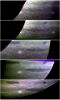
Jupiter-PIA10076.jpgAmmonia Ice-Clouds on Jupiter56 visiteCaption NASA:"The top cloud layer on Jupiter is thought to consist of ammonia ice, but most of that ammonia "hides" from spectrometers. It does not absorb light in the same way ammonia does. To many scientists, this implies that ammonia churned up from lower layers of the atmosphere "ages" in some way after it condenses, possibly by being covered with a photochemically generated hydrocarbon mixture.
The New Horizons Linear Etalon Imaging Spectral Array (LEISA), the half of the Ralph instrument that is able to see in infrared wavelengths that are absorbed by ammonia ice, spotted these clouds and watched them evolve over 5 Jupiter days (about 40 Earth hours). In these images, spectroscopically identified fresh ammonia clouds are shown in bright blue. The largest cloud appeared as a localized source on day 1, intensified and broadened on day 2, became more diffuse on days 3 and 4, and disappeared on day 5.
The diffusion seemed to follow the movement of a dark spot along the boundary of the oval region. Because the source of this ammonia lies deeper than the cloud, images like these can tell scientists much about the dynamics and heat conduction in Jupiter's lower atmosphere".MareKromiumDic 18, 2007
|
|

Jupiter-PIA10096.jpgPolar Lightning on Jupiter56 visiteCaption NASA:"Images taken by the New Horizons Long-Range Reconnaissance Imager (LORRI) of Jupiter's night side showed lightning strikes.
Each "strike" is probably the cumulative brightness of multiple strikes. This is the first lightning seen at High Latitudes on Jupiter; it demonstrates that convection is not confined to lower latitudes, implying an internal driving heat source.
Their power is consistent with previous lightning measurements at Jupiter's Lower Latitudes, equivalent to extremely bright terrestrial "super bolts".MareKromiumDic 18, 2007
|
|
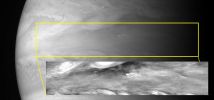
Jupiter-PIA10097.jpgAtmospheric Waves56 visiteWith its Multispectral Visible Imaging Camera (MVIC), half of the Ralph instrument, New Horizons captured several pictures of mesoscale gravity waves in Jupiter's Equatorial Atmosphere. Buoyancy waves of this type are seen frequently on Earth - for example, they can be caused when air flows over a mountain and a regular cloud pattern forms downstream. In Jupiter's case there are no mountains, but if conditions in the atmosphere are just right, it is possible to form long trains of these small waves.
The source of the wave excitation seems to lie deep in Jupiter's atmosphere, below the visible cloud layers at depths corresponding to pressures 10 times that at Earth's surface. The New Horizons measurements showed that the waves move about 100 mt-per-second faster than surrounding clouds; this is about 25% of the speed of sound on Earth and is much greater than current models of these waves predict.
Scientists can "read" the speed and patterns these waves to learn more about activity and stability in the atmospheric layers below".MareKromiumDic 18, 2007
|
|

Europa-1.jpgRising Europa54 visitenessun commentoMareKromiumDic 02, 2007
|
|

Europa.jpg"Faces & Phases" of Europa55 visitenessun commentoMareKromiumDic 02, 2007
|
|

Jupiter-Clouds_NewHorizons_big.jpgJupiter's Clouds (from New Horizon) - HR56 visiteCaption NASA:"The New Horizons Spacecraft took some stunning images of Jupiter earlier this year while on the way out to Pluto. Famous for its Great Red Spot, Jupiter is also known for its regular, equatorial cloud bands, visible through even modest sized telescopes. The above image was taken near Jupiter's Terminator, and shows that the Jovian giant possibly has the widest diversity of cloud patterns in our Solar System. On the far left are clouds closest to Jupiter's South Pole.
Here turbulent whirlpools and swirls are seen in a dark region, dubbed a belt, that rings the Planet.
Even light colored regions, called zones, show tremendous structure, complete with complex wave patterns. The energy that drives these waves likely comes from below. New Horizons is the fastest space probe ever launched, and is zipping through the Solar System on track to reach Pluto in 2015".MareKromiumOtt 15, 2007
|
|
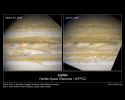
Jupiter-HST.jpgSomething's happening inside Jupiter...55 visiteMassive Jupiter is undergoing dramatic atmospheric changes that have never been seen before with the keen "eye" of NASA's Hubble Space Telescope.
Jupiter's turbulent clouds are always changing as they encounter atmospheric disturbances while sweeping around the planet at hundreds of miles per hour. But these Hubble images reveal a rapid transformation in the shape and color of Jupiter's clouds near the equator, marking an entire face of the globe.
The planet is wrapped in bands of yellows, browns, and whites. These bands are produced by the atmosphere flowing in different directions at various latitudes. Lighter-hued areas where the atmosphere rises are called zones. Darker regions where the atmosphere falls are called belts. When these opposing flows interact, storms and turbulence appear.
Between March 25 and June 5, Hubble's Wide Field and Planetary Camera 2 captured entire bands of clouds changing color. Zones have darkened into belts and belts have lightened and transformed into zones. Cloud features have rapidly altered in shape and size.
The image at left shows a thin band of white clouds above Jupiter's equator. The white color indicates clouds at higher altitudes in Jupiter's atmosphere. In the image at right, the band's white hue has turned brown, showing clouds deep within the planet's atmosphere. The whole band appears to have merged with the one below it.
In the same cloud band above the equator, the small swirls in the left-hand image have morphed into larger wave-like features in the right-hand photo. Dominating the band is a dark streak that resembles a snake. This serpent-shaped structure is actually a small tear in the cloud deck, which gives astronomers a view deep within the atmosphere.
Below the equatorial region, the brownish upside-down shark fin in the left-hand image disappears in the photo at right. Appearing instead are brownish tongue-shaped clouds with a stream of white swirls below them.
These global upheavals have been seen before, but not with Hubble's sharp resolution. Astronomers using ground-based telescopes first spied drastic atmospheric transformation in the 1980s. Another major disturbance was seen in the early 1990s, after Hubble was launched into space. The telescope, however, did not have the resolution to view the upheaval in fine detail. These higher-quality Hubble images may help astronomers understand how such global upheavals develop on Jupiter.
MareKromiumGiu 29, 2007
|
|

Io_Europa-lor_0035136944_0x630_sci_1.jpgEuropa and Io in conjunction (2)87 visitenessun commentoMareKromiumGiu 01, 2007
|
|

Elara-lor_0035239919_0x630_sci_1-01.jpgElara, from New Horizons56 visiteData & Statistics for Elara:
Discovered by: C. Perrine
Date of discovery: 1905
Mass (in Kg): 7,77e+17
Mass (if Earth = 1): 1,3002e-07
Equatorial radius (in Km): 38
Equatorial radius (if Earth = 1): 5,9580e-03
Mean density (grm/cm^3): 3,3
Mean distance from Jupiter (in Km): 11.737.000
Rotational period (in days): 0,5
Orbital period (in days): 259,6528
Mean orbital velocity (Km/sec): 3,29
Orbital eccentricity: 0,2072
Orbital inclination: 24,77°
Escape velocity (Km/sec): 0,0522
Visual geometric albedo: 0,03
Magnitude (Vo): 16,77MareKromiumGiu 01, 2007
|
|

Io_Europa-lor_0035136929_0x630_sci_1.jpgEuropa and Io in conjunction (1)85 visitenessun commentoMareKromiumGiu 01, 2007
|
|

Himalia-lor_0035585519_0x630_sci_1-01.jpgHimalia, from New Horizons56 visiteData & Statistics for Himalia:
Discovered by: C. Perrine
Date of discovery: AD 1904
Mass (in Kg): approx. 9,56e+18
Mass (if Earth = 1): 1,5997e-06
Equatorial radius (in Km): approx. 93
Equatorial radius (if Earth = 1): 1,4581e-02
Mean density (in grm/cm^3): approx. 2,8
Mean distance from Jupiter (in Km): 11.480.000
Rotational period (in days): 0,4
Orbital period (in days): 250,5662
Mean orbital velocity (in Km/sec): 3,34
Orbital eccentricity: 0,1580
Orbital inclination: 27,63°
Escape velocity (in Km/sec): 0,117
Visual geometric albedo: 0,03
Magnitude (Vo): 14,84MareKromiumGiu 01, 2007
|
|
| 325 immagini su 28 pagina(e) |
 |
|
|
|
|
9 | |
|
|
|
|





