| |

| Ultimi arrivi - Jupiter: the "King" and His Moons |

Jupiter-HST~0.jpgThree "Red Spots" Mix it Up on Jupiter55 visiteThis sequence of Hubble Space Telescope images offers an unprecedented view of a planetary game of Pac-Man among 3 "Red Spots" clustered together in Jupiter's Atmosphere. The time series shows the passage of the "Red Spot Jr." in a band of clouds below (South) of the Great Red Spot (GRS). "Red Spot Jr." first appeared on Jupiter in early 2006 when a previously white storm turned red. This is the second time, since turning red, it has skirted past its big brother apparently unscathed. But this is not the fate of "Baby Red Spot", which is in the same latitudinal band as the GRS. This new red spot first appeared earlier this year. The Baby Red Spot gets ever closer to the GRS in this picture sequence until it is caught up in the anticyclonic spin of the GRS. In the final image the Baby Spot is deformed and pale in color and has been spun to the right (East) of the GRS.
These three natural-color Jupiter images were made from data acquired on May 15, June 28, and July 8, 2008, by the Wide Field Planetary Camera 2 (WFPC2).MareKromiumLug 22, 2008
|
|

Io-TohillMons-PIA03600_1.jpgTohill Mons (MULTISPECTRUM-2; credits: Lunexit)56 visiteCaption NASA:"Dramatic shadows across a mountainous landscape on Jupiter's moon Io reveal details of the topography around a peak named Tohil Mons in this mosaic created from images taken by NASA's Galileo Spacecraft in October 2001.
Tohil Mons rises 5,4 Km (18.000 feet) above Io's Surface, according to analysis of stereo imaging from earlier Galileo flybys of Io. The new images, with a resolution of 327 mt (1070 feet) per picture element, were taken when the Sun was low in the sky, producing informative shadows. North is to the top and the Sun illuminates the Surface from the upper right. The topographic features revealed include a very straight ridge extending South-West from the peak, 500- to 850-meter-high (1640- to 2790-foot-high) cliffs to the North-West and a curious pit immediately East of the peak.
Major questions remain about how Io's mountains form and how they are related to Io's ubiquitous volcanoes. Although Io is extremely active volcanically, few of its mountains appear to be volcanoes. However, two volcanic craters do lie directly to the North-East of Tohil's peak, a smaller dark-floored one and a larger one at the very edge of the mosaic. Furthermore, the shape of the pit directly East of the peak suggests a volcanic origin.
Galileo scientists will use these images to investigate the geologic history of Tohil Mons and its relationship to the neighboring volcanic features.
The image is centered at 28° South Latitude and 161° West Longitude".
MareKromiumLug 06, 2008
|
|

Io-PIA02520.jpgMountains on Io (MULTISPECTRUM; credits: Lunexit)54 visiteCaption NASA:"This image taken by NASA's Galileo Spacecraft during its close flyby of Jupiter's moon Io on November 25, 1999 shows some of the curious mountains found there. The Sun is illuminating the scene from the left, and because it is setting, the Sun exaggerates the shadows cast by the mountains. By measuring the lengths of these shadows, Galileo scientists can estimate the height of the mountains. The mountain just left of the middle of the picture is 4 Km (13.000 feet) high and the small peak to the lower left is 1,6 Km (5000 feet) high.
These mountains, like others imaged during a previous Galileo flyby of Io in October '99, seem to be in the process of collapsing. Huge landslides have left piles of debris at the bases of the mountains. The ridges that parallel their margins are also indicative of material moving down the mountainsides due to gravity.
North is to the upper left of the picture. The image, centered at 8,1° South Latitude and 78,7° East Longitude, covers an area approx. 210-by-110 Km (such as about 130-by-70 miles). The resolution is 267 meters (880 feet) per picture element.
The image was taken at a range of approx. 25.000 Km (about 16.000 miles) by Galileo's onboard camera".
MareKromiumLug 06, 2008
|
|

Io-PIA02540.jpgRifting at Hi'iaka Patera (MULTISPECTRUM-2; credits: Lunexit)71 visiteCaption NASA:"NASA's Galileo Spacecraft acquired the images in this mosaic of Hi-iaka Patera (the irregularly shaped, dark depression at the center of the image) and two nearby mountains on November 25, 1999 during its 25th orbit. The sharp peak at the top of the image is about 11 Km (about 36.300 feet) high, and the two elongated plateaus to the West and South of the caldera are both about 3,5 Km (11.500 feet) high.
The ridges on the North-Western mountain are often seen on Ionian mountains and are thought to be formed as surface material slides downslope due to gravity.
At low resolution, many of the dark features, called pateras, appear to be calderas -- depressions formed by collapse into an empty magma chamber. However, higher resolution images such as this one suggest a different origin. In the case of Hi-iaka, the Northern and Southern Margins of the pateras have very similar shapes which appear to fit together. This may indicate that the crust has been pulled apart here and the resulting depression has subsequently been covered by dark lava flows. Furthermore, the two mountains bordering Hi-iaka Patera also appear to fit together. However, the similar shapes and heights of the pateras margins and mountains could be coincidental. Galileo scientists are currently investigating whether mountains and pateras are related to each other and what could cause the surface of Io to rift apart in such a manner.
North is to the top of the mosaic and the sun is illuminating the surface from the left. The resolution is 260 meters (about 280 yards) per picture element. Galileo took the images at a distance of 26.000 Km (approx. 16.000 miles) from Io".MareKromiumLug 06, 2008
|
|

Io-TelegonusMensa-PIA03528_modest.jpgCollapsing Cliff at Telegonus Mensa (MULTISPECTRUM; credits: Lunexit)54 visiteCaption NASA:"This mosaic, showing an area called Telegonus Mensa, on Jupiter's moon Io and obtained by using frames taken by the NASA's Galileo Spacecraft on Oct. 16, 2001, reveal a complex interplay of geologic processes.
Four small, HR frames (9,6 mt, or 32 feet, per picture element) have been set into the larger context mosaic, which has a resolution of 42 mt (140 feet) per picture element. The illumination is from the upper right and North is to the top of the mosaic. A fracture runs North-West from the lower right corner of the mosaic into the amphitheater in the center of the frame. A HR image along this fracture reveals that lava has erupted from it.
The amphitheater itself is the site of extensive erosion, as the cliff has slumped South-Eastward under the influence of Io's gravity. HR frames directly south of the amphitheater show another slumping cliff in detail. Flat tops of massive slump blocks — up to 6 Km (3,7 miles) long and 0,5 Km (0,3 miles) across — are illuminated by the the Sun and cast shadows down the face of the cliff.
Based on these shadows, Galileo scientists estimate that the cliff is 1 to 2 Km high.
Just to the left of center a series of landslides can be seen, the longest of which extends for about 4 Km (such as approx. 2,5 miles)".MareKromiumLug 06, 2008
|
|

JupiterSpots-HST.jpgThe "Eyes" of Jupiter84 visiteFor about 300 years Jupiter's "Banded" Atmosphere has shown a remarkable feature to telescopic viewers, a large swirling storm system known as "The Great Red Spot". In 2006, another red storm system appeared, actually seen to form as smaller whitish oval-shaped storms merged and then developed the curious reddish hue. Now, Jupiter has a third red spot, again produced from a smaller whitish storm. All three are seen in this image made from data recorded on May 9 and 10 with the Hubble Space Telescope's Wide Field and Planetary Camera 2. The spots extend above the surrounding clouds and their red color may be due to deeper material dredged up by the storms and exposed to ultraviolet light, but the exact chemical process is still unknown. For scale, the Great Red Spot has almost twice the diameter of planet Earth, making both new spots less than one Earth-diameter across. The newest red spot is on the far left (West), along the same band of clouds as the Great Red Spot and is drifting toward it. If the motion continues, the new spot will encounter the much larger storm system in August. Jupiter's recent outbreak of red spots is likely related to large scale climate change as the gas Giant Planet is getting warmer near the Equator.MareKromiumMag 23, 2008
|
|

Io-100907_8.jpgIo: Global Map (false colors)55 visiteA: A global map of Jupiter’s moon Io derived from 8 images taken by the Long Range Reconnaissance Imager (LORRI) on the New Horizons Spacecraft, as it passed Jupiter on its way to Pluto in late February 2007. Details as small as 12 Km (7 miles) are visible. The map shows the comprehensive picture of Io’s volcanism obtained by New Horizons. Yellow ovals denote areas with new, faded or shifted plume deposits since the last images taken by the Galileo spacecraft in 2001. Green circles denote areas where probable new lava flows have occurred. Cyan diamonds indicate locations of active volcanic plumes, and orange hexagons are volcanic hot spots detected by the Linear Etalon Imaging Spectral Array (LEISA) instrument. For plumes and hot spots, symbol size indicates the approximate relative size and brightness of the features.
B-F: Comparison of New Horizons (NH) and earlier images of major surface changes discovered by New Horizons at Io’s volcanoes Masubi (45° South, 57° West) and North Lerna (55° South, 290° West). The scale bars are 200 Km long, and a is the solar phase angle. At Masubi, old lava flows seen by Voyager and Galileo (B) have been obscured at low phase angles (C) by deposits from two active plumes associated with a new 240-Km (150-mile) long dark lava flow, which is the longest lava flow known to have been erupted in the solar system since the discovery of Io volcanism in 1979. At North Lerna, a recent eruption has generated a 130-Km long lava flow (F), as well as an active plume that has produced a concentric pattern of deposits.
This image appears in the Oct. 12, 2007, issue of Science magazine, in a paper by John Spencer, et al.MareKromiumFeb 12, 2008
|
|

Jupiter-00.jpgInternal Heat Drives Jupiter's Giant Storm Eruption (VL)55 visiteAn image of Jupiter in Visible-Light (VL) from NASA's Hubble Space Telescope (HST) on May 11, 2007 showing the turbulent pattern generated by the two plumes at the upper left part of Jupiter.
MareKromiumGen 27, 2008
|
|
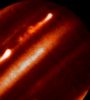
Jupiter-01.jpgInternal Heat Drives Jupiter's Giant Storm Eruption (IR)56 visiteAn image of Jupiter in infrared-light from NASA's Infrared Telescope Facility (IRTF) on April 5, 2007.
MareKromiumGen 27, 2008
|
|

Jupiter-02.jpgInternal Heat Drives Jupiter's Giant Storm Eruption (IR + VL)55 visiteDetailed analysis of two continent-sized storms that erupted in Jupiter's Atmosphere in March 2007 shows that Jupiter's internal heat plays a significant role in generating atmospheric disturbances. Understanding this outbreak could be the key to unlock the mysteries buried in the deep Jovian Atmosphere, say astronomers.
Understanding these phenomena is important for Earth's meteorology where storms are present everywhere and jet streams dominate the atmospheric circulation. Jupiter is a natural laboratory where atmospheric scientists study the nature and interplay of the intense jets and severe atmospheric phenomena.
An international team coordinated by Agustin Sánchez-Lavega from the Universidad del País Vasco in Spain presents its findings about this event in the January 24 issue of the journal Nature.
The team monitored the new eruption of cloud activity and its evolution with an unprecedented resolution using NASA's HST, the NASA Infrared Telescope Facility in Hawaii, and telescopes in the Canary Islands (Spain).
A network of smaller telescopes around the world also supported these observations.
According to the analysis, the bright plumes were storm systems triggered in Jupiter's deep water clouds that moved upward in the atmosphere vigorously and injected a fresh mixture of ammonia ice and water about 20 miles (30 Km) above the visible clouds. The storms moved in the peak of a jet stream in Jupiter's Atmosphere at 375 mph (600 Km/hour). Models of the disturbance indicate that the jet stream extends deep in the buried atmosphere of Jupiter, more than 60 miles (approx. 100 Km) below the cloud tops where most sunlight is absorbed.MareKromiumGen 27, 2008
|
|

Europa-PIA10131.jpgThe Inner Ocean of Europa54 visiteCaption NASA:"Scientists are all but certain that Europa has an ocean underneath its icy surface, but they do not know how thick this ice might be. This artist concept illustrates 2 possible cut-away views through Europa's ice shell. In both, heat escapes, possibly volcanically, from Europa's rocky mantle and is carried upward by buoyant oceanic currents. If the heat from below is intense and the ice shell is thin enough (left), the ice shell can directly melt, causing what are called "chaos" on Europa, regions of what appear to be broken, rotated and tilted ice blocks. On the other hand, if the ice shell is sufficiently thick (right), the less intense interior heat will be transferred to the warmer ice at the bottom of the shell, and additional heat is generated by tidal squeezing of the warmer ice. This warmer ice will slowly rise, flowing as glaciers do on Earth, and the slow but steady motion may also disrupt the extremely cold, brittle ice at the surface.
Europa is no larger than Earth's moon, and its internal heating stems from its eccentric orbit about Jupiter, seen in the distance. As tides raised by Jupiter in Europa's ocean rise and fall, they may cause cracking, additional heating and even venting of water vapor into the airless sky above Europa's icy surface".MareKromiumDic 18, 2007
|
|

Europa-PIA10149.jpgThe Inner Ocean of Europa54 visiteCaption NASA:"Like Earth, Europa is thought to have an iron core, a rocky mantle and a surface ocean of salty water. Unlike on Earth, however, this ocean is deep enough to cover the whole moon, and being far from the Sun, the ocean surface is globally frozen over.
Europa's orbit is eccentric, which means as it travels around Jupiter, large tides, raised by Jupiter, rise and fall. Jupiter's position relative to Europa is also seen to librate, or wobble, with the same period. This tidal kneading causes frictional heating within Europa, much in the same way a paper clip bent back and forth can get hot to the touch, as illustrated by the red glow in the interior of Europa's rocky mantle and in the lower, warmer part of its ice shell. This tidal heating is what keeps Europa's ocean liquid and could prove critical to the survival of simple organisms within the ocean, if they exist".MareKromiumDic 18, 2007
|
|
| 325 immagini su 28 pagina(e) |
|
|
|
|
|
8 | |
|
|
|
|
|
|





