| Ultimi arrivi - Jupiter: the "King" and His Moons |

Jupiter-Impact05-PIA12148.jpgImpact on Jupiter!56 visitenessun commentoMareKromiumLug 21, 2009
|
|
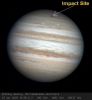
Jupiter-Impact-2010-001.jpgImpact on Jupiter! (ctx frame)56 visitenessun commentoMareKromiumLug 21, 2009
|
|

Jupiter-Impact-2010-000.jpgImpact on Jupiter!68 visiteUn "Grazie di Cuore" a Lorenzo Leone ("Anakin") per aver citato l'informazione - preziosa e straordinaria, da innumerevoli punti di vista - che ora possiamo illustrare con immagini adeguate.
Un asteroide "grande quanto la Terra" o quasi, impatta Giove. "Grande quanto la Terra"? Onestamente ne dubitiamo (rectius: VOGLIAMO DUBITARNE!), per tantissimi motivi (sicurezza della Terra in primis ed efficienza del Sistema di Monitoraggio dei cosiddetti "Asteroidi Vicini" in secundis).
Ma una cosa è certa. O meglio, "sembra" certa: il Cielo sta cambiando.
Osserviamolo meglio! Osserviamolo TUTTI!MareKromiumLug 21, 2009
|
|

Jupiter-Impact-2010-002.jpgImpact on Jupiter! (edm)56 visitenessun commentoMareKromiumLug 21, 2009
|
|

Jupiter-Impact02.jpgImpact on Jupiter!57 visitenessun commentoMareKromiumLug 21, 2009
|
|

Io-PIA10249.jpgTvashtar Eruption from New Horizons109 visiteCaption NASA:"This New Horizons image of Jupiter's volcanic moon Io was taken at 13:05 Universal Time during the Spacecraft's Jupiter flyby on February 28, 2007. It shows the reddish color of the deposits from the giant volcanic eruption at the volcano Tvashtar, near the top of the sunlit crescent, as well as the bluish plume itself and the orange glow of the hot lava at its source. The relatively unprocessed image on the left provides the best view of the volcanic glow and the plume deposits, while the version on the right has been brightened to show the much fainter plume, and the Jupiter-lit night side of Io.
New Horizons' color imaging of Io's sunlit side was generally overexposed because the Spacecraft's color camera, the super-sensitive Multispectral Visible Imaging Camera (MVIC), was designed for the much dimmer illumination at Pluto. However, two of MVIC's four color filters, the blue and "Methane" filter (a special filter designed to map Methane frost on the Surface of Pluto at an infrared wavelength of 0.89 microns), are less sensitive than the others, and thus obtained some well-exposed views of the surface when illumination conditions were favorable. Because only two color filters are used, rather than the usual three, and because one filter uses infrared light, the color is only a rough approximation to what the human eye would see.
The red color of the Tvashtar plume fallout is typical of Io's largest volcanic plumes, including the previous eruption of Tvashtar seen by the Galileo and Cassini Spacecrafts in 2000, and the long-lived Pele plume on the opposite side of Io. The color likely results from the creation of reddish three-atom and four-atom Sulfur molecules (S3 and S4) from plume gases rich in two-atom Sulfur molecules (S2 After a few months or years, the S3 and S4 molecules recombine into the more stable and familiar yellowish form of Sulfur consisting of eight-atom molecules (S8), so these red deposits are only seen around recently-active Io volcanos.
Though the plume deposits are red, the plume itself is blue, because it is composed of very tiny particles that preferentially scatter blue light, like smoke. Also faintly visible in the left image is the pale-colored Prometheus plume, almost on the edge of the disk on the Equator at the 9 o'clock position.
Io was 2,4 MKM from the Spacecraft when the picture was taken, and the center of Io's disk is at 77° West Longitude, 5° South Latitude. The Solar Phase Angle (such as the angle formed by the Sun, Io and New Horizons) was 107°".MareKromiumMar 25, 2009
|
|

Amalthea-Galileo.jpgAmalthea, from Galileo59 visiteOn its way in and out, Galileo took these two snapshots of Amalthea. The purpose was to improve navigation for the upcoming flyby of this little moonlet, but such images also help in the study of the shape of irregular worlds.MareKromiumMar 22, 2009
|
|

Metis-Galileo.jpgMetis (Natural Colors; credits: Ted Stryk)56 visiteMetis, o Metide, è il più interno fra i Satelliti Naturali di Giove. Appartiene al cosiddetto gruppo di Amaltea, che si compone dei piccoli satelliti interni del Pianeta. Il suo nome storico è Giove XVI.
La scoperta di Metis risale al 1979, quando fu individuato grazie alle immagini inviate a Terra dalla sonda spaziale statunitense Voyager 1 e gli venne attribuito il nome provvisorio S/1979 J3; nel 1983 l'Unione Astronomica Internazionale lo battezzò ufficialmente con il nome della titanide Metide, prima moglie di Zeus e madre di Atena secondo la Mitologia Greca.
Il colorito giallo-rossastro che è stato attribuito a questo Corpo Celeste da Ted Stryk potrebbe trovare una giustificazione negli accumuli (depositi superficiali) di Zolfo che Metis - periodicamente - "raccoglie" dallo Spazio durante i suoi passaggi ravvicinati ad Io.MareKromiumMar 09, 2009
|
|

Jupiter-HST-2008-42-a-ful-003_jpg.jpgHiding... (natural colors; credits: NASA)57 visitenessun commentoMareKromiumDic 20, 2008
|
|

Jupiter-HST-2008-42-a-ful-002_jpg.jpgHiding... (natural colors; credits: NASA)55 visitenessun commentoMareKromiumDic 20, 2008
|
|
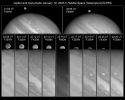
Jupiter-HST-2008-42-a-ful-004_jpg.jpgHiding: the whole sequence55 visiteThis series of images taken with NASA's Hubble Space Telescope shows Jupiter's largest moon, Ganymede, disappearing behind the Planet.
The top images show Ganymede next to Jupiter. The images were taken in blue and red light on Jan. 19, 2005 with Hubble's Advanced Camera for Surveys. The close-up images at bottom follow Ganymede as it ducks behind Jupiter a few minutes later.MareKromiumDic 20, 2008
|
|
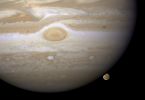
Jupiter-HST-2008-42-a-ful-001_jpg.jpgHiding... (natural colors; credits: NASA)55 visiteNASA's Hubble Space Telescope has caught Jupiter's moon Ganymede playing a game of "peek-a-boo", In this crisp Hubble image, Ganymede is shown just before it ducks behind the giant planet.
Ganymede completes an orbit around Jupiter every 7 days. Because Ganymede's orbit is tilted nearly edge-on to Earth, it routinely can be seen passing in front of and disappearing behind its giant host, only to reemerge later.
Composed of rock and ice, Ganymede is the largest moon in our Solar System. It is even larger than the planet Mercury.
But Ganymede looks like a dirty snowball next to Jupiter, the largest planet in our solar system. Jupiter is so big that only part of its Southern Hemisphere can be seen in this image.
Hubble's view is so sharp that astronomers can see features on Ganymede's surface, most notably the white impact crater, Tros, and its system of rays, bright streaks of material blasted from the crater. Tros and its ray system are roughly the width of Arizona.
The image also shows Jupiter's Great Red Spot, the large eye-shaped feature at upper left. A storm the size of two Earths, the Great Red Spot has been raging for more than 300 years. Hubble's sharp view of the gas giant planet also reveals the texture of the clouds in the Jovian Atmosphere as well as various other storms and vortices.
Astronomers use these images to study Jupiter's Upper Atmosphere. As Ganymede passes behind the giant planet, it reflects sunlight, which then passes through Jupiter's Atmosphere. Imprinted on that light is information about the gas giant's atmosphere, which yields clues about the properties of Jupiter's high-altitude haze above the cloud tops.
This color image was made from three images taken on April 9, 2007, with the Wide Field Planetary Camera 2 in red, green, and blue filters. The image shows Jupiter and Ganymede in close to natural colors.MareKromiumDic 20, 2008
|
|
| 325 immagini su 28 pagina(e) |
 |
|
|
|
|
7 | |
|
|
|
|





