| |

| Ultimi arrivi - Jupiter: the "King" and His Moons |

Jupiter-Impact-2010-007.jpgAnother Impact on Jupiter?68 visiteUn'altra immagine della "Fireball" che ha impattato Giove il giorno 20 Agosto u.s.
In questo caso si tratta di una ripresa effettuata dall'Astrofilo Giapponese Aoki Kazuo, da Tokio, il quale ha registrato un flash che, per coordinate spazio-temporali, coincide con quello rilevato e ripreso dall'altro Astrofilo del Sol Levante, Masayuki Tachikawa, che osservava il Gigante Gassoso dalla città di Kumamoto (la quale è distante circa 800 Km da Tokio).MareKromiumSet 03, 2010
|
|
Io-Volcanic_Depression-PIA03532_modest2.jpgVolcanic Depression near the Equator (Absolute Natural Colors; credits for the additional process. and color.: Dr Paolo C. Fienga - Lunexit Team)120 visitenessun commentoMareKromiumGiu 10, 2010
|
|
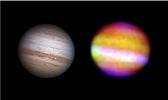
Jupiter_sofiawesley.jpgJupiter from the Stratosphere145 visiteDalla Rubruica "NASA - Picture of the Day", del giorno 3 Giugno 2010:"SOFIA, the Stratospheric Observatory for InfraRed Astronomy, captured its "first light" images on May 26, from an altitude of 35.000 feet.
While flying above most of planet Earth's InfraRed-absorbing water vapor, SOFIA's premier IR views of the cosmos included this remarkable false-color image (right panel) of Jupiter.
For comparison, on the left is a recent, ground-based visible light image. Both show our Solar System's ruling gas giant without its dark Southern Equatorial Belt (normally seen in the upper Hemisphere in this orientation). That familiar feature faded from view early in May. But the bright white stripe in SOFIA's image is a region of Jupiter's clouds transparent to IR Light, offering a glimpse below the cloud tops".MareKromiumGiu 03, 2010
|
|

Europa-Lineae-Minos_Linea-PIA00275.jpgEuropa: Minos Linea (an EDM in possible Absolute Natural Colors; credits for the additional process. and color.: Dr Paolo C. Fienga - Lunexit Team)138 visitenessun commentoMareKromiumMag 28, 2010
|
|

Jupiter-changes.jpgChangings in the Atmosphere of Jupiter85 visiteStraordinario e, al momento, piuttosto inspiegabile: non credete?MareKromiumMag 17, 2010
|
|

Jupiter-PIA12869.jpgHow "Hot " is Jupiter?57 visiteCaption NASA:"New thermal images from powerful ground-based telescopes show swirls of warmer air and cooler regions never seen before within Jupiter's Great Red Spot. The images enable scientists to make the first detailed weather map of the inside of the giant storm system. One observation illustrated by this image is the correspondence between a warm core within an otherwise cold storm system and the reddest color of the Great Red Spot.
The image on the top was obtained by the European Southern Observatory's Very Large Telescope in Chile on May 18, 2008. It was taken in the InfraRed wavelength range of 10.8 microns, which is sensitive to Jupiter's Atmospheric Temperatures in the 300 to 600 millibar pressure range. That pressure range is close to the altitude of the white, red and brown aerosols seen in the visible-light image on the bottom, which was obtained by the Hubble Space Telescope on May 15, 2008.
These images show the interaction of three of Jupiter's largest storms -- the Great Red Spot and two smaller storms nicknamed Oval BA and Little Red Spot".MareKromiumApr 09, 2010
|
|

Io-lor_0034785119_0x630_sci_1~0.jpgIo, from New Horizon (Natural Colors; credits: Lunexit)92 visitenessun commentoMareKromiumDic 19, 2009
|
|

Orbital_Resonance.gifThe "Orbital Resonance" (GIF-Movie; credits: http://fisicaondemusica.unimore.it.)54 visitePremessa: il moto di un Corpo Celeste in orbita attorno ad un altro Corpo Celeste di massa molto maggiore (ex.: un pianeta attorno ad una stella, o un satellite attorno ad un pianeta) è un "Moto Periodico Semplice" ("Moto Circolare Uniforme").
Ora, può accadere che due (o più) pianeti si trovino ad orbitare attorno alla medesima stella (o che due - o più - satelliti si trovino ad orbitare attorno al medesimo "Parent Planet") con tempi di rivoluzione (---> i "Periodi del loro Moto") i quali stanno tra loro in rapporto di due piccoli interi (come 2:1, 2:3, ecc. - si legge "due a uno", "due a tre" etc.).
In questo caso, anche la loro reciproca attrazione gravitazionale verrà ad assumere un carattere di periodicità: essa cioè aumenterà quando i due pianeti si avvicinano, e diminuirà quando essi si allontanano.
Se queste variazioni della forza attrattiva gravitazionale sentita da ciascun pianeta saranno significative per la sua orbita, questa potrà modificarsi. Ed a tal punto sarà possibile identficare due scenari:
1) il moto dei pianeti diviene instabile: le orbite cambiano lentamente finché i due corpi non si influenzano più sensibilmente. (nota: nel caso di un Corpo Celeste Maggiore ed uno minore, questo effetto si risolverà nello "scacciare" il corpo minore da certe zone dello spazio, "liberando" la strada al Corpo Maggiore)
2) i due pianeti non si avvicinano mai abbastanza da influenzarsi violentemente, e quindi entrano in risonanza stabile.
(nota: le loro orbite, in questo caso, subiranno delle modificazioni le quali verranno poi compensate - rectius: annullate - dal verificarsi di modificazioni contrarie nell'arco di ogni rivoluzione)
per maggiori info: http://fisicaondemusica.unimore.it.MareKromiumSet 21, 2009
|
|
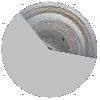
Jupiter-Impact006-ALPO.gifEvolution of the Impact on Jupiter (GIF-Movie)56 visiteDa "NASA - Picture of Day" del giorno 8 Settembre 2009:"Two months ago, something unexpected hit Jupiter.
First discovered by amateur astronomer Anthony Wesley on 2009 July 19, the impact was quickly confirmed and even imaged by the Hubble Space Telescope the very next day. Many of the world's telescopes then zoomed in on our Solar System's largest Planet to see the result.
Some of these images have been complied into the above animation. Over the course of the last month and a half, the above time-lapse sequence shows the Dark Spot - first created when Jupiter was struck - deforming and dissipating as Jupiter's clouds churned and Jupiter rotated.
It is now thought that a small comet -- perhaps less than one kilometer across -- impacted Jupiter on or before 2009 July 19. Although initially expected to be visible for only a week, astronomers continue to track atmospheric remnants of the impact for new information about winds and currents in Jupiter's thick Atmosphere".MareKromiumSet 08, 2009
|
|

Jupiter-Impact-2010-004.jpgImpact on Jupiter! (from Hubble Space Telescope - edm)56 visiteDiscovered by Australian amateur astronomer Anthony Wesley on Sunday, July 19, 2009, the spot was created when a small object plunged into Jupiter's atmosphere and disintegrated. The only other time in history such a feature has been seen on Jupiter was 15 years ago.
"This is strikingly similar to the comet Shoemaker Levy 9 that impacted Jupiter in July 1994" said team member Keith Noll of the Space Telescope Science Institute in Baltimore, Md.
"Since we believe this magnitude of impact is rare, we are very fortunate to see it with Hubble" added Amy Simon-Miller of NASA's Goddard Space Flight Center in Greenbelt, Md. She explained that the details seen in the Hubble view shows a lumpiness to the debris plume caused by turbulence in Jupiter's atmosphere. The spot is presently twice the length of the United States.
Simon-Miller estimated that the diameter of the object that slammed into Jupiter was at least the size of several football fields. The force of the explosion on Jupiter was thousands of times more powerful than the suspected comet or asteroid that exploded over the Tunguska River Valley in Siberia in June 1908.
The WFC3, installed by the STS-125 astronauts in May, is not yet fully calibrated. So while it is possible to obtain celestial images, the camera's full power cannot yet be realized for most observations. The WFC3 can still return meaningful science images that will complement the Jupiter pictures being taken with ground-based telescopes.
This is a Natural Color image of Jupiter as seen in Visible Light.
Credit: NASA, ESA, and H. Hammel (Space Science Institute, Boulder, Colo.), and the Jupiter Impact Team
The members of the Jupiter Impact Team are:
Dr. Heidi B. Hammel (Space Science Institute, Boulder, Colo.)
Dr. Amy Simon-Miller (NASA's Goddard Space Flight Center, Greenbelt, Md.)
Dr. Keith S. Noll (Space Telescope Science Institute, Baltimore, Md.)
Dr. Michael H. Wong (Space Telescope Science Institute, Baltimore, Md.)
Prof. John T. Clarke (Boston University, Boston, Mass.)
Prof. Imke de Pater (University of California, Berkeley, Calif.)
Dr. Glenn S. Orton (Jet Propulsion Laboratory, Pasadena, Calif.)
Dr. Agustin Sanchez-Lavega (University of the Basque Country, Spain)
CONTACT
Dwayne Brown
HQ, Washington
202-358-1726
dwayne.c.brown@nasa.gov
Ray Villard
Space Telescope Science Institute, Baltimore, Md.
410-338-4514
villard@stsci.eduMareKromiumLug 31, 2009
|
|

Jupiter-Impact-2010-003.jpgImpact on Jupiter! (from Hubble Space Telescope - ctx frame)56 visiteNASA scientists have interrupted the checkout and calibration of the Hubble Space Telescope to aim the recently refurbished observatory at a new expanding spot on the giant planet Jupiter. The spot, caused by the impact of a comet or an asteroid, is changing day to day in the Planet's cloud tops.
For the past several days the world's largest telescopes have been trained on Jupiter. Not to miss the potentially new science in the unfolding drama 360 MMs away, Space Telescope Science Institute director Matt Mountain allocated discretionary time to a team of astronomers led by Heidi Hammel of the Space Science Institute in Boulder, Colo.
The Hubble picture, taken on July 23, 2009, is the sharpest visible-light picture taken of the impact feature. The observations were made with Hubble's new camera, the Wide Field Camera 3 (WFC3).
"This image of the impact on Jupiter is fantastic" said U.S. Senator Barbara A. Mikulski, D-Md., chairwoman of the Commerce, Justice and Science Appropriations Subcommittee. "It tells us that our astronauts and ground crew at the Goddard Space Flight Center successfully repaired the Hubble telescope".
"This is just one example of what Hubble's new, state-of-the-art camera can do, thanks to the STS-125 astronauts and the entire Hubble team," said Ed Weiler, associate administrator of NASA's Science Mission Directorate. "However, the best is yet to come!".
"Hubble's truly exquisite imaging capability has revealed an astonishing wealth of detail in the 2009 impact site" said Hammel. "By combining these images with our ground-based data at other wavelengths, our Hubble data will allow a comprehensive understanding of exactly what is happening to the impact debris. My sincerest congratulations and thanks to the team who created Wide Field Camera 3 and to the astronauts who installed it!".
Co-investigator Imke de Pater of the University of California at Berkeley said: "The combination of the Hubble data with mid-infrared images from the Gemini telescope will give us an insight into changes of the vertical structure of the atmosphere due to the impact".MareKromiumLug 31, 2009
|
|

Jupiter-Impact04-PIA12147.jpgImpact on Jupiter!56 visitenessun commentoMareKromiumLug 21, 2009
|
|
| 325 immagini su 28 pagina(e) |
|
|
|
|
6 | |
|
|
|
|
|
|
|





