| |

| Ultimi arrivi - Jupiter: the "King" and His Moons |

Jupiter-PIA23606.jpgThe "Eye" of Jupiter160 visiteCaption NASA Originale:"Swirling in Jupiter's Atmosphere for hundreds of years, the Great Red Spot is captured in this pair of close-up images from Juno's JunoCam Camera. The giant storm churns through Jupiter's Atmosphere, creating the turbulent flows to its West. On the West-side of the Great Red Spot itself, a sliver of red material is being pulled off the periphery. This is a recent, frequent, phenomenon first observed in ground-based data in 2017.
Two images have been mosaicked together by citizen scientist Kevin M. Gill to create this enhanced color composite. When they were taken on Feb. 12, 2019 at 10:24 a.m. PDT (1:24 p.m. EDT) and 10:29 a.m. PDT (1:29 p.m. EDT), Juno was about 43.500 miles (such as about 70.006,464 Km) above Jupiter's cloud tops. Features as small as 31 miles (approx. 49,889 Km) can be resolved in the images, allowing us to see structure in the interior of the Great Red Spot, as well as the fine texture of the white clouds in the South Tropical Zone below".MareKromiumApr 04, 2020
|
|

Jupiter-PIA23437.jpgIo's Shadow164 visiteCaption NASA Originale:"Jupiter's volcanically active moon Io casts its shadow on the planet in this dramatic image from NASA's Juno Spacecraft. As with solar eclipses on the Earth, within the dark circle racing across Jupiter's cloud tops one would witness a full solar eclipse as Io passes in front of the Sun.
Such events occur frequently on Jupiter because it is a large planet with many moons. In addition, unlike most other planets in our solar system, Jupiter's axis is not highly tilted relative to its orbit, so the Sun never strays far from Jupiter's equatorial plane (+/- 3°). This means Jupiter's moons regularly cast their shadows on the planet throughout its year.
Juno's close proximity to Jupiter provides an exceptional fish-eye view, showing a small fraction near the planet's Equator. The shadow is about 2.200 miles (such as approx. 3.540,55 Km) wide, approximately the same width as Io, but appears much larger relative to Jupiter.
A little larger than Earth's Moon, Io is perhaps most famous for its many active volcanoes, often caught lofting fountains of ejecta well above its thin (?) Atmosphere.
Citizen scientist Kevin M. Gill created this enhanced-color image using data from the spacecraft's JunoCam imager. The raw image was taken on Sept. 11, 2019 at 8:41 p.m. PDT (11:41 p.m. EDT) as the Juno spacecraft performed its 22nd close fly-by of Jupiter. At the time the image was taken, the spacecraft was about 4.885 miles (approx. 7.861,64 Km) from the cloud tops at a Latitude of 21° North".
Nota: e per chi ha visto il famoso "2010 Odissea Due: l'Anno del Contatto", questa immagine dovrà "ricordare" qualcosa...MareKromiumApr 04, 2020
|
|

Europa-Ridges-PIA17737-PCF-LXTT-IPF-1.jpgFeatures of Europa (Absolute Natural Colors; credits for the additional process. and color.: Dr Paolo C. Fienga/Lunar Explorer Italia/Italian Planetary Foundation)91 visiteThis image, taken by the NASA - Galileo Spacecraft on February, 2, 1999, shows us huge Cracks and Ridges on the Surface of the Jovian moon Europa. These (absolutely fascinating) Features reveal a complex Geologic History of Europa. Some Ridges, such as the prominent one, at the top right of the frame, develop into several long, arc-shaped "Cycloids" (---> a Cycloid is the curve traced by a point on the rim of a circular wheel as the wheel rolls along a straight line), that could reasonably be related to the changing Tidal Forces as Europa orbits the Gas-Giant Planet Jupiter. The Wall of this Ridge stands perhaps a third of a mile (approx. 0,5 Km) above the surrounding Ridged Plains, although their Edges are - likely - NOT as steep as they appear in this view.
The view was captured by the NASA - Galileo Spacecraft on February 2, 1999, during its E19 orbit, when the spacecraft was about 2500 miles (such as approx. 4023 km) from the Surface of Europa. The Resolution in the scene is roughly 295 feet (such as approx. 89.91 meters) per pixel. North is toward bottom left side of the picture.
This frame (which is a crop taken from an Original NASA - Galileo Spacecraft enhanced color image published on the NASA - Planetary Photojournal with the ID n. PIA 17737) has been additionally processed, contrast enhanced, magnified to aid visibility of the Surface details and then re-colorized, according to an educated guess carried out by Dr Paolo C. Fienga/LXTT/IPF, in what they should be its Absolute Natural Colors (such as the colors that a human eye would actually perceive if someone were onboard the NASA - Galileo Spacecraft and then looked outside, towards the Surface of the Jovian moon Europa), by using an original technique created - and, in time, dramatically improved - by the Lunar Explorer Italia Team. Different colors, as well as different shades of the same color, mean, among others, the existence of different Elements present on the Surface of Europa, each having a different Albedo (---> Reflectivity) and Chemical Composition.
Note: it is possible (but we, as IPF, have no way to be one-hundred-percent sure of such a circumstance), that the actual luminosity of Europa- as it is in this frame - would appear, to an average human eye, a little bit lower than it has been shown (or, better yet: interpreted) here.MareKromiumGen 30, 2014
|
|

Jupiter-Upper_Atmosphere-PIA16837-PCF-LXTT-IPF.jpgInside Jupiter's Atmosphere (Absolute Natural Colors; credits for the additional process. and color.: Dr Paolo C. Fienga/Lunar Explorer Italia/Italian Planetary Foundation)75 visiteThe Jupiter's "Dark Hot Spot" visible in this image - taken on December, 13 of the AD 2000 by the NASA - Cassini Spacecraft Imaging Science Subsystem (while Cassini was on its way to the Saturnian System) - is, in a manner of speaking, a "window" that opens deep inside into Jupiter's Upper Atmosphere. In fact, all around the Dark Hot Spot, there are Layers of higher Clouds, with shapes and colors that can help us to identify which Layer of the Jovian Amosphere they actually belong to.
For instance, the three small gray-bluish Clouds visible to to the right of the frame, are located in the Jovian Upper Troposphere, or perhaps even higher, into the Jovian Stratosphere. On the other hand, the large Gray Band located under the Dark Hot Spot (inside which can be - really - barely seen a few bizarre-looking dense Cloud Formations), is positioned in the Lower Troposphere of Jupiter. In addition, a high, gauzy orangish Haze seems to cover a large portion of the frame.
This picture (which is an Original NASA - Cassini Spacecraft b/w false-color frame published on the NASA - Planetary Photojournal with the ID n. PIA 16837) has been additionally processed and then re-colorized in Absolute Natural Colors (such as the colors that an average human eye would actually perceive if someone were onboard the NASA - CASSINI Spececraft and then looked outside, towards the Jupiter), by using an original technique created - and, in time, dramatically improved - by the Lunar Explorer Italia Team.
Note: we apologize to our Readers, but some of the details (i.e.: a so-called "Gyre" and a "Plume") which characterize part of the dense Cloud-Formations located in the Lower Troposphere of Jupiter can ONLY be seen by watching the false-color version of this frame, as edited by NASA, and found in the Planetary Photojournal. If seen through "human eyes", the aformentioned details disappear almost completely (only the Plume, in fact, can be barely spotted, left of center of the gray Clouds-Band).MareKromiumMar 22, 2013
|
|

Callisto-PIA02277-PCF-LXTT-IPF.jpgValhalla! (Absokute Natural Colors; credits for the additional process. and color.: Dr Paolo C. Fienga/Lunar Explorer Italia/Italian Planetary Foundation)73 visiteThis picture of the gigantic Multi-Ring Impact Basin named "Valhalla" and located on the Jovian moon Callisto, was taken by the NASA - Voyager 1 Spacecraft in the morning of March 6, of the AD 1979, at a distance of about 200.000 Km (such as approx. 124.000 miles) from the Surface of the farthermost of the 4 (four) so-called "Galilean" Natural Satellites (or moons) of the Gas-Giant Planet Jupiter. The complicated Circular Structure which characterizes Valhalla is, in a way (and according to NASA), relatively similar to other large Circular Impact Basins that can be seen on the Surface of the Earth's Moon as well as on the Planet Mercury but, as we already wrote and underlined in the past, we, as IPF, do believe that a true and strong resemblance between Valhalla and another Multi-Ring Impact Basin can only be found with the huge Tyre Crater; a Multi-Ring Impact Crater that is located, as you know, on the Jovian moon Europa.
Usually, the inner portions of these Multi-Ring Impact Basins are generally surrounded by Radially Lineated Ejecta and several Concentric Mountainous Ring Structures, which are thought to have formed during the Impact Event itself. However, the Callistoan Valhalla Multi-Ring Impact Basin consists of a Light-Floored Central Basin, that is approx. 300 Km (such as a little more than 186 miles) in diameter, surrounded by at least 8 (eight) to 10 (ten) discontinuous and rhythmically spaced Ridges, but no Radially Lineated Ejecta can be seen. In any case, the great number of Rings observed around Valhalla is a fact which is consistent with the hypothesis that Callisto possesses a very low Planetary Density and, also, a low internal strength. Furthermore, if you look carefully on the upper right side of the frame, at about 2 o'clock, a beautiful and extremely long and regular Catena (---> Chain of Craters, probably originated by a Cometary Strike or a Meteor that was heavily fragmented at the time of the Impact) can be seen.
This frame (which is an Original NASA - Voyager 1 Spacecraft b/w image published on the NASA - Planetary Photojournal with the ID n. PIA 02277) has been additionally processed and then colorized, according to an educated guess, by Dr Paolo C. Fienga (LXTT-IPF), in Absolute Natural Colors (such as the colors that a human eye would actually perceive if someone were onboard the NASA - Voyager 1 Spacecraft and then looked outside, towards the Jovian moon Callisto), by using an original technique created - and, in time, dramatically improved - by the Lunar Explorer Italia Team. Different colors, as well as different shades of the same color, mean, among others, the existence of different Elements present on the Surface of Callisto, each having a different Albedo (---> Reflectivity) and Chemical Composition.MareKromiumFeb 14, 2013
|
|

Callisto-PIA00080-PCF-LXTT-IPF.jpgClosing-up on Valhalla (Absokute Natural Colors; credits for the additional process. and color.: Dr Paolo C. Fienga/Lunar Explorer Italia/Italian Planetary Foundation)67 visiteCallisto was revealed by the NASA - Voyager 1 cameras to be a heavily cratered and - most likely (as it was thought at that time) - geologically inactive Celestial Body. This mosaic of Voyager 1 images, obtained at a distance of about 400,000 Km (about 248.000 miles) from Callisto, shows Surface details as small as 10 Km (such as 6,2 miles) across. The largest Impact Features on the Callistoan Surface are the so-called "Multi-Ring Impact Basins"; two of them are enormous and Valhalla - the prominent Impact Feature visible here, in today's APOD - is the largest one, with a Bright Central Region approx. 600 Km (a little more than 372 miles) in diameter, and Rings extending as far as about 1800 Km (approx. 1118 miles) from the center. The second largest Impact Multi-Ring Basin is named Asgard, and it measures about 1600 Km (a little more than 993 miles) in diameter.
Multi-Ring Impact Structures probably originated as a result of a Post-Impact Concentric Fracturing of the Lithosphere lying on a layer of soft or - maybe - even Liquid Material: possibly, an Ocean. Last, but not least, in our opinion, as IPF, the remarkable resemblances existing between the Callistoan Valhalla Crater and the Tyre Crater, located on the other Jovian moon Europa, (*) may tell us, in the end, VERY similar stories about these two mysterious Celestial Bodies. Stories that may talk about worlds that, certainly a long, long time ago, were completely (or almost completely) covered by water. Stories that should also tell us something about what could still be happening, even now, up there: in the depths of Callisto, Europa and, maybe, of a few other Celestial Objects orbiting around the four Gas-Giant Planets of the Solar System...
(*) note: if you want to take a look at Tyre Crater, please refer to the APOD of January, 29, 2013
The Catenae, on the other hand (for example the Gomul Catena), are long Chains of Impact Craters lined up in straight lines across the Surface of Callisto. They were probably created by objects that were tidally disrupted as they passed close to Jupiter prior to the impact on Callisto, or by very oblique Impacts.
This frame (which is an Original NASA - Voyager 1 Spacecraft false color image mosaic published on the NASA - Planetary Photojournal with the ID n. PIA 00080) has been additionally processed and then re-colorized, according to an educated guess, by Dr Paolo C. Fienga (LXTT-IPF), in Absolute Natural Colors (such as the colors that a human eye would actually perceive if someone were onboard the NASA - Voyager 1 Spacecraft and then looked outside, towards the Jovian moon Callisto), by using an original technique created - and, in time, dramatically improved - by the Lunar Explorer Italia Team. Different colors, as well as different shades of the same color, mean, among others, the existence of different Elements present on the Surface of Callisto, each having a different Albedo (---> Reflectivity) and Chemical Composition.MareKromiumFeb 14, 2013
|
|
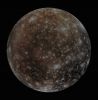
Callisto-PIA03456-PCF-LXTT-IPF.jpgApproaching Callisto (Absolute Natural Colors; credits for the additional process. and color.: Dr Paolo C. Fienga/Lunar Explorer Italia/Italian Planetary Foundation)72 visiteBright scars on a darker Surface testify to a long history of impacts on the Jovian moon Callisto, as it can be seen in this image obtained by the NASA - Galileo Spacecraft. The picture, taken in May 2001, is the only complete global Absolute Natural Color image of Callisto ever obtained by the NASA - Galileo Spacecraft, which orbited around Jupiter from December, 7, of the AD 1995 and until September 21, of the AD 2003, when the Spacecraft was destroyed during a controlled impact with Jupiter itself.
Of Jupiter's 4 (four) largest moons (also known as the "Galilean Moons"), Callisto orbits farthest from the Giant Gas Planet. Furthermore, Callisto's Surface is uniformly cratered but, as you can see for yourself, is not uniform in color or brightness at all. At present day, Planetary Scientists believe that the brighter areas are mainly Ice while the darker ones should be made of highly eroded (and Ice-poor) Rocky Materials.
This frame (which is an Original NASA - Galileo Spacecraft color frame published on the NASA - Planetary Photojournal with the ID n. PIA 03456) has been additionally processed and then re-colorized, according to an educated guess, by Dr Paolo C. Fienga (LXTT-IPF), in Absolute Natural Colors (such as the colors that a human eye would actually perceive if someone were onboard the NASA - Galileo Spacecraft and then looked outside, towards the Jovian moon Callisto), by using an original technique created - and, in time, dramatically improved - by the Lunar Explorer Italia Team. Different colors, as well as different shades of the same color, mean, among others, the existence of different Elements present on the Surface of Callisto, each having a different Albedo (---> Reflectivity) and Chemical Composition.MareKromiumFeb 14, 2013
|
|

Europa-Craters-Mannann_an_Crater-PIA01402-PCF-LXTT-IPF.jpgFeatures of Mannann'an Crater (Absolute Natural Colors; credits for the additional process. and color.: Dr Paolo C. Fienga/Lunar Explorer Italia/Italian Planetary Foundation)153 visiteThis composite view taken by the NASA - Galileo Spacecraft, shows a portion of the Rim and the Interior of the Impact Crater known as Mannann'an, which is located on Jupiter's moon, Europa. A high resolution image (20 meters per picture element) was combined with a lower resolution one (80 meters per picture element), to produce this composite picture. The color data here can be used to distinguish between Regions where the Ice located on the Surface of Europa is purer (---> cleaner) from other areas where the Ice itself, instead, is more contaminated (---> dirty; mixed with other elements); the reddish/brown Surface Material visible to the West (Left side - Sx) of the frame is thought to be "dirty" Ice, while the white/bluish areas visible inside the Crater should be made of "cleaner" Ice. The Rim of Mannann'an is (barely visible) on the left of the composite, approx. at the boundary between the area with the higher concentration of reddish/brown Surface Material and the area where the white Surface Material is dominant. The high resolution data show several small Surface Features inside this Impact Crater, including Concentric Fractures and a Spider-like set of Fractures near the right (East) edge of the image.
North is to the top of the picture and the Sun illuminates the scene from the East (right - Dx). The image, which is centered at 3° North Latitude and 240° West Longitude, covers an area of approximately 18 by 4 Km (such as about 11,12 by 2,48 miles). The finest details that can be discerned in this picture are about 40 meters (44 yards) across. The images were taken by the Solid State Imaging Camera onboard Galileo, when the Spacecraft flew by Europa on March 29th, 1998, at a distance of 1934 Km (such aapprox. 1201 miles) from its Surface.
This frame (which is an Original NASA - Galileo Spacecraft false colors image composite published on the NASA - Planetary Photojournal with the ID n. PIA 01402) has been additionally processed and then re-colorized, according to an educated guess carried out by Dr Paolo C. Fienga (LXTT-IPF), in Absolute Natural Colors (such as the colors that a human eye would actually perceive if someone were onboard the NASA - Galileo Spacecraft and then looked outside, towards the Surface of the Jovian moon Europa), by using an original technique created - and, in time, dramatically improved - by the Lunar Explorer Italia Team. Different colors, as well as different shades of the same color, mean, among others, the existence of different Elements present on the Surface of Europa, each having a different Albedo (---> Reflectivity) and Chemical Composition.MareKromiumGen 31, 2013
|
|

Europa-Craters-Tyre_Crater-PIA00702-PCF-LXTT-IPF.jpgTyre Crater (Absolute Natural Colors; credits for the additional process. and color.: Dr Paolo C. Fienga/Lunexit Team/Italian Planetary Foundation)142 visiteThis unbelievably complex Surface Feature located on the Jovian moon Europa was originally seen as a dark, diffuse Circular Patch on a previous NASA - Galileo Spacecraft's global image of Europa's Leading Hemisphere taken on April 3, 1997. The "Bulls-Eye" pattern appears to be a 140- Km-wide Impact "Scar" (about the size of the island of Hawaii) which formed as the Surface of Europa fractured minutes after a (probably) mountain-sized Asteroid or Comet slammed into this fascinating Celestial Body.
This approx. 214-Km-wide picture is the product of the combination of 3 (three) images which have originally been processed in false colors, so to enhance shapes and compositions of the photographed Surface. North is toward the top of this picture, which is illuminated from Sunlight coming from the West. This composite reveals a sequence of events which have deeply modified the Surface of Europa. The earliest event was the impact which formed the Tyre Structure, located at 34° North Latitude and 146,5° West Longitude. The impact was then followed by the formation of the brown/reddish lines superposed on Tyre. The brown/reddish color, in fact, designates areas that are probably made of (or covered by) some kind of a "dirty" Water-Ice Mixture. On the other hand, the fine light blue-gray lines crossing the whole Region from West to East appear to be Ridges which (obviously) formed after the Crater.
The images forming this composite were taken on April 4, 1997, at a resolution of 595 meters (1950 feet) per picture element and a range of approx. 29.000 Km (such as about 18.000 miles) from Europa. The frames were taken by Galileo's Solid State Imaging (CCD) System.
This frame (which is the Original NASA - Galileo Spacecraft false-color image composite published on the NASA - Planetary Photojournal with the ID n. PIA 00702) has been additionally processed and then re-colorized, according to an educated guess carried out by Dr Paolo C. Fienga (LXTT-IPF), in Absolute Natural Colors (such as the colors that a human eye would actually perceive if someone were onboard the NASA - Galileo Spacecraft and then looked outside, towards the Surface of the Jovian moon Europa), by using an original technique created - and, in time, dramatically improved - by the Lunar Explorer Italia Team. Different colors, as well as different shades of the same color, mean, among others, the existence of different Elements present on the Surface of Europa, each having a different Albedo (---> Reflectivity) and Chemical Composition.MareKromiumGen 31, 2013
|
|

Europa-Ice_Floes-PIA00578-PCF-LXTT-IPF.jpgEuropa's Ice Floes (Absolute Natural Colors; credits for the additional process. and color.: Dr Paolo C. Fienga/Lunexit Team/Italian Planetary Foundation)128 visiteJupiter's moon Europa, as seen in this image taken on June 27, 1996 by the NASA - Galileo Spacecraft, displays a few Surface Features that, in some areas, seem to resembe to Ice Floes (---> usually large, flat, and free masses of floating Sea Ice ) seen in the Polar Seas of our Home Planet Earth. Europa, which is about the size of Earth's Moon, possesses an Icy Crust that has been severely fractured, as indicated by the dark linear, curved, and wedged-shaped bands seen here. These Fractures have broken the Crust into Plates which are as large as 30 Km (such as about 18,6 miles) across. The Areas between the Plates are filled with Material that is probably Icy "Slush", contaminated with Rocky Debris. Some individual Plates were separated and rotated into new positions. Europa's density indicates that this Celestial Body has a shell of Water Ice thicker than approx. 100 Km (such as about 62 miles), parts of which could be liquid. Currently, Water Ice could extend from the Surface down to the Rocky Interior of Europa, but the Features seen in this image suggest that the motion of the disrupted Icy Plates was lubricated by soft Ice or perhaps liquid Water that was just below the Surface at the time of disruption.
This image covers part of the Equatorial Zone of Europa and was taken from a distance of approx. 156.000 Km (such as about 96.876 miles) by the Solid-State Imaging Subsystem onboard the NASA - Galileo Spacecraft. North is up and the Sun is nearly directly overhead. The area shown here is about 510 by 989 Km (such as approx. 317-by-614 miles), and the smallest visible Surface Feature is about 1,6 Km (approx. 1 mile) across.
This frame (which is the Original NASA - Galileo Spacecraft b/w image published on the NASA - Planetary Photojournal with the ID n. PIA 00578) has been additionally processed and then colorized, according to an educated guess carried out by Dr Paolo C. Fienga (LXTT-IPF), in Absolute Natural Colors (such as the colors that a human eye would actually perceive if someone were onboard the NASA - Galileo Spacecraft and then looked outside, towards the Surface of the Jovian moon Europa), by using an original technique created - and, in time, dramatically improved - by the Lunar Explorer Italia Team. Different colors, as well as different shades of the same color, mean, among others, the existence of different Elements present on the Surface of Europa, each having a different Albedo (---> Reflectivity) and Chemical Composition.MareKromiumGen 31, 2013
|
|
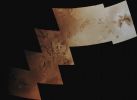
Io-Zamama_Patera-PIA03531-PCF-LXTT-IPF.jpgZamama (Absolute Natural Colors; credits for the additional process. and color.: Dr Paolo C. Fienga/Lunar Explorer Italia/Italian Planetary Foundation)102 visiteThe source area of what had been a towering Volcanic Plume in the middle of August of the AD 2001, lies in the far-right frame of this Image-Mosaic (of pictures taken by the NASA - Galileo Spacecraft on October, 16th, 2001) which shows us a portion of the Northern Latitudes of the Jovian "Volcanic" moon, Io. The Region showed in this Image-Mosaic includes the Zamama Lava Flow-Field, which emanates from the Northernmost of 2 (two) small Volcanoes visible in the far left frame. These Lava Flows were not present in any of the NASA - Voyager 1 Probe's images of Io, so it is logic to assume that they must have formed sometime between the NASA - Voyager 1 Fly-By (that occurred in the AD 1979) and the early observations of Io made by the NASA - Galileo Spacecraft and which took place in the AD 1996 (in addition to that, it has to be said that the NASA - Galileo Spacecraft also observed the Zamama Lava Flow-Field during the Io encounters that occurred in the AD 1999: a time when some NASA scientists identified narrow, long, dark Lava Flows which they thought to be relatively similar to other Lava Flows found on Planet Earth and, to be precise, in the Hawaii Islands).
Moving North/East, the second and third frames of this mosaic show a number of Lava Flow-Fields and several Unnamed Volcanic Depressions, known as "Paterae". It is still unclear whether the broad, shield-like features (or "Plateaux") on which the Paterae rest were created by Eruptions from the Paterae themselves, or if they were just preexisting Volcanic Features. Furthermore, some Fractures and Dark Lines suggest that the Crust of Io, in a few places of this Region, is breaking up, thus creating Cracks that Magma can use to rise up to the Surface. Finally, the far-right frame of this mosaic shows dark Lava Flows and bright "Spots". The bright "Spots" are probably Sulphur-bearing Plume Deposits, which are thought to be associated with the source of a Plume Eruption approx. 500 Km (such as about 310 miles) high, that was observed by the Galileo Spacecraft in August, 2001 (a Plume Eruption that actually was the largest one ever observed on Io).
This Image-Mosaic (which is an NASA - Original Galileo Spacecraft b/w Image-Mosaic published on May, 28th, 2002, on the NASA - Planetary Photojournal and identified by the serial n. PIA 03531) has been additionally processed and then colorized in Absolute Natural Colors (such as the colors that a human eye would actually perceive if someone were onboard the NASA - Galileo Spacecraft and then looked ahead, towards the Jovian moon Io), by using an original technique created - and, in time, dramatically improved - by the Lunar Explorer Italia Team.MareKromiumDic 19, 2012
|
|

Io-Loki_Patera-PIA00320-PCF-LXTT-IPF.jpgVolcanic Plains and Paterae on Io: Loki Patera (Absolute Natural Colors; credits for the additional process. and color.: Dr Paolo C. Fienga/Lunar Explorer Italia/Italian Planetary Foundation)94 visiteA huge area of Io's Volcanic Plains is well shown in this mosaic of pictures taken by the NASA - Voyager 1 Space Probe. Numerous Volcanic Calderas and Lava Flows are visible here, including the Loki Patera (an active Lava Lake), which is the large shield-shaped and dark red Surface Feature visible in the lower right portion of the mosaic. As a matter of fact, the (sometime) intense light emitted from the Lava that boils inside Loki Patera can even be seen through telescopes, all the way from Earth, and these observations tell us that Loki has been active continuously (or at least every time an astronomer took a good look at it...) since the Voyager 1 Fly-By, which occurred in the month of March of the AD 1979.
The composition of Io's Volcanic Plains and Lava Flows has not been completely determined yet but, in the light of the information that we already possess (and, in particular, once we duly consider the orange-yellow color that can be seen over most of the Surface of Io), it is reasonable to say that they could dominantly consist of Sulphur, with Surface Frosts made of Sulphur Dioxide, Silicates (such as Basalts) encrusted with Sulphur and Sulphur Dioxide Condensates. The bright whitish patches, on the other hand, could probably consist of freshly deposited Sulphur Dioxide Frost. The dark red (and, sometime, almost black) spots, including Loki, are hot Sulphur Lava Lakes, which may remain molten even for a long time, thanks to the intrusions of molten Silicate Magma that (probably in an almost continuous way) comes up from deep inside Io. However, the very ultimate source of heat that keeps Io active, must be the Tidal (Frictional) Heating, due to the perpetual flexure of Io that is caused by the powerful Gravitational Influence of both Jupiter and Europa.
This picture (which is an Original NASA - Voyager 1 Space Proble color image mosaic published on the NASA - Planetary Photojournal with the n. PIA 00320) has been additionally processed and then re-colorized in Absolute Natural Colors (such as the colors that a human eye would actually perceive if someone were onboard the NASA - Voyager 1 Space Probe and then looked outside, towards the limb of the Jovian moon Io), by using an original technique created - and, in time, dramatically improved - by the Lunar Explorer Italia Team. Different colors, as well as different shades of the same color, mean, among others, the existence of different Elements present on the Surface of Io, each having a different Albedo (---> Reflectivity) and Chemical Composition.MareKromiumSet 30, 2012
|
|
| 325 immagini su 28 pagina(e) |
|
3 | |
|
|
|
|
|
|
|
|
|
|





