| |

| Ultimi arrivi - Jupiter: the "King" and His Moons |

Amalthea-PIA01076.jpgAmalthea and a few inner Moons of Jupiter71 visiteChe cosa distingue questi "macigni vaganti" dalla maggior parte delle Lune di Giove? Si tratta di Lune originarie del Sistema Gioviano o sono state "attratte" da Giove, durante un passaggio troppo ravvicinato? Probabilmente si tratta di asteroidi vaganti o di comete mancate: oggetti provenienti dalla Fascia di Kuiper (KBO) che, in transito accanto al Gigante Gassoso, si sono trovati all'angolo ed alla velocità corretti per non essere nè semplicemente deflessi dalla loro corsa e quindi scagliati via nello...Ago 26, 2004
|
|

Io-Eruption on Tvashtar Catena-PIA02584_modest.jpgIo: eruption in Tvashtar Catena84 visiteThis pair of images taken by NASA's Galileo spacecraft captures a dynamic eruption at Tvashtar Catena, a chain of volcanic bowls on Jupiter's moon Io. They show a change in the location of hot lava over a period of a few months in 1999 and early 2000.
The image on the left uses data obtained on Nov. 26 and July 3, 1999, at resolutions of 183 meters (600 feet) and 1.3 kilometers (0.8 miles) per pixel, respectively. The red and yellow lava flow itself is an illustration based upon imaging data. The image on the right is a composite using a five-color observation made on Feb. 22, 2000, at 315 meters (1030 feet) per pixel.
These are among the most fortuitous observations made by Galileo because this style of volcanism is too unpredictable and short-lived to plan to photograph.
Short-lived bursts of volcanic activity on Io had been previously detected from Earth-based observations, but interpreting the style of volcanic activity from those lower-resolution views was highly speculative. These Galileo observations confirm hypotheses that the initial, intense thermal output comes from active lava fountains. Galileo's high-resolution observations of volcanic activity on Io have also confirmed other hypotheses based on earlier, low-resolution data. These include interpretations of slowly spreading lava flows at Prometheus and Amirani and an active lava lake at Pele. These tests of earlier hypotheses increase scientists' confidence in interpreting volcanic activity seen in low-resolution remote sensing data of Earth as well as Io. However, these data are still of insufficient resolution to adequately test the more quantitative models that have been applied to volcanic eruptions on Earth and Io.
These images also show other geologic features on Io, such as the scalloped margins of the plateau to the northeast of the active lavas. These margins appear to have formed by sapping, a process usually associated with springs of water. Liquid sulfur dioxide might be the fluid responsible for sapping on Io. A better understanding of sapping on Io will influence how scientists interpret similar features on Mars(where the viability of carbon dioxide or water as the sapping fluid remains controversial).
Ago 25, 2004
|
|

Europa-fullcolor-PIA02590_modest.jpgEuropa in full colors65 visitenessun commentoAgo 25, 2004
|
|

Io-Tupan Patera-fullcolor-PIA02599_modest.jpgIo: Tupan Patera72 visiteWonderful colors in a volcanic crater named Tupan Patera on Jupiter's moon Io, as seen in this image from NASA's Galileo spacecraft, show varied results of lava interacting with sulfur-rich materials.
The colorfulness of the image is only slightly enhanced from what the human eye would see on the scene. The red in the image includes a small amount of infrared energy. Tupan Patera, named after a Brazilian thunder god, was seen as an active hot spot in earlier Galileo observations, but those low-resolution views did not show details of volcanic activity. This image taken in October 2001 at a resolution of 135 meters (443 feet) per picture element reveals the complex nature of the crater.
Tupan is now clearly shown to be a volcanic depression, about 75 kilometers (47 miles) across, surrounded by cliffs about 900 meters (3000 feet) tall. In the center is a large area that must be higher than the rest of the crater floor because it has not been covered by the dark lavas. Much of the area is coated with a diffuse red deposit that Galileo scientists believe has condensed from sulfur gas escaping from volcanic vents. The floor of Tupan is covered with a surreal pattern of dark black, green, red, and yellow materials. The black material is recent, still-warm lava. The yellow is presumed to be a mix of sulfurous compounds, and the green appears to form where red sulfur has interacted with the dark lavas. While Galileo scientists have found previous evidence for both molten sulfur and molten rock on Io, this image shows the best evidence to date of chemical reactions taking place between the two.
The intermingled patches of sulfur and lava are difficult to explain. The yellowish sulfur may be melting from within the crater walls over solidified but warm lava. The sulfur may boil away from the areas too hot for liquid sulfur to sit on, leaving patches where the dark lava is still visible.
North is to the top of the image and the Sun illuminates the surface from the upper right.
Ago 25, 2004
|
|
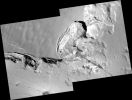
Io-Telegonus Mensa-PIA03528_modest.jpgIo: Telegonus Mensa55 visitenessun commentoAgo 25, 2004
|
|
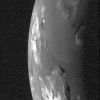
Io-PIA03530-1.jpgIo: the Loki Volcano from Galileo (RAW-HR and b/w Original NASA-Galileo Spacecraft Frame)62 visiteCaption NASA:"Light from the setting Sun falls across the Loki Volcanic Region on Jupiter's moon Io in this image taken by NASA's Galileo Spacecraft taken on October, 16, 2001.
The image was taken to examine the relative depths and heights of the major Surface Features existing in the Region. The Sun illuminates the surface from the right. Galileo's camera caught the large Volcanic Crater, or "Patera" of Loki near the Terminator (such as the boundary line between night and day). The image also shows several smaller craters plus shadows cast by the high peaks of several mountains.
Shadows cast by the low Sun should reveal any topography associated with Loki, such as a plateau in the center of the Patera or high Patera Walls. The near absence of shadows in this Region surprised Galileo scientists, as they had expected much more pronounced topography near Loki.
Another surprising aspect of this image is that features that have been black in previous Voyager and Galileo images of Loki, such as the dark Lava Flows visible inside the Patera, are here brighter than their surroundings. The best explanation is that the shiny, glassy surfaces of chilled Lava Flows look extremely dark when the Sun is directly overhead, but they reflect the Sun's light comparatively well when it shines at a low angle, in a similar manner to the reflective surfaces of bodies of water.
Other Volcanic Paterae in this image show the same unusual reflectance as seen at Loki. Some of them are being viewed at such an angle that these reflections from Lava Flows are the brightest features in the image. This image tells us that Lava Flows on Io chill quickly and form glassy surfaces, not unlike recently cooled lava flows in Hawaii.
The image has a resolution of about 1,1 Km (approx. 0,7 miles) per picture element. North is to the top of the picture".Ago 25, 2004
|
|
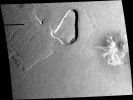
Io-Volcanic_Depression-PIA03532_modest1.jpgVolcanic Depression near the Equator (Original NASA/Galileo b/w Frame)57 visiteThis image taken by NASA's Galileo spacecraft on Oct. 16, 2001, near the equator of Jupiter's moon Io shows the contrast in volcanism styles found on Io.
The central feature is a large patera, or volcanic depression, almost 100 kilometers (60 miles) long. It may have formed after eruptions of lava emptied a subsurface magma chamber and left an empty space into which the crust collapsed. Evidence of lava flows associated with this patera, however, is difficult to find. Either the flows have been buried, or perhaps they never erupted and simply drained back deep into the crust.
On the right of the image is a small shield volcano, similar to volcanoes in Hawaii. It is rare for lavas on Io to be thick enough to pile up into shields around vents. They usually run out in thin, long flows instead. This shield abuts some very pale lava flows that emerged from a small vent to the west. These flows could be made of sulfur, like flows at Io's Emakong Patera. The vent is also surrounded by dark, diffuse material, which may be the result of lava erupted in an explosive, gas-rich eruption, similar to the 1980 eruption of Mount Saint Helens in Washington.
North is to the top of the image and the illumination is from the right. The image has a resolution of 330 meters (1,080 feet) per picture element and is 340 (211 miles) kilometers across.
Ago 25, 2004
|
|

ZC-Jupiter from Mars-PIA04532_modest.jpgJupiter and 3 Galilean Moons from Mars83 visiteCi siamo chiesti tante volte, guardando Giove dalla Terra, come lo si vedrebbe da Marte. Ebbene, abbiamo trovato la risposta (grazie all'aiuto del Mars Global Surveyor Orbiter): in questo frame davvero eccezionale, Giove e 3 dei suoi 4 Satelliti Galileiani, così come li vedremmo da Marte! Un'immagine bellissima da guardare e su cui occorre riflettere molto. Perchè? Perchè conquistare lo Spazio, alle volte, vuol dire anche ampliare i confini dell'Immaginazione...Ago 25, 2004
|
|

ZA-The Red Spot from HST.jpgMoments of the "Red Spot" - HST64 visitenessun commentoAgo 21, 2004
|
|
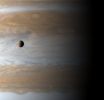
IO 2.jpgIo & Jupiter (from Cassini)63 visiteL'immenso Giove ed il piccolo (ma affascinante e VIVO, geologicamente parlando) Io, in un transito immortalato dalla Sonda Cassini, in transito accanto al Signore degli Dei ed in viaggio verso il Sistema di Saturno.Lug 08, 2004
|
|

IO 4.jpgIo (Flying over a volcanic eruption and a sea of sulphur - Tvashtar Catena)104 visiteAn active volcanic eruption on Jupiter's moon Io was captured in this image taken on February 22, 2000 by NASA's Galileo spacecraft. Tvashtar Catena, a chain of giant volcanic calderas centered at 60 degrees north, 120 degrees west, was the location of an energetic eruption caught in action in November 1999. A dark, "L"-shaped lava flow to the left of the center in this more recent image marks the location of the November eruption. White and orange areas on the left side of the picture show newly erupted hot lava, seen in this false color image because of infrared emission. The two small bright spots are sites where molten rock is exposed to the surface at the toes of lava flows. The larger orange and yellow ribbon is a cooling lava flow that is more than more than 60 kilometers (37 miles) long. Dark, diffuse deposits surrounding the active lava flows were not there during the November 1999 flyby of Io.
This color mosaic was created by combining images taken in the near-infrared, clear, and violet filters from Galileo's camera. The range of wavelengths is slightly more than that of the human eye. The mosaic has been processed to enhance subtle color variations. The bright orange, yellow, and white areas at the left of the mosaic use images in two more infrared filters to show temperature variations, orange being the coolest and white the hottest material. This picture is about 250 kilometers (about 155 miles) across. North is toward the top and illumination from the Sun is from the west (left).
Lug 08, 2004
|
|

IO 5.jpgZal Patera, Io, in color73 visiteThe Zal Patera region of Jupiter's volcanic moon Io is shown in this combination of high-resolution black and white images taken by NASA's Galileo spacecraft on November 25, 1999 and lower resolution color images taken by Galileo on July 3, 1999. By combining both types of images, Galileo scientists can better understand the relationships between the different surface materials and the underlying geologic structures. For example, in the center toward the top of the picture, the edge of the caldera, or volcanic crater, is marked by the black flows, and it coincides with the edge of a plateau. Also, the red material(just above and to the right of the center of the image) is typically associated with regions where lava is erupting onto the surface. Here the red material follows the base of a mountain, which may indicate that sulfurous gases are escaping along a fault associated with the formation of the mountain.
Scientists can use the lengths of the shadows cast to estimate the height of the mountains. They estimate that the northernmost plateau, which bounds the western edge of Zal Patera, rises up to approximately 2 kilometers (6,600 feet) high. The mountain to the south of the caldera has peaks up to approximately 4.6 kilometers (15,000 feet) high, while the small peak at the bottom of the picture is approximately 4.2 kilometers (14,000 feet) high.
North is to the top of the image, which is centered at 33.7 degrees north latitude and 81.9 degrees west longitude. The higher resolution images have a sharpness of about 260 meters (or yards) per picture element, and they are illuminated from the left. These images were taken on November 25, 1999 at a range of 26,000 kilometers (16,000 miles). The color images are illuminated from almost directly behind the Galileo spacecraft. The resolution of the color images is 1.3 kilometers (0.8 miles) per picture element. They were taken on July 3, 1999 at a distance of about 130,000 kilometers (81,000 miles).
Lug 08, 2004
|
|
| 325 immagini su 28 pagina(e) |
|
|
|
|
|
|
|
|
26 | |
|
|
|





