| Ultimi arrivi - Jupiter: the "King" and His Moons |

Io-Fire Fountain from Earth-PIA02522.jpgA "Fire Fountain" on Io...from Earth!84 visiteIl 25 Novembre 1999, dall'Osservatorio di Mauna-Kea (Hawaii), viene osservata e ripresa questa straordinaria immagine relativa ad una gigantesca "flare" (o "Fontana di Luce") occorsa su Io. Noi riteniamo che immagini come questa siano destinate ad entrare nella Storia della Scienza, ed è un peccato che a questi fenomeni i mezzi di comunicazione di massa non dedichino - praticamente - alcun rilievo. Peccato, davvero peccato...Ago 26, 2004
|
|

Io-flares and eruptions-PIA02254.jpgFlares and Eruptions on the limb of crescent Io99 visiteUn frame da ricordare, per bellezza ed importanza: ecco come appaiono le "flares" sul bordo di un pianeta in ombra. Sappiamo, in questo caso, che si tratta di eruzioni ed outgassing in corso e nessuno ne dubita. Tuttavia, quando fenomeni similari (o identici) vengono osservati sulla Luna, tutti (o quasi) gli Scienziati ed i Ricercatori si affrettano a dire che non è possibile e che deve trattarsi di sviste o bagliori da impatto. Ma perchè fa così paura l'idea che la Luna possa essere ancora in parte "viva"?
Voyager 2 took this picture of Io July 10, 1979, from a range of 1.2 million kilometers (750,000 miles). It was one of the last of an extensive sequence of "volcano watch" pictures planned as a time lapse study of the nearest of Jupiter's Galilean satellites. The sunlit crescent of Io is seen at the left, and the night side illuminated by light reflected from Jupiter can also be seen. Three volcanic eruption plumes are visible on the limb. All three were previously seen by Voyager 1. On the bright limb Plume 5 (upper) and Plume 6 (lower) are about 100 kilometers high, while Plume 2 on the dark limb is about 185 kilometers high and 325 kilometers wide. The dimensions of Plume 2 are about 1 1/2 times greater than during the Voyager 1 encounter, indicating that the intensity of the eruptions has increased during the four-month time interval between the Voyager encounters. The three volcanic eruptions and at least three others have apparently been active at roughly the same intensity or greater for a period of at least four months.
Ago 26, 2004
|
|

Io-Southern Limb and light-PIA02250.jpgThe Southern Limb of Io and a possible "Transient Phoenomenon"66 visiteUn'immagine interessantissima del bordo dell'emisfero sud di Io. Elevatissimo dettaglio e grande suggestione del paesaggio. Io è un mondo violento ed in costante tumulto: il numero di vulcani attivi su questo Pianeta è elevatissimo (gli ultimi dati in nostro possesso parlavano di 6 vulcani attivi contemporaneamente), dunque non ci meravigliamo se vediamo delle flares, come quella alla Dx di questo frame, splendere nel buio. Potrebbe trattarsi di un outgassing: un classico fenomeno transitorio.
Original caption:"NASA's Galileo spacecraft captured this dramatic image of mountains on Io in February 2000. The image was taken when the Sun was low in the sky, illuminating the scene from the left, so it reveals topographic details of Io's surface. A low scarp, roughly 250 meters (820 feet) high, runs from the upper left toward the center of the image. Mongibello Mons, the jagged ridge at the left of the image, rises 7 kilometers (23,000 feet) above the plains of Io, higher than any mountain in North America. Few of Io's mountains (see also PIA02526) resemble volcanoes. Instead, Galileo scientists believe that the mountains are formed when blocks of Io's crust are uplifted along thrust faults. Angular mountains are thought to be younger, while older mountains have more subdued topography, such as the rise near the top center of this image.
The image has a resolution of 335 meters (1,100 feet) per picture element. North is to the top of the image.
Ago 26, 2004
|
|

Io-Ionian Mountains and calderas-PIA02526.jpgIonian Mountains and Calderas on Io (real colors)74 visitenessun commentoAgo 26, 2004
|
|
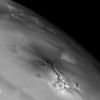
Io-PIA02232-1.jpgIo's Limb (RAW b/w NASA-Galileo Spacecraft Original Frame)55 visiteCaption NASA:"This picture of Io was taken on the morning of March 5 at a range of 75.445 Km. The area shown is at approx. 15° South Latitude and 244° East Longitude. Many depressions and elevations are shown. The light is coming from the left, so a depression has a bright right wall and shadow on the left wall. The depressions are complex in shape and do not resemble impact craters. Two of the depressions are joined by a shallow trough. The elevations are irregular and comical. They are cut by linear and irregular troughs. The surface is smooth and plain-like, that is, the surface is not pockmarked by abundant impact craters so are probably geologically young.Ago 26, 2004
|
|
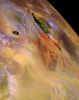
Io-Zal Patera-PIA02527.jpgZal Patera (False Colors; credits: NASA/JPL)56 visitenessun commentoAgo 26, 2004
|
|

Io-Eruption-PIA02545.jpgEruption on Tvashtar Catena65 visiteAn active volcanic eruption on Jupiter's moon Io was captured in this image taken on February 22, 2000 by NASA's Galileo spacecraft. Tvashtar Catena, a chain of giant volcanic calderas centered at 60 degrees north, 120 degrees west, was the location of an energetic eruption caught in action in November 1999. A dark, "L"-shaped lava flow to the left of the center in this more recent image marks the location of the November eruption. White and orange areas on the left side of the picture show newly erupted hot lava, seen in this false color image because of infrared emission. The two small bright spots are sites where molten rock is exposed to the surface at the toes of lava flows. The larger orange and yellow ribbon is a cooling lava flow that is more than more than 60 kilometers (37 miles) long. Dark, diffuse deposits surrounding the active lava flows were not there during the November 1999 flyby of Io.
This color mosaic was created by combining images taken in the near-infrared, clear, and violet filters from Galileo's camera. The range of wavelengths is slightly more than that of the human eye. The mosaic has been processed to enhance subtle color variations. The bright orange, yellow, and white areas at the left of the mosaic use images in two more infrared filters to show temperature variations, orange being the coolest and white the hottest material. This picture is about 250 kilometers (about 155 miles) across. North is toward the top and illumination from the Sun is from the west (left).
Ago 26, 2004
|
|

Io-Zal Patera-PIA02553.jpgThe "Zal" Patera79 visiteThis stereo image of Jupiter's moon Io shows the topography of a region on Io that includes the Zal Patera feature and a mountain or plateau that borders it to the west. It was created by combining two different views taken by NASA's Galileo spacecraft on November 25, 1999 (shown in red) and February 22, 2000 (shown in blue).
A mountain 120 kilometers (75 miles) wide rises to the west of the patera, a dark volcanic depression. By measuring the shadow, scientists were able to determine that the eastern margin of this mountain is about 1.5 kilometers (5000 feet) high. To the west and northwest, the mountain's margins are scalloped, which may indicate that a process called sapping is eroding them. Sapping occurs when fluid escapes from the base of a cliff, causing the material above it to collapse. Along the northwestern margin, the rough material at the base of the cliff maybe debris left over from the sapping process. Dark lava flows can be seen coming from a fissure to the east of the mountain.
Galileo scientists are in the process of generating topographic maps from these images. Such maps will reveal the heights and slopes of different landforms in this region, which will help scientists determine the strength and other properties of Io's surface materials. They will also be useful in understanding the processes of uplift and erosion on Io.
The picture is centered at 42.3 degrees north latitude and 76.9 degrees west longitude. North is to the top of the picture. The observations used to make the stereo image were made at ranges of 26,000 and 33,500 kilometers (16,200 and 20,900 miles) from Io. The resolution of the stereo image is about 335 meters (370 yards) per picture element.
Ago 26, 2004
|
|

Io-Zal Region-PIA02554.jpgZal Region on Io54 visiteThis image shows one of many intriguing mountains on Jupiter's moon Io. The image was made by combining a recent high-resolution, black and white image with earlier low-resolution color data to provide a high-resolution, color view. NASA's Galileo spacecraft took both images.
The 240-kilometer (150-mile) long mountain in the image is south of the volcanic hot spot named Zal. The black and white version of this image was useful for showing the shape of the mountain and the small fans of debris piled against the base of its tall, steep cliffs. However, when colorized the relationship between different types of materials becomes apparent. For example, the bright, red material is believed to contain a compound of sulfur that forms when sulfur is boiled at a high temperature. Active eruptions of molten rock (lava) are the most likely source for the heat. Thus we see red sulfur where lava reaches the surface. Other sulfur compounds cover the yellow areas, and the black areas are fresh silicate lava that has not yet been coated by the yellow sulfurous materials. The green patches are still somewhat mysterious; they appear to form when red sulfur lands on warm lava and the two react in a manner that is still unknown.
In this image, it is clear that the red material has blown out of a long crack along the western side of the mountain. Lava has flowed from this crack and filled a depression (caldera). Some of the red sulfur close to the dark caldera appears to have been converted into green material. The fact that lava comes up along the faults that define the sides of the mountains provides important clues to how the mountains form and the state of the interior of Io. Scientists at the University of Arizona speculate that the formation of the mountains on Io may be related to plumes of hot material rising inside the fiery body of Io.
North is to the top and the setting sun is shining from the west. The image is centered at about 33 degrees north, 72 degrees west. The high-resolution image was taken on February 22, 2000 by NASA's Galileo spacecraft. The image was taken by the Galileo's onboard camera from a range of 33,500 kilometers (20,800 miles) and has a resolution of 335 meters (1,100 feet) per picture element. The color images were taken on July 3, 1999. They have resolutions of 1.3 kilometers (0.81 miles) per picture element and are illuminated from almost directly behind the spacecraft. They were taken at a distance of about 130,000 kilometers(81,000 miles) from Io.
Ago 26, 2004
|
|
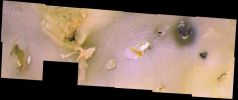
Io-Chain of Craters-PIA02566.jpgA chain of craters and "paterae" on Io54 visiteThis mosaic illustrates the range of "patera" morphology on Io.
But what is a "patera"? It is an irregular depression, or a complex one with scalloped edges, but which does not have the characteristics of an impact crater. The "paterae" on Io often correspond to active volcanic centers and are in some ways similar to calderas. What's a "caldera"? "Calderas" are large, usually roughly circular depressions that form by collapse over shallow magma chambers that have been partially emptied by volcanic eruptions. However, the "paterae" on Io are different from "calderas" seen elsewhere in the Solar System. They have many straight edges and sharp angles, suggesting that they are related to fractures in Io's crust. In many cases the lava can be seen to erupt from these straight edges. Planetary geologists aren't sure whether the paterae form over magma chambers or if they result from fractures and movements in the crust, and the lava subsequently follows the fractures.Ago 26, 2004
|
|

Amalthea-PIA02532.jpgA white streak on Amalthea68 visite...spazio interstellare, nè per essere attratti ed ingurgitati definitivamente da Giove, come è invece accaduto alla Cometa Shoemaker-Levy. Molti Scienziati non escludono neppure l'ipotesi che possa trattarsi di frammenti di una Luna Gioviana disintegratasi (magari a seguito di una collisione) qualche milione di anni fa. La verità, come sempre, non sarà facile da trovarsi...Ago 26, 2004
|
|

Thebe-Amalthea-Metis-PIA02531.jpgThebe, Amalthea and Metis55 visiteUna curiosità: è difficile non notare la notevole somiglianza fra Thebe (il primo "macigno" da Sx) e la Luna Marziana Phobos.
E qual'è il "punto di contatto" fra questi due corpi celesti?
Ma si tratta, naturalmente, del grande cratere che, nel caso di Thebe, notiamo sulla Sx del piccolo Satellite. Un grande cratere che ci ricorda molto da vicino lo "Stickney Crater" di Phobos.Ago 26, 2004
|
|
| 325 immagini su 28 pagina(e) |
 |
|
|
|
|
|
|
25 | |
|
|





