| Ultimi arrivi - Jupiter: the "King" and His Moons |

Europa-crescent-V2-PIA00325.jpgCrescent Europa from Voyager 257 visiteThis mosaic of Europa, the smallest Galilean satellite, was taken by Voyager 2. This face of Europa is centered at about the 300° meridian. The bright areas are probably ice deposits, whereas the darkened areas may be the rocky surface or areas with a more patchy distribution of ice. The most unusual features are the systems of long linear structures that cross the surface in various directions. Some of these linear structures are over 1000 Km long and about 2 or 3 Km wide. They may be fractures or faults which have disrupted the surface.Ago 26, 2004
|
|

Europa-Lineae-Agenor_Linea-HR-PIA01646.jpgThe "Agenor Linea" on Europa (detail mgnf + HR)61 visiteAgenor Linea is an unusual feature on Jupiter's icy moon Europa since it is brighter than its surroundings while most of Europa's ridges and bands are relatively dark. During the Galileo spacecraft's 17th orbit of Jupiter, high resolution images were obtained of Agenor Linea near Europa's day/night boundary so as to emphasize fine surface details. This mosaic shows high resolution images embedded in slightly lower resolution images which were also acquired during the 17th orbit. The Galileo images show that Agenoris not a ridge, but is relatively flat. Its interior consists of several long bands, just one of which is the very bright feature known as Agenor. Each long band shows fine striations along its length. A few very small craters pockmark Agenor Linea and its surroundings. Agenor is cut by some narrow fractures, and by some small subcircular features called lenticulae. Rough chaotic terrain is visible at the top and bottom of this photo, and appears to be "eating away" at the edges of Agenor. Though previously it was suspected that Agenor Linea might be one of the youngest features on Europa, this new view shows that it is probably not.
North is to the upper right of the picture and the sun illuminates the surface from the east. The image, centered at 44 degrees south latitude and 219 degrees west longitude, covers an area approximately 130 by 95 kilometers (80 by 60 miles). The highest resolution images were obtained at a resolution of about 50 meters (165 feet) per picture element and are shown here in context at about 220 meters per picture element. The images were taken on September 26th, 1998 at ranges as close as 5000 kilometers (3100 miles) by the Solid State Imaging (SSI) system on NASA's Galileo spacecraft.
Ago 26, 2004
|
|

Europa-Thera and Thrace Macula-PIA00875.jpg"Thera" and "Thrace" Macula on Europa56 visiteThis image of Europa's southern hemisphere was obtained by the solid state imaging (CCD) system on board NASA's Galileo spacecraft during its sixth orbit of Jupiter. The upper left portion of the image shows the southern extent of the "wedges" region, an area that has undergone extensive disruption. South of the wedges, the eastern extent of Agenor Linea (nearly 1000 kilometers in length) is also visible. Thera and Thrace Macula are the dark irregular features southeast of Agenor Linea. This image can be used by scientists to build a global map of Europa by tying such Galileo images together with images from 1979 during NASA's Voyager mission. Such lower resolution images also provide the context needed to interpret the higher resolution images taken by the Galileo during both its nominal mission and the upcoming Europa mission. North is to the top of the picture and the sun illuminates the surface from the right. The image, centered at -40 latitude and 180 longitude, covers an area approximately 675 by 675 kilometers. The finest details that can be discerned in this picture are about 3.3 kilometers across. The images were taken on Feb 20, 1997 at 12 hours, 55 minutes, 34 seconds Universal Time when the spacecraft was at a range of 81,707 kilometers.Ago 26, 2004
|
|

Europa-Lineae-Agenor_Linea-PIA00877.jpgThe "Agenor Linea" on Europa72 visitenessun commentoAgo 26, 2004
|
|

Europa-PIA00874.jpgEuropa's Leading Hemisphere57 visiteThis image of Europa's Leading Hmisphere was obtained by the Solid State Imaging (CCD) System on board NASA's Galileo spacecraft during its seventh orbit of Jupiter. In the upper left part of the image is Tyre, a multi-ringed structure that may have formed as a result of an ancient impact. Also visible are numerous lineaments that extend for over 1000 Km. The limb, or edge, of Europa in this image can be used by scientists to constrain the radius and shape of the satellite. North is to the top of the picture and the Sun illuminates the surface from the right. The image, centered at -40° Latitude and 180° Longitude, covers an area approx. 2000 by 1300 Km. The finest details that can be discerned in this picture are about 6,6 Km across. The images were taken on April 3, 1997 at 17 h, 42', 19" Universal Time when the spacecraft was at a range of about 318.000 Km from Europa.Ago 26, 2004
|
|

Europa-Craters-Pwyll_Crater-PIA01211.jpgPwyll Crater on Europa (Extremely Enhanced Natural Colors; credits: NASA/JPL)55 visiteThis enhanced color image of the region surrounding the young impact crater Pwyll on Jupiter's moon Europa was produced by combining low resolution color data with a higher resolution mosaic of images obtained on December 19, 1996 by the Solid State Imaging (CCD) system aboard NASA's Galileo spacecraft. This region is on the trailing hemisphere of the satellite, centered at 11 degrees South and 276 degrees West, and is about 1240 kilometers across. North is toward the top of the image, and the sun illuminates the surface from the east.
The 26 kilometer diameter impact crater Pwyll, just below the center of the image, is thought to be one of the youngest features on the surface of Europa. The diameter of the central dark spot, ejecta blasted from beneath Europa's surface, is approximately 40 kilometers, and bright white rays extend for over a thousand kilometers in all directions from the impact site. These rays cross over many different terrain types, indicating that they are younger than anything they cross. Their bright white color may indicate that they are composed of fresh, fine water ice particles, as opposed to the blue and brown tints of older materials elsewhere in the image.
Also visible in this image are a number of the dark lineaments which are called "triple bands" because they have a bright central stripe surrounded by darker material. Scientists can use the order in which these bands cross each other to determine their relative ages, as they attempt to reconstruct the geologic history of Europa.Ago 26, 2004
|
|

Europa-Icy cliffs-PIA01182.jpgIcy cliffs on Europa (extreme detail mgnf)85 visiteThis image, taken by the camera onboard NASA's Galileo spacecraft, is a very HR view of the Conamara Chaos region on Jupiter's moon Europa. It shows an area where icy plates have been broken apart and moved around laterally. The top of this image is dominated by corrugated plateaux ending in icy cliffs over a hundred meters (a few hundred feet) high. Debris piled at the base of the cliffs can be resolved down to blocks the size of a house. A fracture that runs horizontally across and just below the center of the Europa image is about the width of a freeway.
North is to the top right of the image, and the sun illuminates the surface from the east. The image is centered at approx. 9° North Latitude and 274° West Longitude. The image covers an area approx. 1,7 by 4 Km (about 1 by 2,5 miles). The resolution is 9 mt (roughly 30 feet) per picture element. This image was taken on December 16, 1997 at a range of 900 Km (about 540 miles) by Galileo's Solid State Imaging System.Ago 26, 2004
|
|

Europa-Chaotic_Terrain-Conamara_Chaos-PIA01181.jpgConamara Chaos Region on Europa (HR)72 visiteThis view of the Conamara Chaos region on Jupiter's moon Europa shows cliffs along the edges of high-standing ice plates. The washboard texture of the older terrain has been broken into plates which are separated by material with a jumbled texture. The cliffs themselves are rough and broadly scalloped, and smooth debris shed from the cliff faces is piled along the base. For scale, the height of the cliffs and size of the scalloped indentations are comparable to the famous cliff face of Mount Rushmore in South Dakota.
This image was taken on December 16, 1997 at a range of 900 Km (540 miles) by the Solid State Imaging System Camera on Galileo spacecraft. North is to the top right of the picture and the sun illuminates the surface from the east. This image, centered at approx. 8° North Latitude and 273° West Longitude, covers an area approx. 1,5 by 4 Km (about 0,9 by 2,4 miles). The resolution is 9 mt (30 feet) per picture element.Ago 26, 2004
|
|

Europa-V1-PIA00016-0.jpgEuropa56 visite"TUTTI QUESTI MONDI VI APPARTENGONO, TRANNE EUROPA: NON TENTATE DI ATTERRARVI.
VIVETECI INSIEME.
VICETECI IN PACE".
Ricordate questa "famosissima" trasmissione (diretta alla Terra ed all'equipaggio dell'astronave Sovietica "Leonov") proveniente dall'astronave Americana "Discovery", in quel momento guidata dall'Elaboratore HAL 9000?
Naturalmente stiamo parlando di "2010 - Odissea 2", il prosieguo cinematografico dell'immortale capolavoro di Sir Stanley Kubrick "2001 - A Space Odyssey".
Europa: la culla di una Nuova Civiltà, da studiare "restando lontani", così da non contaminarla con la nostra arroganza e supponenza.
Due film da rivedere e, dopo aver visto queste immagini, su cui provare a meditare...Ago 26, 2004
|
|
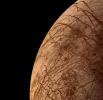
Europa-V2-PIA00459.jpgEuropa from Voyager 2 - the closest approach62 visiteCaption NASA originale:"This color image of the Jovian moon Europa was acquired by Voyager 2 during its close encounter on Monday morning, July 9, 1979. Europa, the size of our Moon, is thought to have a crust of ice perhaps 100 kilometers thick which overlies the silicate crust. The complex array of streaks indicate that the crust has been fractured and filled by materials from the interior. The lack of relief, any visible mountains or craters, on its bright limb is consistent with a thick ice crust hypothesis".Ago 26, 2004
|
|

Europa-Lineae-Minos_Linea-PIA00275.jpgEuropa: Minos Linea (detail mgnf) - false colors90 visiteFalse color has been used here to enhance the visibility of certain features in this composite of 3 images of the Minos Linea region on Jupiter's moon Europa taken on 28 June 1996 Universal Time by the Solid State Imaging Camera on NASA's Galileo spacecraft. Triple bands, lineae and mottled terrains appear in brown and reddish hues, indicating the presence of contaminants in the ice. The icy plains, shown here in bluish hues, subdivide into units with different albedos at infrared wavelengths probably because of differences in the grain size of the ice.
The composite was produced using images with effective wavelengths at 989, 757 and 559 nnmts. The spatial resolution in the individual images ranges from 1,6 to 3,3 Km (about 1 to 2 miles) per pixel.
The area covered, centered at 45° North and 221° West, is about 1.260 Km (approx. 780 miles) across.Ago 26, 2004
|
|
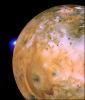
Io-Plumes from Loki-V1-PIA00010_modest.jpgLoki's eruption on Io (the "Plume")65 visiteUn'informazione importante per chi volesse provare a calcolare le dimensioni effettive della "piuma vulcanica" (conoscendo, ovviamente, le dimensioni di Io): l'immagine è stata scattata da (circa) 490.000 Km.
Original caption:"Voyager 1 image of Io showing active plume of Loki on limb. Heart-shaped feature southeast of Loki consists of fallout deposits from active plume Pele. The images that make up this mosaic were taken from an average distance of approximately 490.000 Km (about 340.000 miles)".Ago 26, 2004
|
|
| 325 immagini su 28 pagina(e) |
 |
|
|
|
|
23 | |
|
|
|
|





