| |

| Ultimi arrivi - Jupiter: the "King" and His Moons |

Ganymede-PIA00353~0.jpgGanymede from 2,6 MKM58 visiteThis picture was taken on March 4, 1979 at 2:30 A.M. PST by Voyager 1 from a distance of about 2,6 MKM (such as about 1,6 MMs). Ganymede is Jupiter's largest satellite with a radius of about 2600 Km which means about 1,5 times that of our Moon. Ganymede has a bulk density of only approximately 2,0 g/cc (almost half that of the Moon).
In the light of the above, Ganymede is probably composed of a mixture of rock and ice. The features here, the large dark regions, in the northeast quadrant, and the white spots, resemble features found on the Moon, mare and impact craters respectively. The long white filaments resemble rays associated with impacts on the lunar surface. The various colors of different regions probably represent differing surface materials. There are several dots on the picture of single color (blue, green, and orange) which are the result of markings on the camera used for pointing determinations and are not physical markings.Ago 26, 2004
|
|

Ganymede-PIA00380_modest.jpgGanymede from 250.000 Km57 visiteCaption NASA originale:"This picture of Ganymede, Jupiter's largest satellite, was taken by Voyager 1 on the afternoon of March 5, 1979, from a range of about 250,000 km. The center of the picture is at 60 north latitude and 318 longitude and the distance across the bottom of the photograph is about 1000 km. The smallest features visible in this picture are about 5 km across. This picture shows impact craters many of which display ray systems probably consisting largely of icy material thrown out by the impacts. Peculiar systems of sinuous ridges and grooves traverse the surface and are best seen near the terminator". Ago 26, 2004
|
|

Ganymede-PIA00706.jpgCrescent Ganymede from Galileo55 visiteView of Ganymede from the Galileo spacecraft during its first encounter with the Jovian Satellite. North is to the top of the picture and the Sun illuminates the surface from the right. The finest details that can be discerned in this picture are about 6,7 Km across. It is 8:45:09 UT on June 26, 1996. Ago 26, 2004
|
|
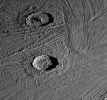
Ganymede-PIA01609.jpgRecent impact craters on Ganymede56 visiteOblique view of two fresh impact craters in bright grooved terrain near the north pole of Jupiter's moon, Ganymede. The craters postdate the grooved terrain since each is surrounded by swarms of smaller craters formed by material which was ejected out of the crater as it formed, and which subsequently reimpacted onto the surrounding surface. The crater to the north, Gula, which is 38 kilometers (km) in diameter, has a distinctive central peak, while the crater to the south, Achelous, (32 km in diameter) has an outer lobate ejecta deposit extending about a crater radius from the rim. Such images show the range of structural details of impact craters, and help in understanding the processes that form them.
North is to the top of the picture and the sun illuminates the surface from the right. The image, centered at 62 degrees latitude and 12 degrees longitude, covers an area approximately 142 by 132 kilometers. The resolution is 175 meters per picture element. The images were taken on April 5, 1997 at 6 hours, 33 minutes, 37 seconds Universal Time at a range of 17,531 kilometers by the Solid State Imaging (SSI) system on NASA's Galileo spacecraft.
Ago 26, 2004
|
|

Ganymede-PIA01610.jpgGanymede's surface detail: a comet fell over there?142 visiteView of a chain of craters named Enki Catena on Jupiter's moon, Ganymede. This chain of 13 craters probably formed by a comet which was pulled into pieces by Jupiter's gravity as it passed too close to the planet. Soon after this breakup, the 13 fragments crashed onto Ganymede in rapid succession. The Enki craters formed across the sharp boundary between areas of bright terrain and dark terrain, delimited by a thin trough running diagonally across the center of this image. The ejecta deposit surrounding the craters appears very bright on the bright terrain. Even though all the craters formed nearly simultaneously, it is difficult to discern any ejecta deposit on the dark terrain. This may be because the impacts excavated and mixed dark material into the ejecta and the resulting mix is not apparent against the dark background.
North is to the bottom of the picture and the sun illuminates the surface from the left. The image, centered at 39 degrees latitude and 13 degrees longitude, covers an area approximately 214 by 217 kilometers. The resolution is 545 meters per picture element. The image was taken on April 5, 1997 at 6 hours, 12 minutes, 22 seconds Universal Time at a range of 27282 kilometers by the Solid State Imaging (SSI) system on NASA's Galileo spacecraft.
Ago 26, 2004
|
|

Ganymede-PIA01618.jpgGanymede's surface (detail mgnf)59 visiteView of the Marius Regio and Nippur Sulcus area of Jupiter's moon, Ganymede showing the dark and bright grooved terrain which is typical of this satellite. This regional scale view was imaged near the terminator (the line between day and night) and provides geologic context for small areas that were imaged at much higher resolution earlier in the tour of NASA's Galileo spacecraft through the Jovian system. The older, more heavily cratered dark terrain of Marius Regio is rutted with furrows, shallow troughs perhaps formed as a result of ancient giant impacts. Bright grooved terrain is younger and is formed through tectonism probably combined with icy volcanism. The lane of grooved terrain in the lower left, Byblus Sulcus, was imaged during the spacecraft's second orbit, as were Philus Sulcus and Nippur Sulcus, seen here in the upper left. Placing the small higher resolution targets of Galileo's second orbit into the context of more distant, lower resolution views of the areas surrounding and connecting them, and imaging them along Ganymede's terminator, allows for an integrated understanding of Ganymede' s geology.
North is to the top left of the picture and the sun illuminates the surface from the lower right. The image, centered at 43 degrees latitude and 194 degrees longitude, covers an area approximately 664 by 518 kilometers. The resolution is 940 meters per picture element. The image was taken on May 7, 1997 at 12 hours, 50 minutes, 11 seconds Universal Time at a range of 92,402 kilometers by the Solid State Imaging (SSI) system on NASA's Galileo spacecraft.
Ago 26, 2004
|
|

Ganymede-PIA00716.jpgGanymede (full disk) from about 3,4 MKM54 visiteThis color picture of Ganymede, Jupiter's largest satellite, was taken on the afternoon of March 2, 1979, by Voyager 1 from a distance of about 3,4 MKM (about 2,1 MMs). This photograph was assembled from 3 black-and-white pictures in the Image Processing Laboratory at JPL. (...)
Ganymede is slightly larger than the planet Mercury but has a density almost three times less than Mercury. Therefore, Ganymede probably consists in large part of ice. At this resolution the surface shows light and dark markings interspersed with bright spots. The large darkish area near the center of the satellite is crossed by irregular light streaks somewhat similar to rays seen on the Moon. The bright patch in the southern hemisphere is reminiscent of some of the larger rayed craters on the Moon caused by meteorite impact.Ago 26, 2004
|
|
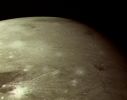
Ganymede-PIA01515.jpgThe North Pole of Ganymede (in real colors)55 visiteThis color picture as acquired by Voyager 1 during its approach to Ganymede on Monday afternoon (the 5th of March). At ranges between about 230 to 250 thousand km. The images show detail on the surface with a resolution of four and a half km. This picture is of a region in the northern hemisphere near the terminator. It shows a variety of impact structures, including both razed and unrazed craters, and the odd, groove-like structures discovered by Voyager in the lighter regions. The most striking features are the bright ray craters which have a distinctly 'bluer' color appearing white against the redder background. Ganymede's surface is known to contain large amounts of surface ice and it appears that these relatively young craters have spread bright fresh ice materials over the surface. Likewise, the lighter color and reflectivity of the grooved areas suggests that here, too, there is cleaner ice. We see ray craters with all sizes of ray patterns, ranging from extensive systems of the crater in the southern part of this picture, which has rays at least 300-500 kilometers long, down to craters which have only faint remnants of bright ejects patterns (such as several of the craters in the southern half of PIA01516; P21262). This variation suggests that, as on the Moon, there are processes which act to darken ray material, probably 'gardening' by micrometeoroid impact. Ago 26, 2004
|
|

Ganymede-PIA02252.jpgGanymede in HR (Voyager 1)54 visiteThis view of Ganymede was taken on the afternoon of March 5, 1979, from a range of about 267.000 Km (roughly 167.000 miles). A bright rayed impact crater is prominent on the left side of the frame. The ejecta material extends for a thousand kilometers. The rays are on top and therefore are younger than the brighter ridged and grooved terrain crossing the picture. These features may be breaks in the surface caused by faulting. Many older craters are visible that have lost their rays.Ago 26, 2004
|
|

Ganymede-V1-PIA02233_modest.jpgGanymede in HR (Voyager 1)55 visiteThis picture of Ganymede was taken on the afternoon of March 5, from a range of about 272.000 Km. The center of the picture lies at 13° Lat. and 359° Long. Many bright impact craters are shown that have radial ejecta patterns. These rays lie across and therefore are younger than the bright and dark background material. Many older impact craters are shown that have lost their rays probably by impact erosion. The bright background areas contain grooves and ridges that may be caused by faulting of the surface materials.Ago 26, 2004
|
|

Ganymede-V1-PIA02278_modest.jpgThe limb of Ganymede (from Voyager 1)54 visiteThis picture of Ganymede, Jupiter's largest satellite, was taken by Voyager 1 on the afternoon of March 5, 1979 from a range of 253.000 Km (about 151.800 miles). The picture is centered at 66° South Latitude and 3° Longitude and shows the south western limb region of Ganymede. The smallest features visible are about 2,5 Km (roughly 1,5 miles) across. The surface shows numerous impact craters, many of which have extensive bright ray systems. Light bands traversing the surface contain alternating bright and dark lines which probably represent deformation of the icy central material.Ago 26, 2004
|
|
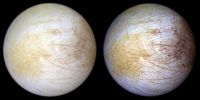
Europa-PIA01295.jpgEuropa in natural colors (Sn) and enhanced colors (Dx)62 visiteThis color composite view combines violet, green, and infrared images of Jupiter's intriguing moon, Europa, for a view of the moon in natural color (left) and in enhanced color designed to bring out subtle color differences in the surface (right). The bright white and bluish part of Europa's surface is composed mostly of water ice, with very few non-ice materials. In contrast, the brownish mottled regions on the right side of the image may be covered by hydrated salts and an unknown red component. The yellowish mottled terrain on the left side of the image is caused by some other unknown component. Long, dark lines are fractures in the crust, some of which are more than 3,000 kilometers (1,850 miles) long.
North is to the top of the picture and the sun fully illuminates the surface. Europa is about 3,160 kilometers (1,950 miles) in diameter, or about the size of Earth's moon. The finest details that can be discerned are 25 kilometers across. The images in this global view were taken in June 1997 at a range of 1.25 million kilometers by the Solid State Imaging (SSI) system on NASA's Galileo spacecraft, during its ninth orbit of Jupiter.
Ago 26, 2004
|
|
| 325 immagini su 28 pagina(e) |
|
|
|
|
|
22 | |
|
|
|
|
|
|





