| Ultimi arrivi - Jupiter: the "King" and His Moons |

Jupiter-HW-PIA00360_modest.jpgHigh Winds on Jupiter (from appx. 4.000.000 Km)56 visiteCaption NASA originale:"A high resolution image of the Jovian mid-latitudes taken by Voyager 1 on March 2, 1979, shows distinctly differing characteristics of the planet's meteorology. The well defined pale orange line running from southwest to northeast (North is at the top) marks the high speed north temperate current with wind speeds of about 120 meters p/s. These high winds produce a cleaner flow pattern in the surrounding clouds whose average lifetime is of about 2 years".Ago 30, 2004
|
|

Jupiter-WO-PIA01513_modest.jpgWhite Ovals on Jupiter53 visiteCaption NASA originale:"This photo of Jupiter was taken by Voyager 1 on March 1st, 1979, from a distance of 4.300.000 Km. The region shown is just to the southeast of the Great Red Spot. A small section of the spot can be seen at upper left. One of the 40-year-old white ovals in Jupiter's atmosphere can also be seen at middle left, as well as a wealth of other atmospheric features, including the flow lines in and around the ovals.
The smallest details that can be seen in this photo are about 80 Km across".Ago 30, 2004
|
|

Jupiter-V1-PIA01518_modest.jpgThe "Plume"55 visiteCaption NASA originale:"Reconstruction of a plume on Jupiter, photographed on March 1st, 1979".
Nota: in questo frangente per "plume" si intende uno 'sbuffo' di nuvole bianche e vaporose le quali si distinguono nettamente dal resto del paesaggio circostante.
L'espressione "plume", di regola, viene invece impiegata per indicare il 'pennacchio' di fumo che caratterizza i vulcani in fase eruttiva (innumerevoli sono, infatti, le "plumes" che vediamo sul piccolo - ma attivissimo! - Io).Ago 30, 2004
|
|

Jupiter-V2-PIA01527_modest.jpgThe "Red Spot" of Jupiter53 visiteCaption NASA originale:"The region of white clouds now extends from east of the Red Spot and around its northern boundary, preventing small cloud vortices from circling the feature. The disturbed region west of the Red Spot has also changed since the equivalent Voyager 1 image. It shows more small scale structure and cloud vortices being formed out of the wave structures. The picture was taken on July 3, 1979, from about 6 MKM".Ago 30, 2004
|
|
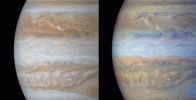
Jupiter-CH-PIA02877_modest.jpgReal Colors and False Colors of Jupiter55 visiteCaption NASA originale:"These color composite frames of the mid-section of Jupiter were of narrow angle images acquired on December 31, 2000, a day after Cassini's closest approach to the planet. The smallest features in these frames are roughly ~ 60 kilometers. The left is natural color, composited to yield the color that Jupiter would have if seen by the naked eye. The right frame is composed of 3 images: two were taken through narrow band filters centered on regions of the spectrum where the gaseous methane in Jupiter's atmosphere absorbs light, and the third was taken in a red continuum region of the spectrum, where Jupiter has no absorptions". Ago 30, 2004
|
|

Jupiter_s Rings-PIA01529_modest.jpgColorful Jupiter's Rings833 visiteCaption NASA originale:"Jupiter's faint ring system is shown in this color composite as two light orange lines protruding from the left toward Jupiter's limb. This picture was taken in Jupiter's shadow through orange and violet filters. The colorful images of Jupiter's bright limb are evidence of the spacecraft motion during these long exposures. The Voyager 2 spacecraft was at a range of 1.450.000 kilometers about two degrees below the plane of the ring. The lower ring image was cut short by Jupiter's shadow on the ring itself".Ago 30, 2004
|
|

Callisto-Asgard emi.-Gal-PIA00562_modest.jpgThe "Asgard" hemisphere of Callisto (detail mgnf)61 visiteCaption NASA originale:"...Dominating the scene is the impact structure, Asgard, centered on the smooth, bright region near the middle of the picture and surrounded by concentric rings up to 1.700 kilometers in diameter. A second ringed structure with a diameter of about 500 kilometers can be seen to the north of Asgard, partially obscured by the more recent, bright-rayed crater, Burr. The icy materials excavated by the younger craters contrast sharply with the darker and redder coatings on older surfaces of this Moon..."Ago 29, 2004
|
|

Callisto-Asgard emisph.-Gal-PIA01100_modest.jpgThe "Asgard" hemisphere of Callisto55 visiteCaption NASA originale:"False color view of a portion of the leading hemisphere of Jupiter's moon Callisto as seen through the infrared filters of the Solid State Imaging (CCD) system aboard NASA's Galileo spacecraft. North is to the top of the picture and the sun illuminates the surface from the east. More recent impacts have excavated bright, relatively clean ice from beneath Callisto's battered surface. Callisto's dark mottled appearance may be due to contamination by non-ice components contributed by impactors or concentrated in a residue as ice is removed".Ago 29, 2004
|
|

Callisto-Chain of craters-PIA00514_modest.jpgA chain of craters on Callisto99 visiteCaption NASA originale:"A portion of a chain of impact craters on Jupiter's moon Callisto is seen in this image taken by the Galileo spacecraft on November 4, 1996. This crater chain on Callisto is believed to result from the impact of a split object, similar to the fragments of Comet Shoemaker-Levy 9 which smashed into Jupiter's atmosphere in July of 1994". Ago 26, 2004
|
|

Callisto-V1-PIA00362_modest.jpgCallisto from 1.200.000 Km (Voyager 1)56 visiteCaption NASA originale:"This color photo of Jupiter's satellite Callisto was made from three black-and-white images taken March 5 from a distance of 746.000 miles (1,2 MKMs).
It shows the entire hemisphere of Callisto that was photographed at HR by Voyager 1 during the close encounter with the satellite. Visible near the upper left limb is the large basin-like structure discovered by Voyager 1. The central region of the basin is much brighter than the average surface of the satellite. Near the south polar region are two bright areas associated with smaller basin-like structures. These bright areas are believed to contain more clean ice than the rest of Callisto's generally 'dirty-ice' surface".Ago 26, 2004
|
|

Callisto-V1-PIA02277_modest.jpgCallisto's basin from Voyager 157 visiteCaption NASA originale:"This picture of a multi=ring basin on Callisto was taken the morning of March 6, 1979, from a distance of about 200.000 Km. The complicated circular structure seen at left center is similar to the large circular impact basins that dominate the surface of the Earth's moon and also the planet Mercury. The inner parts of these basins are generally surrounded by radially lineated ejecta and several concentric mountainous ring structures that are thought to form during the impact event. This multi-ring basin on Callisto consists of light floored central basin some 300 k m in diameter surrounded by at least eight to ten discontinuous rhythmically spaced ridges. No radially lineated ejecta can be seen. The ring structures on Moon and Mercury have been likened to ripples produced on a pond by a rock striking the water. The great number of rings observed around this basin on Callisto is consistent with its low planetary density and probable low internal strength".Ago 26, 2004
|
|

Callisto-full disk-PIA03456_modest.jpgCallisto from Galileo91 visiteCaption NASA originale:"Bright scars on a darker surface testify to a long history of impacts on Jupiter's moon Callisto in this image of Callisto from NASA's Galileo spacecraft.
The picture, taken in May 2001, is the only complete global color image of Callisto obtained by Galileo, which has been orbiting Jupiter since December 1995. Of Jupiter's four largest moons, Callisto orbits farthest from the giant planet.
Callisto's surface is uniformly cratered but is not uniform in color or brightness. Scientists believe the brighter areas are mainly ice and the darker areas are highly eroded, ice-poor material".Ago 26, 2004
|
|
| 325 immagini su 28 pagina(e) |
 |
|
|
|
|
21 | |
|
|
|
|





