| Ultimi arrivi - Jupiter: the "King" and His Moons |

Europa-PIA03002_modest.jpgGeologic evidence of a "liquid" Ocean under Europa's icy surface57 visiteCaption NASA originale:"The image on the left shows a region of Europa's crust made up of blocks which are thought to have broken apart and rafted into new positions. These features are the best geologic evidence to date that Europa may have had a subsurface ocean at some time in its past. Combined with the geologic data, the presence of a magnetic field leads scientists to believe an ocean is most likely present at Europa today. In this false color image, reddish-brown areas represent non-ice material resulting from geologic activity. White areas are rays of material ejected during the formation of the 25-Km diameter impact crater Pwyll (see global view). Icy plains are shown in blue tones to distinguish possibly coarse-grained ice (dark blue) from fine-grained ice (light blue). Long, dark lines are ridges and fractures in the crust, some of which are more than 3.000 Km long. These images were obtained by NASA's Galileo spacecraft during September and December 1996 and February 1997".Gen 12, 2005
|
|
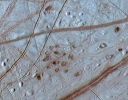
Europa-PIA03878_modest.jpgLenticulae on Europa68 visiteCaption NASA originale:"Reddish spots and shallow pits pepper the enigmatic ridged surface of Europa in this view combining information from images taken by the Galileo spacecraft during 2 orbits. The spots and pits visible in this region of Europa's northern hemisphere are each about 10 Km across. The dark spots are called "lenticulae," the Latin term for freckles. Their similar sizes and spacing suggest that Europa's icy shell may be churning away like a lava lamp, with warmer ice moving upward from the bottom of the ice shell while colder ice near the surface sinks downward. Other evidence has shown that Europa likely has a deep melted ocean under its icy shell. Ruddy ice erupting onto the surface to form the lenticulae may hold clues to the composition of the ocean and to whether it could support life".
Nota Lunexit: Si, la NASA parla di un "profondo oceano liquido" al di sotto della crosta ghiacciata di Europa.
Un oceano "vivo", forse?
Ci chiediamo: ma perchè abbiamo abbandonato questa strada (sempre complessa, ma più vicina e più solida) per andare a cercare "qualcosa" di completamente indefinibile - e per giunta muovendoci alla cieca - su Titano?
Insomma, l'idea del Landing su Titano (attuata) è stata un Grande Passo, ma fermarsi su Europa e guardare meglio era proprio un'idea sbagliata?!?... Misteri della NASA.Gen 12, 2005
|
|

Europa-Lineae-Agenor_Linea.jpgEuropa: the "Agenor Linea"57 visiteCaption NASA originale:"This bright white swath cutting across the surface of icy Jovian moon Europa is known as "Agenor Linea". In all about 1000 Km long and 5 Km wide, only a section is pictured here as part of a combined color and black and white Galileo's images. Most linear features on Europa are dark in color but Agenor Linea is uniquely bright for unknown reasons. Also unknown is the origin of the reddish material along the sides. While these and other details of Europa's surface formations remain mysterious, the general results of Galileo's exploration of Europa have supported the idea that an ocean of liquid water lies beneath the cracked and frozen crust. An extraterrestrial liquid ocean holds out the tantalizing possibility of life". Curioso: alla NASA sono davvero incapaci di fare commenti equilibrati alle immagini che loro stessi propongono. Parlano di "Tantalizing possibility of life" sotto il ghiaccio di Europa, ma sono incapaci di dire che su Marte, forse, esiste qualche forma di vita...Dic 18, 2004
|
|

Jupiter - HST.jpgTriple eclypse on Jupiter (false colors - HST)64 visiteDa "NASA - Picture of the Day" dell'11.11.2004: "This false-color image of banded gas giant Jupiter shows a triple eclipse in progress on March 28 - a relatively rare event, even for a large planet with many moons. Captured by the Hubble Space Telescope's near-infrared camera are shadows of Jupiter's moons Ganymede (left edge), Callisto (right edge) and Io, three black spots crossing the sunlit Jovian cloud tops. In fact, Io itself is visible as a white spot near picture center with a bluish Ganymede above and to the right, but Callisto is off the right hand edge of the scene. Viewed from Jupiter's perspective, these shadow crossings would be seen as solar eclipses, analogous to the Moon's shadow crossing the sunlit face of planet Earth. Historically, timing the eclipses of Jupiter's moons allowed astronomer Ole Roemer to make the first accurate measurement of the speed of light in 1676". Nov 11, 2004
|
|

AA-Jupiter-PIA02666_modest.jpgJupiter from Cassini-Huygens124 visiteJupiter Data and Statistics
Mass (kg) = 1.900e+27
Mass (Earth = 1) = 3,1794e+02
Equatorial radius = 71.492 Km
Equatorial radius (Earth = 1) = 1,1209e+01
Mean density (gm/cm^3) = 1,33
Mean distance from the Sun = 778.330.000 Km
Mean distance from the Sun (Earth = 1) = 5,2028
Rotational period (days) = 0,41354
Orbital period (days) = 4332,71
Mean orbital velocity = 13,07 Km per second
Tilt of axis = 3,13°
Orbital inclination = 1,308°
Equatorial surface gravity (m/sec^2) = 22,88
Equatorial escape velocity = 59,56 Km per second
Magnitude (Vo) = - 2,70
Mean cloud temperature = - 121°C
Atmospheric pressure (bars) = 0,7
Atmospheric composition: Hydrogen 90%; Helium 10%Ott 22, 2004
|
|

Jupiter-water cloud-GAL-PIA01639_modest.jpgWater clouds on Jupiter70 visiteThis false-color picture of a convective thunderstorm 10.000 Km(6.218 miles) northwest of Jupiter's Great Red Spot was obtained by NASA's Galileo spacecraft on June 26, 1996. The white cloud in the center is a tall, thick cloud about 1.000 Km (620 miles) across, standing 25 Km (15 miles) higher than most of the surrounding clouds. Its base extends off to the left and appears red in this representation. This red color indicates that the cloud base is very deep in the atmosphere, about 50 Km (30 miles) below the surrounding clouds. Most of the wisps and features in Jupiter's clouds are thick and thin ammonia clouds, forming at a pressure just less than Earth's sea level pressure. On Jupiter, water is the only substance to form a cloud at a depth where the pressure is about 5 times the Earth's sea level pressure. The red base of this thunderstorm is so deep that it can only be a water cloud. In 1979 NASA's Voyager spacecraft saw convective clouds of this type near the Great Red Spot. They erupted like this roughly once every 10 days and lasted a few days each. But Voyager's cameras could not allow the determination of the storms' altitude. It is thought that this storm is analogous to an Earth thunderstorm, with the cloud's high, bright, white portion comparable to the familiar anvil cloud on Earth. Whether any rain or snow is falling below this cloud is unknown, but there are indications that similar storms on Jupiter have lightning in them. Set 16, 2004
|
|

Jupiter_s Aurora-HST-PIA03155_modest.jpgJupiter's Aurora - HST78 visiteCaption NASA originale:"Auroras are curtains of light resulting from high-energy electrons racing along the planet's magnetic field into the upper atmosphere.
The electrons excite atmospheric gases, causing them to glow.
The image shows the main oval of the aurora, which is centered on the magnetic north pole, plus more diffuse emissions inside the polar cap. The HST image shows also unique emissions from the magnetic "footprints" of 3 of Jupiter's largest moons.
Auroral footprints can be seen in this image from Io (along the lefthand limb), Ganymede (near the center), and Europa (just below and to the right of Ganymede's auroral footprint).
These emissions, produced by electric currents generated by the satellites, flow along Jupiter's magnetic field, bouncing in and out of the upper atmosphere". Set 12, 2004
|
|

Io-sulphur_s role-PIA02547_modest.jpgThe Role of Sulphur in Io's Volcanoes71 visiteCaption NASA originale:"Sulphur gas, consisting of pairs of sulphur atoms (S2) - as detected above Io's volcano Pele by the HST in October 1999 - is ejected from the hot vents of Io's volcanoes (green arrow). Such sulphur gas lands on the cold surface where the sulphur atoms rearrange into molecules of 3 or 4 atoms (S3 and S4) which give the surface a reddish color. In time, the atoms rearrange into their most stable configuration (S8) that forms ordinary pale-yellow sulphur".Set 08, 2004
|
|

Io-Pele plume-PIA02546_modest.jpgThe "sulphuric plume" of Pele61 visiteThis image depicts the discovery of sulfur gas in the plume of the Pele volcano on Jupiter's moon Io, as seen by the Hubble Space Telescope in October 1999, during a flyby of Io by NASA's Galileo spacecraft. The main image shows Io passing in front of Jupiter as seen by Hubble's Wide-Field Planetary Camera (WFPC2) in near-ultraviolet light. The small inset shows that when a WFPC2 image at shorter ultraviolet wavelengths is included in a color composite with the near-ultraviolet image, Io's Pele plume appears as a dark smudge off the edge of Io's disk, silhouetted against Jupiter. The larger inset shows data from Hubble's Space Telescope Imaging Spectrograph, which mapped the composition of Pele's plume by analyzing the ultraviolet light from Jupiter which had passed through the plume. The regions shown in yellow were rich in sulfur gas, which was precisely centered over the Pele volcano, whose position is shown along with the edge of Io's disk.
Set 08, 2004
|
|
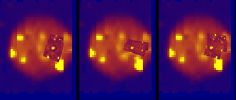
Io-active volcanoes-PIA02558_modest.jpgActive volcanoes on Io in 3 different months56 visiteCaption NASA originale:Changes in the volcanoes on Io can be seen in these 3 views, taken by NASA's Galileo spacecraft during its 3 flybys of Io in October and November 1999 and February 2000. All the images show the active volcanoes as bright yellow, corresponding to hot lava flows that appear glowing in infrared wavelengths. The 3 views were taken by the spacecraft's near-infrared mapping spectrometer and show the comparison of a typical low-resolution observation to the high-resolution views. The Prometheus volcano is seen near the middle of all three images. Before the recent flybys, only Prometheus and three other volcanoes were known to be active in this region. After these and other high-resolution observations, scientists were able to detect 14 volcanoes in the same area. The fainter volcanoes (hot spots) show some significant changes over intervals of 1 to 3 months. The area shown by all three observations put together is about 2 million square kilometers (about 770,000 square miles)".Set 08, 2004
|
|
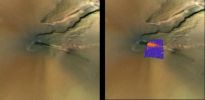
Io-Pele Volcano-PIA02560_modest.jpgThe "Pele" Volcano79 visitePele, one of Io's best-known volcanoes, was observed by the infrared spectrometer, an instrument onboard NASA's Galileo spacecraft, during the flyby of Jupiter's moon Io on February 22, 2000. The temperature map is shown here on the left in false color, superimposed on a visible color image of the Pele region obtained by the Voyager spacecraft in 1979. The red color represents the hottest lava flows. The purple colors are cooler materials. Preliminary results show that the temperatures of the hottest lava flows are at least 1,400 Kelvin (about 2,000 Fahrenheit), consistent with the temperatures of basaltic lava seen on the Kilauea volcano in Hawaii. It is possible that the eruption temperatures at Pele are even higher, as lava cools quickly once it starts to spread over the surface. The Voyager context image is 200 kilometers (124 miles) across.
Set 08, 2004
|
|

Io-hot spots-PIA02589_modest.jpgHot-spots on Io (at night) - edited65 visiteCaption NASA originale:"The left-hand frame shows the best view that Galileo has yet provided of Io's nighttime temperatures. For reference, the right hand frame, based on Galileo camera images, shows the same hemisphere of Io in visible light. The thin bright crescent indicates the only observable portion illuminated by sunlight during the temperature measurements. Several volcanoes are identified on both images: "L-K" is Lei-Kung Fluctus, "L" is Loki, "Pi" is Pillan, "M" is Marduk and "Pe" is Pele".Set 08, 2004
|
|
| 325 immagini su 28 pagina(e) |
 |
|
|
|
|
19 | |
|
|
|
|





