| |

| Ultimi arrivi - Jupiter: the "King" and His Moons |

Europa-PIA02500.jpgFrozen H2SO4 (Sulphuric Acid) on Europa?56 visiteFrozen Sulfuric Acid on Jupiter's moon Europa is depicted in this image produced from data gathered by NASA's Galileo spacecraft. The brightest areas, where the yellow is most intense, represent Regions of high frozen Sulfuric Acid concentration. Sulfuric Acid is found in "exhaust battery acid" and in Earth's acid rain.
This image is based on data gathered by Galileo's NIMS (Near Infrared Mapping Spectrometer).
Europa's Leading Hemisphere is toward the bottom right and there are enhanced concentrations of Sulfuric Acid in the Trailing Side of Europa (the upper left side of the image). This is the face of Europa that is struck by sulfur ions coming from Jupiter's innermost moon, Io. The long, narrow features that criss-cross Europa also show Sulfuric Acid that may be from sulfurous material extruded in cracks.
Galileo, launched in 1989, has been orbiting Jupiter and its moons since December 1995.Ott 20, 2005
|
|
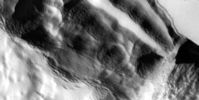
Io-PIA02597.jpgTelegonus Mensa in HR59 visiteA cliff slumps outward in these HR view that NASA's Galileo spacecraft captured of the edge of a mountain named Telegonus Mensa on Jupiter's moon Io. When Galileo flew near the South Pole of Io in October 2001, scientist's targeted this cliff to study the process of erosion. Water and wind cause most erosion on Earth, but Io has neither surface water nor atmosphere. The cliff is slumping due to gravity (?). The picture has a resolution of about 10 mt (33 feet) per picture element. Galileo's camera took it from a distance of about 1000 Km (about 620 miles). North is to the top and the Sun illuminates the surface from the upper right.Ott 20, 2005
|
|

Io-PIA00715.jpgIo: three views of the one and the same55 visiteThree views of the full disk of Jupiter's volcanic moon, Io, each shown in natural and enhanced color. These three views, taken by Galileo in late June 1996, show about 75 percent of Io's surface. North is up. The top disks are intended to show the satellite in natural color (but colors will vary with display devices) while the bottom disks show enhanced color (near-infrared-, green-, and violet-filtered images) to highlight details of the surface. These images reveal that some areas on Io are truly red, whereas much of the surface is yellow or light greenish. (Accurate natural color renditions were not possible from the Voyager images taken during the 1979 flybys because there was no coverage in the red.) The reddish materials may be associated with very recent fragmental volcanic deposits (pyroclastics) erupted in the form of volcanic plumes. Dark materials appear in flows and on caldera floors. Bright white materials correspond to sulfur dioxide frost, and bright yellow materials appear to be in new flows such as those surrounding Ra Patera. The red material may be unstable since the color appears to fade over time. This fading appears to occur most rapidly in the equatorial region and more slowly over the polar regions; surface temperature may control the rate of transformation. Comparisons of these images to those taken by the Voyager spacecraft 17 years ago have revealed that many changes have occurred on Io. Since that time, about a dozen areas at least as large as the state of Connecticut have been resurfaced. Io's diameter is 3632 km. Ott 20, 2005
|
|

Io-PIA00491.jpgIo: five views of the one and the same55 visiteFive color views of Jupiter's moon Io, as seen by NASA's Galileo spacecraft camera, were taken between the 25th and the 29th of June, 1996 Universal Time. The color is a composite of the red, green, and violet filters of the on board imaging system with the brightness of the violet bandpass increased to provide better color discrimination. The full disk images were intended for color mapping of Io's surface and for comparison to Voyager images. Where images overlap several features can be seen to change in relative brightness, perhaps due to unusual light scattering behavior or active phenomena. The crescent images were intended primarily for color imaging of active volcanic plumes on the bright limb and these images showed that the Voyager-era Loki plumes were no longer active and revealed a new plume at Ra Patera. The smallest features which can be discerned in the 5 views range from 9 to 23 kilometers and provide our best look at Io since the 1979 Voyager flybys. Sub-spacecraft longitudes on Io (from upper left to lower right) are 69, 338, 264, 211, and 221 W. North is to the top.
Launched in October 1989, Galileo entered orbit around Jupiter on December 7, 1995. The spacecraft's mission is to conduct detailed studies of the giant planet, its largest moons and the Jovian magnetic environment.
Ott 20, 2005
|
|

Io-PIA00495.jpgAs Time Goes By...On Io!54 visiteVolcanoes on Jupiter's moon Io are compared in these images from Galileo spacecraft (right) taken in early September of 1997 and from the Voyager spacecraft (left) taken in 1979. Prometheus (bright ring in upper right) was first seen as an erupting volcano by the Voyager spacecraft and still features an active plume. A smaller active plume was discovered at the volcano Culann Patera (dark feature at lower left) by the Galileo spacecraft. Prometheus has displayed similar characteristics such as size, shape and brightness to Galileo's cameras as it did to Voyager's. However, several intriguing differences are also apparent. There appears to be a new dark lava flow emanating from the vent of Prometheus, and the plume is now erupting from a position about 75 Km (about 46,5 miles) west from where the hot spot resided in 1979. It is not known if the plume source is the same or if the plume is now emanating from a new source. Overall, scientists studying Galileo images of Io see that a wide variety of surface changes have occurred on Io since 1979. The Galileo image was taken at a range of about 487,000 kilometers (about 302,000 miles) from Io. The Voyager image was taken from about 800,000 kilometers (about 500,000 miles).
Ott 20, 2005
|
|
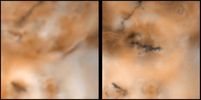
Io-PIA01071.jpgAs Time Goes By...On Io! (2)55 visitenessun commentoOtt 20, 2005
|
|

Io-PIA01070.jpgAs Time Goes By...On Io! (1)59 visiteDetail of changes on Jupiter's moon Io in the Region around Volund as seen by the Voyager 1 spacecraft in April 1979 (left frame) and NASA's Galileo spacecraft in September 1996 (right frame). North is to the top of both frames which are approx. 600 by 600 Km. Note the new linear feature, which may be a volcanic fissure, trending east from the southern end of Volund. Dark diffuse material lies to the west and a ring of bright material which may be SO2- rich plume deposits appears to be centered near the middle of the new linear feature.Ott 20, 2005
|
|
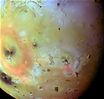
Io-Pele-PIA01112.jpgPele's deposits on Io56 visiteThe varied effects of Ionian volcanism can be seen in this false color infrared composite image of Io's Trailing Hemisphere. LR color data from Galileo's first orbit (June, 1996) have been combined with a HR clear filter picture taken on the third orbit (November, 1996) of the spacecraft around Jupiter. A diffuse ring of bright red material encircles Pele, the site of an ongoing, high velocity volcanic eruption. Pele's plume is nearly invisible, except in back-lit photographs, but its deposits indicate energetic ejection of sulfurous materials out to distances more than 600 Km from the central vent. Another bright red deposit lies adjacent to Marduk, also a currently active ediface. High temperature hot spots have been detected at both these locations, due to the eruption of molten material in lava flows or lava lakes. Bright red deposits on Io darken and disappear within years or decades of deposition, so the presence of bright red materials marks the sites of recent volcanism.Ott 20, 2005
|
|
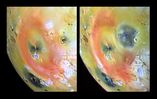
Io-PillanPatera-PIA00744.jpgPillan Patera58 visiteThese images of Jupiter's volcanic moon, Io, show the results of a dramatic event that occurred on the fiery satellite during a five-month period. The changes, captured by the solid state imaging (CCD) system on NASA's Galileo spacecraft, occurred between the time Galileo acquired the left frame, during its seventh orbit of Jupiter, and the right frame, during its tenth orbit. A new dark spot, 400 kilometers (249 miles) in diameter, which is roughly the size of Arizona, surrounds a volcanic center named Pillan Patera. Galileo imaged a 120 kilometer (75 mile) high plume erupting from this location during its ninth orbit. Pele, which produced the larger plume deposit southwest of Pillan, also appears different than it did during the seventh orbit, perhaps due to interaction between the two large plumes. Pillan's plume deposits appear dark at all wavelengths. This color differs from the very red color associated with Pele, but is similar to the deposits of Babbar Patera, the dark feature southwest of Pele. Some apparent differences between the images are not caused by changes on Io's surface, but rather are due to differences in illumination, emission and phase angles. This is particularly apparent at Babbar Patera.
North is to the top of the images. The left frame was acquired on April 4th, 1997, while the right frame was taken on Sept. 19th, 1997. The images were obtained at ranges of 563,000 kilometers (350,000 miles) for the left image, and 505,600 kilometers (314,165 miles) for the right.
Ott 20, 2005
|
|

Io-GalaiPatera-PIA00324.jpgGalai Patera57 visiteIo's volcanic plains are shown in this Voyager 1 image, which spans an area about 1030 km (640 miles) from left to right. North is about the 1:30 position. Numerous volcanic calderas and lava flows are visible here. The brown teardrop-shaped feature at left center is Galai Patera, a 100-km-long (62 mi) lava-flooded caldera (collapsed vent) of a volcano. The composition of Io's volcanic plains and lava flows has not been determined. The prevalent yellow, brown, and orange material may consist dominantly of sulfur with surface frosts of sulfur dioxide or of silicates (such as basalt) encrusted with sulfur and sulfur dioxide condensates. The whitish patches probably are freshly deposited SO2 frost.Ott 20, 2005
|
|

Io-LokiPatera-PIA00320.jpgLoki patera: an everlasting eruption...54 visiteA huge area of Io's volcanic plains is shown in this Voyager 1 image mosaic. Numerous volcanic calderas and lava flows are visible here. Loki Patera, an active lava lake, is the large shield-shaped black feature. Heat emitted from Loki can be seen through telescopes all the way from Earth. These telescopic observations tell us that Loki has been active continuously (or at least every time astronomers have looked) since the Voyager 1 flyby in March 1979. The composition of Io's volcanic plains and lava flows has not been determined, but they could consist dominantly of Sulphur (S) with surface frosts of S dioxide or of silicates (such as basalts) encrusted with S and S dioxide condensates. The bright whitish patches probably consist of freshly deposited SO2 frost. The black spots, including Loki, are probably hot sulfur lava, which may remain molten by intrusions of molten silicate magma, coming up from deeper within Io. The ultimate source of heat that keeps Io active is tidal frictional heating due to the continual flexure of Io by the gravity of Jupiter and Europa, another of Jupiter's satellites.Ott 20, 2005
|
|
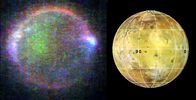
Io-PIA01637.jpgIo's "aurorae"63 visiteThis eerie view of Jupiter's moon Io in eclipse (left) was acquired by NASA's Galileo spacecraft while the moon was in Jupiter's shadow. Gases above the satellite's surface produced a ghostly glow that could be seen at visible wavelengths (red, green and violet). The vivid colors, caused by collisions between Io's atmospheric gases and energetic charged particles trapped in Jupiter's magnetic field, had not previously been observed. The green and red emissions are probably produced by mechanisms similar to those in Earth's polar regions that produce the aurora, or northern and southern lights. Bright blue glows mark the sites of dense plumes of volcanic vapor, and may be places where Io is electrically connected to Jupiter. The viewing geometry is shown in the image on the right. North is to the top of the picture and Jupiter is on the right. The resolution is 13,5 Km (about 8 miles) per picture element. The images were taken on May 31, 1998 at a range of 1,3 MKM (such as about 800.000 miles) by Galileo's onboard solid state imaging camera system during the spacecraft's 15th orbit of Jupiter.
Ott 20, 2005
|
|
| 325 immagini su 28 pagina(e) |
|
|
|
|
|
17 | |
|
|
|
|
|
|





