| Ultimi arrivi - Jupiter: the "King" and His Moons |

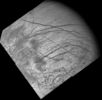
Europa-mosaic-PIA01407.jpgDifferent surface features of Europa57 visite1. Triple bands and dark spots were the focus of some images from Galileo's eleventh orbit of Jupiter. Triple bands are multiple ridges with dark deposits along the outer margins. Some extend for thousands of kilometers across Europa's icy surface. They are cracks in the ice sheet and indicate the great stresses imposed on Europa by tides raised by Jupiter, as well as Europa's neighboring moons, Ganymede and Io. The dark spots or "lenticulae" are spots of localized disruption.
2. The Conamara Chaos region reveals icy plates which have broken up, moved, and rafted into new positions. This terrain suggests that liquid water or ductile ice was present near the surface. On Galileo's twelfth orbit of Jupiter, sections of this region with resolutions as high as 10 meters per picture element will be obtained.
3. Mannann'an Crater is a feature newly discovered by Galileo in June 1996. Color and high resolution images (to 40 meters per picture element) from Galileo's fourteenth orbit of Jupiter will offer a close look at the crater and help characterize how impacts affect the icy surface of this moon.
4. Cilix, a large mound about 1.5 kilometers high, is the center of Europa's coordinate system. Its concave top and what may be flow like features to the southwest of the mound are especially intriguing. The origin of this feature is unknown at present. Color, stereo, and high resolution images (to 65 meters per picture element) from Galileo's fifteenth orbit of Jupiter will offer new insights and resolve questions about its origin.
5. Images of Agenor Linea (white arrow) and Thrace Macula (black arrow) with resolutions as high as 30 meters per picture element will be obtained during Galileo's sixteenth orbit of Jupiter. Agenor is an unusually bright lineament on Europa. Is the brightness due to new ice, and if so, does it represent recent activity? Could the dark region of Thrace Macula be a flow from ice volcanism?
6. Images of Europa's south polar terrain obtained during Galileo's seventeenth orbit of Jupiter will offer insights into the processes which are active in this region. Is the ice crust thicker near Europa's poles than near the equator? The prominent dark line running from upper left to lower right through the center of this image is Astypalaea Linea. It is a fault about the length of the San Andreas fault in California and is the largest such fault known on Europa. Images with resolutions of 48 meters per picture element will be obtained to examine its geologic structure.
7. This long lineament, Rhadamanthys Linea. is spotted with dark "freckles". Are these freckle features formed by icy volcanism? Is this an early form of a triple band? Stereo and high resolution (to 46 meters per picture element) obtained during Galileo's eighteenth orbit of Jupiter may indicate whether the lineament is the result of volcanic processes or is formed by other surface processes.
8. During Galileo's nineteenth orbit of Jupiter, images of Europa will be taken with very low sun illuminations, similar to taking a picture at sunset or sunrise. The object will be to search for backlit plumes issuing from icy volcanic vents. Such plumes would be direct evidence of a liquid ocean beneath the ice. Resolutions will be as high as 40 meters per picture element. This picture was simulated image from Galileo data obtained during the spacecraft's second orbit of Jupiter in September 1996.
North is to the top of the pictures. During orbit 13, the Galileo spacecraft was behind the sun from our vantage point on Earth so it did not obtain or transmit data from that orbit. The left two images in the bottom row were obtained by NASA's Voyager 2 spacecraft in 1979; the remaining images were obtained by the Solid State Imaging (SSI) system on NASA's Galileo spacecraft in 1996.
Ott 21, 2005
|
|
Europa-PIA00295.jpgEuropa: a splendid frame (in Super HD)56 visiteDark crisscrossing bands on Jupiter's moon Europa represent widespread disruption from fracturing and the possible eruption of gases and rocky material from the moon's interior in this four-frame mosaic of images from NASA's Galileo spacecraft. These and other features suggest that soft ice or liquid water was present below the ice crust at the time of disruption. The data do not rule out the possibility that such conditions exist on Europa today. The pictures were taken from a distance of 156,000 kilometers (about 96,300 miles) on June 27, 1996. Many of the dark bands are more than 1,600 kilometers (1,000 miles) long, exceeding the length of the San Andreas fault of California. Some of the features seen on the mosaic resulted from meteoritic impact, including a 30- kilometer (18.5 mile) diameter crater visible as a bright scar in the lower third of the picture. In addition, dozens of shallow craters seen in some terrains along the sunset terminator zone (upper right shadowed area of the image) are probably impact craters. Other areas along the terminator lack craters, indicating relatively youthful surfaces, suggestive of recent eruptions of icy slush from the interior. The lower quarter of the mosaic includes highly fractured terrain where the icy crust has been broken into slabs as large as 30 kilometers (18.5 miles) across. The mosaic covers a large part of the northern hemisphere and includes the north pole at the top of the image. The sun illuminates the surface from the left. The area shown is centered on 20 degrees north latitude and 220 degrees west longitude and is about as wide as the United States west of the Mississippi River.Ott 21, 2005
|
|

Europa-PIA01212.jpgEuropa's terminator108 visiteThis image of Europa was obtained by the Solid State Imaging (CCD) System on board NASA's Galileo spacecraft during its 4th orbit of Jupiter. Linear features with bright central stripes referred to as "Triple Bands" (TB) are seen to transect the surface of Europa. Several of these TBs are over 700 Km in length. In the left side of the image the surface of Europa is seen to be locally pitted and irregular. Ridges less than 100 Km in length are also visible in this Region.
The area seen in this image, centered near 27° South and 300° West, is 760 (456 miles) by 850 Km (510 miles) across, which is approximately the size of the state of Texas or the country of France. North is to the top of the image, with the sun illuminating the surface from the left. The image which has a resolution of 1,3 Km per picture element (e cioè "per pixel") was obtained on December, 19th, 1996.Ott 21, 2005
|
|

Europa-PIA01101.jpgWhen the Sun sets...On Europa57 visiteThis image of Europa was taken by the Galileo spacecraft under "low-Sun" illumination - the equivalent of taking a picture from a high altitude at Sunrise or Sunset. Note that in this image the topography of the terrain is emphasized. Planetary geologists use information from images acquired under a variety of lighting conditions to identify different types of structures and interpret how they formed. For example, the length of the shadow cast by a feature (e.g. a ridge or knob) is indicative of that feature's height. In this recent image, ridges and irregularly shaped knobs ranging in size from 5 Km across down to the limit of resolution (0,44 Km/pixel) can be seen. Measurements from shadow lengths indicate that features in this image range from tens of meters up to approx. 100 mt in height. The Galileo spacecraft acquired this image of Europa's surface during its 3rd orbit around Jupiter. The image covers an area of approx. 40 by 75 Km, centered near 10° South and 190° West.Ott 21, 2005
|
|

Europa-PIA00578.jpgIce "floes" on Europa59 visiteJupiter's moon Europa, as seen in this image taken June 27, 1996 by NASA's Galileo spacecraft, displays features in some areas resembling ice floes (--->banchise) seen in Earth's Polar Seas. Europa has an icy crust that has been severely fractured, as indicated by the dark linear, curved, and wedged-shaped bands seen here. These fractures have broken the crust into plates as large as 30 Km (approx. 18,5 miles) across. Areas between the plates are filled with material that was probably icy slush contaminated with rocky debris. Some individual plates were separated and rotated into new positions. Europa's density indicates that it has a shell of water ice thicker than 100 Km, parts of which could be liquid. Currently, water ice could extend from the surface down to the rocky interior, but the features seen in this image suggest that motion of the disrupted icy plates was lubricated by soft ice or liquid water below the surface at the time of disruption. This image covers part of the Equatorial Region of Europa.Ott 21, 2005
|
|

Europa-Ice_Floes-PIA00291.jpgThe typical "surface features" of Europa59 visiteJupiter's moon Europa, as seen in this image taken June 27, 1996 by NASA's Galileo spacecraft, displays features in some areas resembling ice floes seen in Earth's polar seas. Europa, about the size of Earth's moon, has an icy crust that has been severely fractured, as indicated by the dark linear, curved, and wedged-shaped bands seen here. These fractures have broken the crust into plates as large as 30 kilometers (18.5 miles) across. Areas between the plates are filled with material that was probably icy slush contaminated with rocky debris. Some individual plates were separated and rotated into new positions. Europa's density indicates that it has a shell of water ice as thick as 100 kilometers (about 60 miles), parts of which could be liquid. Currently, water ice could extend from the surface down to the rocky interior, but the features seen in this image suggest that motion of the disrupted icy plates was lubricated by soft ice or liquid water below the surface at the time of disruption. This image covers part of the equatorial zone of Europa and was taken from a distance of 156,000 kilometers (about 96,300 miles) by the solid-state imager camera on the Galileo spacecraft. North is to the right and the sun is nearly directly overhead. The area shown is about 360 by 770 kilometers (220-by-475 miles or about the size of Nebraska), and the smallest visible feature is about 1.6 kilometers (1 mile) across.Ott 21, 2005
|
|
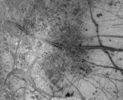
Europa-Craters-Unnamed_Crater-PIA00294.jpgFresh features on Europa56 visiteA newly discovered impact crater can be seen just right of the center of this image of Jupiter's moon Europa returned by NASA's Galileo spacecraft camera. The crater is about 30 kilometers (18.5 miles) in diameter. The impact excavated into Europa's icy crust, throwing debris (seen as whitish material) across the surrounding terrain. Also visible is a dark band, named Belus Linea, extending east-west across the image. This type of feature, which scientists call a 'triple band,' is characterized by a bright stripe down the middle. The outer margins of this and other triple bands are diffuse, suggesting that the dark material was put there as a result of possible geyser-like activity which shot gas and rocky debris from Europa's interior. The curving 'X' pattern seen in the lower left corner of the image appears to represent fracturing of the icy crust and infilling by slush which froze in place. The crater is centered at about 2 degrees north latitude by 239 degrees west longitude. The image was taken from a distance of 156,000 kilometers (about 96,300 miles) on June 27, 1996, during Galileo's first orbit around Jupiter. The area shown is 860 by 700 kilometers (530 by 430 miles), or about the size of Oregon and Washington combined.Ott 21, 2005
|
|

Europa-PIA00366.jpgEuropa: computer mosaic from Voyager 257 visiteEuropa looks like a cracked egg in this computer mosaic of the best Voyager 2 images. In this presentation, the variation of surface brightness due to the angle of the sun has been removed by computer processing, so that surface features can be seen equally well at all places. The many broad dark streaks show up well, but this presentation does not bring out the much fainter and more enigmatic light streaks. These pictures were taken from a distance of about 250.000 Km and show features as small as 5 Km across.Ott 21, 2005
|
|

Europa-PIA00723.jpgBeautiful Europa...54 visiteThis global view of Europa shows the location of a four-frame mosaic of images taken by NASA's Galileo spacecraft, set into low-resolution data obtained by the Voyager spacecraft in 1979. Putting new data into its surrounding context is a technique that allows scientists to better understand features observed on planetary surfaces. The Galileo spacecraft obtained these images during its first orbit of Jupiter at a distance of about 156.000 km (such approx. 96.300 miles) on June 27, 1996. The finest details that can discerned in this picture are about 1,6 Km (1 mile) across. North is to the top.Ott 21, 2005
|
|

Ganymede-PIA00496.jpgFrost on crater-tops of Ganymede58 visiteScientists believe that water-ice frosts are the likely cause for the brightening seen around the circular rims of these craters located at a high northern latitude (57°) on Jupiter's moon Ganymede in this image taken by NASA's Galileo spacecraft on September 6, 1996. The image shows the same kind of bright, high-latitude surface areas as those first seen by the Voyager 1 spacecraft in 1979, but at higher resolution (this image spans about 18 Km - or 11 miles on a side). Even though the Sun is shining from the south, the north-facing walls of the ridges and craters are brighter than the walls facing the Sun. This is interpreted to mean that the very bright north-facing slopes are covered with surface water-ice frosts, and that these frosts preferentially accumulate in such high-latitude locations.
Galileo scientists say that at the HR seen in Galileo images, the high-latitude brightness seen by Voyager 1 might be partly attributable to frosts forming on cooler, north-facing slopes. The right-hand side of the image is dominated by a north-south line of impact craters; the smallest ones at the top are about 2 kilometers (1.2 miles) in diameter and the large one at the bottom is about 5 kilometers (about 3 miles) in diameter. Ganymede is the largest moon in the solar system, larger than the planet Mercury and nearly the size of Mars.Ott 20, 2005
|
|

Ganymede-PIA00707.jpgFine details of Ganymede icy-surface57 visiteDramatic view of fine details in ice hills and valleys in an unnamed region on Jupiter's moon Ganymede. North is to the top of the picture and the sun illuminates the surface from the left. The finest details that can be discerned in this picture are only 11 mt across (similar to the size of an average house) some 2000 times better than previous images of this region. The bright areas in the left hand version are the sides of hills facing the sun; the dark areas are shadows. In the right hand version the processing has been changed to bring out details in the shadowed regions that are illuminated by the bright hillsides. The brightness of some of the hillsides is so high that the picture elements "spill over" down the columns of the picture. The image was taken on June 28, 1996 from a distance of about 1000 Km. Ott 20, 2005
|
|

Europa-Craters-Tyre_Crater-PIA00702.jpgTyre Crater (False Colors; credits for the additional process. and color.: NASA/JPL)56 visiteThis feature on Europa was seen as a dark, diffuse circular patch on a previous Galileo global image of Europa's Leading Hemisphere on April 3, 1997. The "bulls-eye" pattern appears to be a 140- Km-wide impact scar (about the size of the island of Hawaii) which formed as the surface fractured minutes after a mountain-sized asteroid or comet slammed into the satellite. This approx. 214-Km-wide picture is the product of 3 images which have been processed in false color to enhance shapes and compositions. North is toward the top of this picture, which is illuminated from sunlight coming from the West. This color composite reveals a sequence of events which have modified the surface of Europa. The earliest event was the impact which formed the Tyre structure at 34° North Latitude and 146,5° West Longitude. The impact was followed by the formation of the reddish lines superposed on Tyre. The red color designates areas that are probably a dirty water ice mixture. The fine blue-green lines crossing the region from west to east appear to be ridges which formed after the crater.Ott 20, 2005
|
|
| 325 immagini su 28 pagina(e) |
 |
|
|
|
|
16 | |
|
|
|
|





