| Ultimi arrivi - Jupiter: the "King" and His Moons |

Jupiter-PIA02865-3.JPGJupiter's clouds - 890 nnmts filter59 visiteTo the North-West (above and to the left) of the dark feature is a small cloud that is bright in the 619-nnmts image but has no contrast at the other wavelengths. This is the signature expected for a thick water cloud. Another feature seen only in the weak-methane ratio is a dark ring near the center of the image.
This feature is probably a counter-clockwise rotating, upwelling core surrounded by a sinking perimeter with diminished cloudiness. The fact that it is seen only in the weak methane ratio indicates the effects of a lower-level circulation that does not penetrated to the upper ammonia cloud level and may be confined to the deeper water cloud.
The opposite behavior is evident in an oval storm that appears dark in 727 and 890 nnmts images, but is absent in the weak 619-nnmts frame. It is located to the South-West of the Great Red Spot. Further to the West - at slightly more Northerly Latitudes - are a series of small spots that are dark at all wavelengths.
These and a myriad of other contrast features at many latitudes reveal much about Jupiter's complicated cloud structure and meteorology.Gen 03, 2006
|
|

Jupiter-PIA02865-2.JPGJupiter's clouds - 727 nnmts filter58 visiteAll the already mentined Jovian features have also been seen from ground-based telescopes, from NASA's HST and from NASA's Galileo spacecraft.
Chief among these features is the very dark patch seen in the weak methane image (619 nnmts) near the top-middle of the frame.
It is almost invisible in the next image (890 nnmts) and it appears to be composed of strands of bright clouds in this frame (727 nnmts).
This is a Region similar to the "hot spot" where the Galileo Probe entered Jupiter's atmosphere in 1995.
These images indicate that cloud cover is present at the higher altitudes but absent from the lower altitudes and this is also what the Galileo Probe found when it entered Jupiter's atmosphere.Gen 03, 2006
|
|
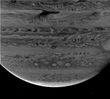
Jupiter-PIA02865-1.JPGJupiter's clouds - 619 nnmts filter56 visiteThe images shown here demonstrate the power of these filters in studies of cloud stratigraphy. The images cover latitudes from about 15° North at the top down to the Southern Polar Region at the bottom. (...)
The most prominent feature seen in all 3 filters is the Polar Stratospheric Haze that makes Jupiter bright near the Pole. The equatorial band is also very bright in the strong 890-nnmts image and to a lesser extent in the 727 band, but is subdued in the weak 619-nnmts image. These are high, thin, haze layers that are nearly transparent at wavelengths outside the methane absorption bands.
Another prominent feature is the Great Red Spot: about a third of it appears at the right-hand edge of the frame.
It is a bright feature in methane absorption because it has extensive cloud cover reaching to high altitude.
A wisp of high thin cloud can be seen trailing off its western rim in the 2nd and 3rd image.Gen 03, 2006
|
|

Jupiter-PIA02880.jpgThe "Heat" of Jupiter56 visiteOriginal caption:"These images taken through the wide angle camera near closest approach in the deep near-infrared methane band, combined with filters which sense electromagnetic radiation of orthogonal polarization, show that the light from the Poles of Jupiter is "polarized".
That is, the Poles appear bright in one image, and dark in the other. Polarized light is most readily scattered by aerosols. These images indicate that the aerosol particles at Jupiter's Poles are small and likely consist of aggregates of even smaller particles, whereas the particles at the Equator and covering the Great Red Spot are larger.
Images like these will allow scientists to ascertain the distribution, size and shape of aerosols, and consequently, the distribution of heat, in Jupiter's atmosphere".Gen 03, 2006
|
|

Jupiter-PIA02873.jpgJupiter, from Cassini56 visiteOriginal caption:"This true-color simulated view of Jupiter is composed of 4 images taken by NASA's Cassini spacecraft on December 7, 2000. To illustrate what Jupiter would have looked like if the cameras had a field-of-view large enough to capture the entire Planet, the cylindrical map was projected onto a globe. The resolution is about 144 Km (about 89 miles) per pixel. Jupiter's moon Europa is casting the shadow on the Giant Gas Planet".Gen 03, 2006
|
|

Jupiter-1994-33-a-full_jpg.jpgJupiter in natural colors, after being struck by Shoemaker-Levy 958 visiteThis image of the giant planet Jupiter, by NASA's HST, reveals the impact sites of fragments "D" and "G" from Comet Shoemaker-Levy 9.
The large feature was created by the impact of fragment "G" on July 18, 1994 at 3:28 a.m. EDT. It entered Jupiter's atmosphere from the south at a 45° angle and the resulting ejecta appears to have been thrown back along that direction. The smaller feature to the left of the fragment "G" impact site was created on July 17, 1994, at 7:45 a.m. EDT by the impact of fragment "D".
This image was taken 1h and 45' after fragment "G" impacted the Planet. The "G" impact has concentric rings around it, with a central dark spot that is about 2.500 Km in diameter. Such a dark spot is surrounded by a thin, dark, ring whose diameter is roughly 7.500 Km.
Last (but not least...), the dark, thick, outermost ring's inner edge has a diameter of approx. 12.000 Km (the size of Earth...).
The impact sites are located in Jupiter Southern Hemisphere at a latitude of about 44°.Nov 03, 2005
|
|

Jupiter-1994-35-a-web_print.jpgJupiter in ultraviolet light, after being struck by Shoemaker-Levy 957 visiteUltraviolet image of Jupiter taken by the Wide Field Camera of the HST. The image shows Jupiter's atmosphere at a wavelength of 2550 Angstroms after many impacts by fragments of comet Shoemaker-Levy 9. The most recent impactor is fragment R which is below the center of Jupiter (third dark spot from the right). This photo was taken 3:55 EDT on July 21, 1994, about 2,5 hours after R's impact. A large dark patch from the impact of fragment H is visible rising on the morning (left) side. Proceeding to the right, other dark spots were caused by impacts of fragments Ql, R, D and G (now one large spot) and L, with L covering the largest area of any seen thus far.
The spots are all very dark in ultraviolet light because - we think - a large amount of dust, right after the impacts, was being deposited on the upper layers of Jupiter stratosphere - and dust absorbs Sunlight.
The dark, round spot just above the center of Jupiter is the moon "Io".Nov 03, 2005
|
|
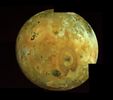
Io-PIA02294.jpgIo: full disk, from about 400.000 Km54 visitePerhaps the most spectacular of all the Voyager photos of Io is this mosaic obtained by Voyager 1 on March 5, 1979, at a range of 400.000 Km (approx.). A great variety of color and albedo is seen on the surface, now thought to be the result of surface deposits of various forms of Sulfur and Sulfur Dioxide. The two great volcanoes Pele and Loki (upper left) are prominent.Ott 21, 2005
|
|
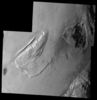
Io-PIA02555.jpgShamshu Mons and Patera from 34.500 Km54 visiteThis mosaic of images taken by NASA's Galileo spacecraft on February 22, 2000 shows 3 mountains and two lava-filled depressions in the Shamshu Region of Io. The dark oval feature on the left side is a depression that has been resurfaced by lava flows. The rough terrain North-East of the depression is Shamshu Mons. A 10-Km (6-mile) wide canyon oriented in North-East to South-West direction cuts this mountain. The northwestern edge of the mountain has been scalloped by erosion and it appears that the material has flowed along the canyon floor. Portions of 2 more mountains can be seen on the right side. The depression between these mountains is Shamshu Patera, a volcanic hotspot. The dark patches within it are recent and active lava flows. The northernmost edge of Shamshu Patera appears to be cutting into the mountain to its northeast. North is to the top of the picture and the Sun illuminates the surface from the West. This mosaic has a resolution of about 345 mt/pixel and covers an area of about 390x380 Km.Ott 21, 2005
|
|

Europa-PIA01144.jpgCold, cold world...54 visiteThis infrared image of Europa, showing heat radiation from its surface at a wavelength of 27 microns (millionths of a meter), provides the best view yet of Europa's daytime temperatures. Temperatures, derived from the brightness of the infrared radiation, can be determined from the colors by reference to the scale at the bottom of the image. The image, taken by Galileo spacecraft, shows the full disk of Europa, highly distorted by the relative motion of Europa and the spacecraft, centered on longitude 190°, with North at the top. The data show that midday temperatures at Europa's Equator reach about 130° Kelvin (-225 F). The surface is even colder toward the Poles and before or after midday.
Small patches of different colors on Europa's disk show regions that are warmer or cooler than their immediate surroundings: the warm patches are generally relatively dark and thus absorb more sunlight, than neighboring Regions, while the cool patches are relatively bright. In the lower left corner, heat radiation from Jupiter itself, appearing orange-red in this representation, can be seen peeking out from behind Europa's disk.
The image was taken with Galileo's PPR (Photopolarimeter-Radiometer) instrument on the spacecraft's seventh orbit around Jupiter, from a range of about 65,000 kilometers (40,389 miles). Surface temperatures derived from the strength of infrared radiation, as was done here, are called "brightness temperatures", and may be slightly in error.
The PPR instrument builds up an image by slowly scanning across the target over a period of up to one hour. The motion of Galileo relative to Europa during this time causes distortions in the satellite shape on the image, which therefore does not appear circular. The small overlapping circles that make up the image show the size of the area, about 160 kilometers (99 miles) across, covered by each individual PPR measurement. Blue spots in the dark sky in the right-hand portion of the image are due to noise.
Ott 21, 2005
|
|

Europa-PIA01405.jpgDark Region on Europa54 visiteThis view taken by NASA's Galileo spacecraft of Jupiter's icy moon Europa focuses on a dark, smooth Region whose center is the lowest area in this image. To the West (left), it is bounded by a cliff and terraces, which might have been formed by normal faulting. The slopes toward the East (right) leading into the dark spot are gentle. Near the center of the dark area, it appears the dark materials have covered some of the bright terrain and ridges. This suggests that when the dark material was deposited, it may have been a fluid or an icy slush. Only a few impact craters are visible, with some of them covered or flooded by dark material. Some appear in groups, which may indicate that they are secondary craters formed by debris excavated during a larger impact event. A potential source for these is the nearby crater Mannann`an.
North is to the top of the picture which is centered at 1° South Latitude and 225° West Longitude. The images in this mosaic have been re-projected to 50 mt/pixel. Ott 21, 2005
|
|

Europa-PIA01404.jpgConamara Chaos Region (HR)54 visiteThis HR view of the Conamara Chaos Region on Jupiter's moon Europa, reveals craters which range in size from about 30 to over 450 mt (slightly over 1/4 of a mile) in diameter. The large number of craters seen here is unusual for Europa. This section of Conamara Chaos lies inside a bright ray of material which was ejected by the large impact crater, Pwyll, about 1000 Km (620 miles) to the South. The presence of craters within the bright ray suggests that many are secondaries which formed from chunks of material that were thrown out by the enormous energy of the impact which formed Pwyll. North is to the upper right of the picture and the Sun illuminates the surface from the East. The image, centered at 9° Latitude and 274° Longitude, covers an area of approx. 8 by 4 Km (such as about 5 by 2,5 miles). The finest details that can be discerned in this picture are about 20 mt (66 feet) across. The images were taken on December 16, 1997 from a distance of 960 Km from Europa.Ott 21, 2005
|
|
| 325 immagini su 28 pagina(e) |
 |
|
|
|
|
15 | |
|
|
|
|





