| Ultimi arrivi - Jupiter: the "King" and His Moons |

Callisto-HR-01.jpgCallisto: North Pole and Northern Hemisphere (HR) - detail mgnf118 visitenessun commentoAgo 29, 2006
|
|

Callisto-HR-00.jpgCallisto: the full disk (HR)55 visitenessun commentoAgo 29, 2006
|
|

Jupiter-02.jpgJupiter's Magnetic Fields60 visitenessun commentoAgo 10, 2006
|
|

Jupiter-01.jpgWhat's inside Jupiter?58 visitenessun commentoAgo 10, 2006
|
|

Jupiter-00.jpgJupiter (natural colors)59 visitenessun commentoAgo 10, 2006
|
|

Jupiter-Storms.jpgColliding "Spots"58 visiteCaption NASA originale:"Two storms systems larger than Earth are nearly colliding right now on planet Jupiter. No one was sure what would happen, but so far both storms have survived. In the above false-color infrared image taken last week by the Gemini Observatory in Hawaii, the red spots appear white because their cloud tops tower above other clouds. Blue color represents lower clouds than white, while clouds colored red are the deepest. The smaller red spot, sometimes called Red Spot Jr. or just Oval BA, turned red earlier this year for reasons unknown. If both Jovian hurricanes continue to survive, they will surely pass near each other again in a few years since they revolve around Jupiter at different rates. Astronomers will continue to monitor Red Spot Jr. closely, however, to see if it will remain red when it rotates away from the larger Great Red Spot".Lug 25, 2006
|
|

Jupiter-2006-19-d-xlarge_web.jpgFather and Son: Jupiter's Red Spots62 visitenessun commentoMag 05, 2006
|
|

Jupiter-2006-19-b-full_jpg.jpgJupiter's Red Spot Jr. and the surrounding "swirls"58 visitenessun commentoMag 05, 2006
|
|

Jupiter~1.jpgThe "Eyes" of Jupiter: a change of colors could mean a climate change?55 visiteJupiter's Great Red Spot is a swirling storm seen for over 300 years, since the beginning of telescopic observations. But in February 2006, planetary imager Christopher Go noticed it had been joined by Red Spot Jr - formed as smaller whitish oval-shaped storms merged and then developed the remarkable reddish hue. This sharp HST image showing the two salmon-colored Jovian storms was recorded in April 2006. About half the size of the original Red Spot, Red Spot Jr. is similar in diameter to planet Earth. Seen here below and left of the ancient storm system, it trails the Great Red Spot by about an hour as the planet rotates from left to right. While astronomers still don't exactly understand why Jupiter's red spots are red, they do think the appearance of Red Spot Jr. provides evidence for climate change on the Solar System's ruling Gas Giant.Mag 05, 2006
|
|

Europa-PIA01126.jpgEuropa's Lanscape (HR)57 visiteThis mosaic shows some of the highest resolution images obtained by the Solid State Imaging (SSI) System on NASA's Galileo spacecraft during its 11th orbit around Jupiter. North is to the top of the image. The Sun illuminates the scene from the left, showing hundreds of ridges that cut across each other, indicating multiple episodes of ridge formation either by volcanic or tectonic activity within the ice. Also visible in the image are numerous isolated mountains or "massifs". The highest of these, located in the upper right corner and lower center of the mosaic, are approx. 500 mt (about 1.640 feet) high. Irregularly shaped areas where the ice surface appears to be lower than the surrounding plains (e.g., in the left-center and lower left corner of the mosaic) may be related to the "chaos" areas of iceberg-like features seen in earlier SSI images of Europa.
The mosaic, centered at 35,4° North Lat. and 86,8° West Long., covers an area of 108 by 90 Km (about 66 x 55 miles).
The smallest distinguishable features in the image are about 68 meters (223 feet) across. These images were obtained on November 6, 1997, when the Galileo spacecraft was approximately 3,250 kilometers (1,983 miles) from Europa.Apr 24, 2006
|
|
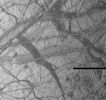
Europa-Ridges-PIA00518.jpgRidges on Europa55 visiteThis view of Jupiter's moon Europa shows a portion of the surface that has been highly disrupted by fractures and ridges. This picture covers an area about 238 Km (approx. 150 miles) wide by 225 Km (about 140 miles); in other words, the distance between Los Angeles and San Diego. Symmetric ridges in the dark bands suggest that the surface crust was separated and filled with darker material, somewhat analogous to spreading centers in the ocean basins of Earth. Although some impact craters are visible, their general absence indicates a youthful surface. The youngest ridges, such as the two features that cross the center of the picture, have central fractures, aligned knobs, and irregular dark patches. These and other features could indicate cryovolcanism, or processes related to eruption of ice and gases.
This picture, centered at 16° South Lat. and 196° West Long., was taken at a distance of 40.973 Km (about 25.290 mi) on November 6, 1996, by the Galileo spacecraft Solid State Imaging Television Camera.Apr 24, 2006
|
|

Europa-PIA01401.jpgThe frozen Ocean of Europa56 visiteThis complex area on the side of Europa which faces away from Jupiter shows several types of features that are formed by disruptions of Europa's icy crust. North is to the top of the image, taken by NASA's Galileo spacecraft, and the Sun illuminates the surface from the left. The prominent wide, dark bands are up to 20 Km (about 12 miles) wide and over 50 Km (appx. 30 miles) long. They are believed to have formed when Europa's icy crust fractured, separated and filled in with darker, "dirtier" ice or slush from below. A relatively rare type of feature on Europa is the 15-Km-diameter (about 9,3-mile) impact crater in the lower left corner. The small number of impact craters on Europa's surface is an indication of its relatively young age. A region of chaotic terrain south of this impact crater contains crustal plates which have broken apart and rafted into new positions. Some of these "ice rafts" are nearly 1 Km (about 1/2 a mile) across.
Other regions of chaotic terrain are visible and indicate heating and disruption of Europa's icy crust from below. The youngest features in this scene are the long, narrow cracks in the ice which cut across all other features. One of these cracks is about 30 kilometers (18 miles) to the right of the impact crater and extends for hundreds of miles from the top to the bottom of the image.Apr 24, 2006
|
|
| 325 immagini su 28 pagina(e) |
 |
|
|
|
|
13 | |
|
|
|
|





