| Ultimi arrivi - Jupiter: the "King" and His Moons |

Io-022707_Erupt_on_Io.jpgRestless Tvashtar56 visiteThe first images returned to Earth by New Horizons during its close encounter with Jupiter feature the Galilean moon Io, snapped with the Long Range Reconnaissance Imager (LORRI) at 0840 UTC on February 26, while the moon was 2,5 MMs (about 4 MKM) from the spacecraft.
Io is intensely heated by its tidal interaction with Jupiter and is thus extremely volcanically active. That activity is evident in these images, which reveal an enormous dust plume, more than 150 miles high, erupting from the volcano Tvashtar. The plume appears as an umbrella-shaped feature of the edge of Io's disk in the 11 o'clock position in the right image, which is a long-exposure (20-millisecond) frame designed specifically to look for plumes like this. The bright spots at 2 o'clock are high mountains catching the setting sun; beyond them the night side of Io can be seen, faintly illuminated by light reflected from Jupiter itself.
The left image is a shorter exposure — 3 milliseconds — designed to look at surface features. In this frame, the Tvashtar volcano shows as a dark spot, also at 11 o'clock, surrounded by a large dark ring, where an area larger than Texas has been covered by fallout from the giant eruption.
This is the clearest view yet of a plume from Tvashtar, one of Io's most active volcanoes. Ground-based telescopes and the Galileo Jupiter orbiter first spotted volcanic heat radiation from Tvashtar in November 1999, and the Cassini spacecraft saw a large plume when it flew past Jupiter in December 2000. The Keck telescope in Hawaii picked up renewed heat radiation from Tvashtar in spring 2006, and just two weeks ago the Hubble Space Telescope saw the Tvashtar plume in ultraviolet images designed to support the New Horizons flyby.
The New Horizons images of the plume — which show features as small as 20 Km (12 miles), are 12 times sharper than the HST images and about three times sharper than the Cassini images. "This is the best image of a large volcanic plume on Io since the Voyager flybys in 1979" says John Spencer, deputy leader of the New Horizons Jupiter Encounter Science Team from Southwest Research Institute.
"If the Tvashtar plume remains active, the images we take later in the encounter should be even better".Mar 01, 2007
|
|

Jupiter-NO-00-022807_3.jpgJupiter! (after New Horizons' Fly-By)56 visitenessun commentoMareKromiumFeb 28, 2007
|
|

Jupiter-021307_JKdk3.jpgJupiter, from New Horizons59 visiteCaption NASA:"This image of Jupiter is produced from a 2x2 mosaic of photos taken by the New Horizons Long Range Reconnaissance Imager (LORRI), and assembled by the LORRI Team at the Johns Hopkins University Applied Physics Laboratory.
The telescopic camera snapped the images during a 3', 35" span on February 10, 2007, when the spacecraft was about 29 MKM (approx. 18 MMs) from Jupiter.
At this distance, Jupiter's diameter was 1015 LORRI pixels - nearly filling the imager's entire (1,024-by-1,024 pixel) field of view.
Features as small as 290 Km (about 180 miles) are visible.
Both the Great Red Spot and Little Red Spot are visible in the image, on the left and lower right, respectively. The apparent "storm" on the Planet's right limb is a section of the South Tropical Zone that has been detached from the Region to its West (or left) by a "disturbance" that scientists and amateur astronomers are watching closely.
At the time LORRI took these images, New Horizons was 820 million kilometers (510 million miles) from home - nearly 5½ times the distance between the Sun and Earth. This is the last full-disk image of Jupiter LORRI will produce, since Jupiter is appearing larger as New Horizons draws closer, and the imager will start to focus on specific areas of the planet for higher-resolution studies".MareKromiumFeb 18, 2007
|
|

PSP_002162_9030_RED_browse.jpgJupiter from Mars57 visiteCaption NASA:"The HiRISE camera is the most powerful telescope to have left Earth orbit. As such, it is capable of some interesting astronomical observations.
This image of Jupiter and its major satellites was acquired to calibrate the pointing and color response of the camera. An oversight in planning this unusual observation put the focus mechanism in the wrong location, blurring the image. This does not detract from the calibration objectives, but makes the raw image less esthetic.
To compensate, the image has been "sharpened" on the ground by Dennis Gallagher, the HiRISE chief optical designer. With this sharpening, and because Mars is closer to Jupiter than Earth is, this image has comparable resolution as the HST's pictures of Jupiter.
The colors are not what is seen by the human eye because HiRISE is able to detect light with a slightly longer wavelength than we can (that is, the infrared)".MareKromiumFeb 05, 2007
|
|
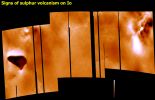
Io-Sulphur_Volcanism-Original_NASA_Galileo.jpgRecent Sulphur Volcanism on Io (natural colors)55 visitenessun commentoGen 17, 2007
|
|

IO_-_TRUE_COLOR_FROM_GALILEO.jpgIo: the World of Sulphur64 visitenessun commentoMareKromiumGen 01, 2007
|
|

Io-SouthernLimbandlight-PIA02250.jpgThe Southern limb of Io59 visitenessun commentoMareKromiumDic 28, 2006
|
|

Io-Tohill-Scarp-00.jpgThe mysterious Tohill Mons and Patera (1) - natural colors55 visitenessun commentoDic 27, 2006
|
|

Io-Tohill-Scarp-01.jpgThe mysterious Tohill Mons and Patera (2) - natural colors55 visitenessun commentoDic 27, 2006
|
|

Jupiter_from_New_Horizons-092606_1_hr.jpgJupiter, from New Horizons72 visiteBlazing along its path to Pluto, NASA's New Horizons has come within hailing distance of Jupiter. The first picture of the Giant Planet from the spacecraft's Long Range Reconnaissance Imager (LORRI), taken Sept. 4, 2006, is a tantalizing promise of what's to come when New Horizons flies through the Jupiter system early next year.
New Horizons was still 291 MKM (nearly 181 MMs) away from Jupiter when LORRI took the photo.
As New Horizons comes much closer, next January and February 2007, LORRI will take more-detailed images.
"These first LORRI images of Jupiter are awe-inspiring," says New Horizons Project Scientist Hal Weaver, of the Johns Hopkins University Applied Physics Laboratory (APL), where LORRI was designed and built. "New Horizons is speeding toward this majestic planet at 45,000 miles per hour, right on target for a close encounter on February 28 of next year. LORRI's resolution at Jupiter will be 125 times better than now, and we're really looking forward to getting the most detailed views of the Jovian system since Cassini's flyby in late 2000 and Galileo's final images in 2003."
Now on the outskirts of the asteroid belt, LORRI snapped this image during a test sequence to help prepare for the Jupiter encounter observations. It was taken close to solar opposition, meaning that the Sun was almost directly behind the camera when it spied Jupiter. This makes Jupiter appear blindingly bright, about 40 times brighter than Pluto will be for LORRI's primary observations when New Horizons encounters the Pluto system in 2015. To avoid saturation, the camera's exposure time was kept to 6 milliseconds. This image was, in part, a test to see how well LORRI would operate with such a short exposure time.
"LORRI's first Jupiter image is all we could have expected," says LORRI Principal Investigator Andy Cheng, of APL. "We see belts, zones and large storms in Jupiter's atmosphere. We see the Jovian moons Io and Europa, as well as the shadows they cast on Jupiter. It is most gratifying to detect these moons against the glare from Jupiter."
LORRI wasn't the only New Horizons instrument peeking at Jupiter on Sept. 4; the Ralph imager also performed some important calibrations. "We rapidly scanned Ralph's Multispectral Visible Imaging Camera [MVIC] across Jupiter to test a technique we plan to employ near closest approach next February. We also observed Jupiter in the infrared using Ralph's Linear Etalon Imaging Spectral Array [LEISA]," says Ralph Program Manager Cathy Olkin, of the Southwest Research Institute. "Everything worked great."
New Horizons won't observe Jupiter again until early January 2007, when periodic monitoring will begin, followed by intensive observations at the end of February. The spacecraft will also continue to look at the Jovian magnetosphere for several months after closest approach.
"New Horizons is headed to a spectacular science encounter with the Jupiter system early next year," says mission Principal Investigator Alan Stern, of the Southwest Research Institute. "The first LORRI images of Jupiter just whet our appetite for the observations to come."
Nov 10, 2006
|
|

Europa-HR.jpgEuropa (full disk - HR)64 visitenessun commentoAgo 29, 2006
|
|

Callisto-HR-02.jpgCallisto: South Pole and Southern Hemisphere (HR) - detail mgnf55 visitenessun commentoAgo 29, 2006
|
|
| 325 immagini su 28 pagina(e) |
 |
|
|
|
|
12 | |
|
|
|
|





